
Hello again. Last lesson established the central premise of this course: coordination and body awareness can improve after 50, but progress is best built through safe, specific practice rather than by comparing yourself with dancers or gymnasts. We also introduced proprioception as awareness of position and movement, and interoception as awareness of internal bodily state.
This lesson gives you a practical vocabulary. These terms overlap in real movement, but they are not interchangeable. Being able to name the main demand of a task will help you choose practice that serves your immediate goals: steadier everyday movement now, and a safe foundation for a future return to judo.
One movement can involve many capacities
Consider a clinician-approved, supported side-to-side weight shift. It may involve:
- Balance, because you are keeping yourself stable while your weight moves.
- Coordination, because you are controlling timing, direction, and muscular tension smoothly.
- Proprioception, because you are sensing where your pelvis, knees, and feet are as weight transfers.
- Strength, because your leg and trunk muscles must generate enough force to support you.
- Interoception, because you can notice breathing, effort, tension, or discomfort as you move.
Yet the task is not necessarily an agility drill, and a few slow repetitions are not cardiovascular training. The fact that several capacities contribute does not mean they are the same thing.
A useful way to think about this is to distinguish four kinds of labels:
| Kind of label | Terms in this lesson | What it describes |
|---|---|---|
| Sensory information | Proprioception, interoception | What you sense about your body |
| Movement quality | Coordination | How accurately and smoothly you organise movement |
| Control outcome | Balance | Whether you remain stable |
| Physical capacity | Strength, cardiovascular fitness | What force or sustained work your body can provide |
| Performance demand | Agility | How quickly and adaptably you can reposition yourself |
When analysing a movement, identify its primary purpose first. Then identify the supporting capacities. This prevents a common mistake: doing a general exercise and assuming it automatically trains the specific skill you want.
The physical-activity categories: balance, strength, and cardiovascular fitness
The National Institute on Aging groups activity for older adults into aerobic, muscle-strengthening, and balance activity. This is a helpful public-health framework, although your coordination work will sometimes sit across categories.
Exercise and Physical Activity for Older Adults
Read Exercise and Physical Activity for Older Adults from the U.S. National Institute on Aging. It provides clear, practical definitions of aerobic, strength, and balance activities, plus safety guidance that is appropriate to keep in mind during rehabilitation.
On pp. 7–14, begin with the section “Three Types of Exercise and Physical Activity.” Read the overview to see why categories overlap in activities such as dancing and tai chi. Then read the full “Aerobic Activity” section on pp. 8–9, especially the endurance explanation. Notice the difference between a temporary rise in breathing and the longer-term adaptation called endurance. On pp. 10–12, read “Muscle-Strengthening Activity,” focusing on the definition and examples. Finally, read “Balance-Training Activity” on pp. 13–14, including the examples and safety advice. The wobble-board example is not a recommendation for your current stage; the resource’s instruction to use support and move mindfully is the relevant point.
Balance: maintaining stability
Balance is the ability to maintain stability while still or moving. It is an outcome: can you keep control of your body’s position without falling, grabbing unexpectedly for support, or making a large corrective step?
Balance has several practical forms:
- Static balance: holding a position, such as a supported single-leg stand.
- Dynamic balance: staying stable while moving, such as shifting weight, stepping sideways, or reaching for a cupboard.
- Reactive balance: recovering after an unexpected disturbance, such as a small slip or being bumped in a crowd.
For now, your practice is appropriately focused on static and controlled dynamic balance. Reactive balance and fast recovery drills have a place later, but should not be improvised while your knee restricts pivots, impact, and rapid directional change.
Balance is not simply “having strong legs.” Strength can help you correct a loss of balance, but a strong person can still be unsteady if sensory information, timing, attention, or movement strategy is poor.
Strength: available force
Strength is the capacity of muscles to produce force against resistance. Examples include standing from a low chair, lifting a shopping bag, climbing stairs, or performing a clinician-approved squat variation.
Strength may support balance and coordination, but it is not either of them:
- A person may be able to rise from a chair because they have adequate leg strength, yet rush, lean too far forward, or wobble once standing. That points to a control or balance issue.
- Another person may move very smoothly but fatigue after a few repetitions. That may point more toward strength or endurance limits.
Your rehabilitation exercises may include strength work. In this course, we will treat it as a useful support for coordination rather than make it the central training goal.
Cardiovascular fitness: sustained aerobic work
Cardiovascular fitness, often called aerobic fitness or endurance, is the ability to sustain activity that uses large muscle groups over time while the heart, lungs, and circulation deliver oxygen to working muscles.
Walking, swimming, cycling, and some forms of dancing can become aerobic activity when performed long enough and at sufficient intensity. You would usually notice a sustained increase in breathing and heart rate.
A key distinction:
Feeling out of breath during a movement does not, by itself, mean you are training cardiovascular fitness effectively.
For example, a new stepping sequence might make you breathe harder because you are concentrating, nervous, or moving inefficiently. The primary training demand may still be coordination. Conversely, a steady walk can improve aerobic endurance even though it contains only a modest coordination challenge.
Your currently approved walking, swimming, and cycling can support cardiovascular fitness. They may also improve confidence and general capacity for practice, but they do not fully replace practice of balance, sequencing, or accurate weight transfer.
Coordination: how movement is organised
Coordination is the ability to produce voluntary movement that is smooth, accurate, controlled, and appropriately timed. It concerns how a movement is performed: the chosen direction, amount of force, sequence, speed, and level of muscular tension.
A coordinated movement does not need to be fast or spectacular. A slow, calm transfer of weight with the knee tracking as intended may be highly coordinated. By contrast, a fast movement can be poorly coordinated if it is jerky, overshoots its target, or uses excessive bracing.
Read the opening sections of Coordination Exercises from Physiopedia for a clinical description of coordination and a useful distinction between fine- and gross-motor coordination.
In “Introduction,” read the core definition, then continue through the list describing speed, distance, direction, timing, and muscular tension. These are practical features you can observe in your own movement. Next, in “Components of Coordinated Movement,” read the discussion of perception and sensory feedback. The historical claim about a fixed number of repetitions is not a target for your practice; retain the broader point that precise, repeated practice matters. Finish with “Types of Coordination,” noting the contrast between fine motor tasks such as buttoning and gross motor tasks such as walking.
Coordination can be:
- Fine motor coordination: precise control of small muscles, as in handwriting, sewing, or fastening buttons.
- Gross motor coordination: organisation of larger body movements, as in walking, rising from a chair, swimming, or shifting stance.
- Hand-eye coordination: using visual information to guide the hands, as in catching, pouring, or using a computer mouse.
Your main focus is gross motor coordination, but coordination is not limited to legs. A future low-impact drill might combine a simple arm pattern with a permitted stepping pattern. The challenge would be to preserve rhythm and accuracy without losing stability.
A useful test for the concept: you can practise coordination without a major balance challenge. Seated alternating foot taps to a steady rhythm, for example, train timing and accuracy while reducing the demand for standing balance.
Proprioception: sensing position, movement, and force
Proprioception is your sense of body position and movement. It helps you know, without staring at every body part, where your foot is relative to the floor, whether your knee is bending, how far your arm has reached, and how much effort a movement requires.
It depends on information from receptors in muscles, tendons, joints, and skin, interpreted by the nervous system. Vision can support it. In fact, looking at your feet or using a mirror can be a sensible temporary aid while learning a new movement. The aim is not to eliminate visual feedback prematurely, but to gradually become less dependent on it when it is safe to do so.
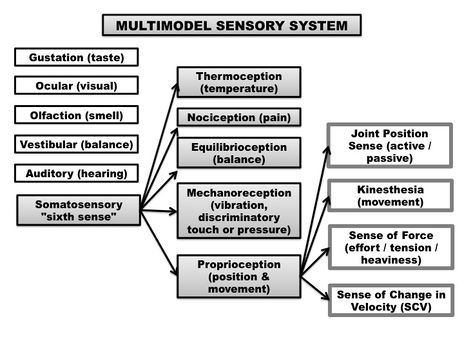
The diagram is useful as a map, with one caveat: sensory systems cooperate rather than operate as isolated boxes. When you make a supported weight shift, you may use vision, pressure under the soles of the feet, muscle and joint signals, and information from the vestibular system in the inner ear.
For your purposes, distinguish proprioception from balance this way:
- Proprioception is information: “I sense that more of my weight is on my left foot.”
- Balance is control: “I use that information, along with other signals, to remain stable during the shift.”
A person can have reasonable proprioceptive awareness but still lose balance through delayed or poorly organised corrections. Equally, someone may compensate for uncertain proprioception by relying heavily on vision and moving cautiously.
Interoception: sensing your internal state
Interoception is the perception and interpretation of signals arising from within the body. During movement, these might include breathing depth, heartbeat, warmth, thirst, muscular effort, fatigue, hunger, nausea, tension, calmness, or the sense that something feels wrong.

Interoception is not the same as “being emotional,” although internal sensations contribute to emotional experience. Nor is it the same as diagnosing a medical problem. In practice, this course uses interoception more modestly: noticing enough information to regulate practice sensibly.
For example:
- “My breathing is becoming shallow because I am concentrating hard.”
- “My shoulders are rising and I am gripping the chair.”
- “This feels like ordinary leg effort, not sharp knee pain.”
- “I feel less steady and more fatigued than at the start, so I will simplify the task.”
This is particularly relevant during rehabilitation. Good interoceptive attention does not mean treating every sensation as danger. It means noticing changes, interpreting them cautiously, and responding according to the plan you and your clinician have agreed.
The distinction from cardiovascular fitness is important:
- Interoception: your present perception of breathing, heartbeat, effort, and recovery.
- Cardiovascular fitness: the longer-term ability of the heart, lungs, and circulation to sustain aerobic work.
Agility: rapid, adaptive whole-body movement
Agility is the ability to rapidly change body position or direction in response to a situation or cue while retaining control. In sport, it may involve acceleration, deceleration, directional change, and reacting to an opponent or signal.
A judo example would be adjusting foot placement and posture in response to a partner’s movement. A daily-life example might be changing course quickly to avoid an obstacle on the pavement.
Agility draws on several ingredients:
- balance, especially during movement;
- coordination of steps and body position;
- perception of visual and body-position information;
- reaction and decision-making;
- sufficient strength and power to speed up or slow down.
However, agility is not simply “coordination at high speed.” It includes adapting to a changing environment or cue.
At your current rehabilitation stage, fast agility practice is not the appropriate target. Controlled multidirectional stepping without pivots is a foundation for later agility, but it is not the same as practising agility in its full sense. Do not add speed, twisting, jumping, unexpected cues, or reduced support to make a drill seem more athletic.
Classifying practical examples
Use the table below as a decision aid. The “main label” does not deny the contribution of the other capacities; it identifies what the activity is chiefly asking you to practise.
| Practical movement | Main label | Supporting capacities | Why |
|---|---|---|---|
| Supported single-leg stand | Balance | Proprioception, coordination, strength | The central task is staying stable over a reduced base of support. |
| Slow supported side-to-side weight shifts | Balance and coordination | Proprioception, interoception | You maintain stability while smoothly transferring weight and noticing position. |
| Seated alternating foot taps to a beat | Coordination | Rhythm, attention, lower-leg strength | The central challenge is accurate timing and sequence, not standing stability. |
| Rising from a chair with control | Strength | Balance, coordination | Leg force is essential, while controlled alignment and stability matter too. |
| A 20–30 minute approved walk or cycle | Cardiovascular fitness | Coordination, balance | If sustained at an appropriate intensity, the main adaptation is aerobic endurance. |
| A quick response to avoid a moving object | Agility | Balance, coordination, reaction | The task requires rapid adaptation to an external change. |
| Noticing shallow breathing and knee tension before a drill | Interoception | Attention | The task is sensing internal state, not performing movement. |
| Placing a foot accurately without looking directly at it | Proprioception | Coordination, balance | The main information is about limb position and movement. |
Tai chi and dance are good illustrations of overlap. A slow tai chi sequence may primarily train coordination, balance, and body awareness. A long, continuous dance class might also become cardiovascular exercise. The activity’s name does not determine its training effect; its specific demands, dose, and how you perform it do.
A five-minute movement-label audit
This week, use only activities already approved in your physiotherapy plan. Do not turn this into a new test.
Choose one or two familiar activities, such as supported weight shifts, seated foot taps, a short walk, or cycling. After each one, write a single line in your existing notes:
- Activity: name it plainly.
- Primary demand: choose one or two terms from this lesson.
- Supporting demands: add up to three.
- One observation: for example, “steadier with slower pace,” “breathing became shallow,” or “leg effort limited repetitions.”
A sample entry might read:
Supported lateral weight shifts. Primary: balance and coordination. Supporting: proprioception, interoception, leg strength. Observation: smoother when I kept one hand on the counter and moved more slowly.
This small audit will give later lessons a clearer foundation than the general statement “I am bad at coordination.” It identifies which component was difficult and what might be adjusted safely.
Key takeaways
- Balance is maintaining stability while still or moving.
- Coordination is organising movement smoothly, accurately, with suitable timing, direction, force, and tension.
- Agility is rapid, adaptive repositioning in response to a changing situation; it is a later-stage goal, not a current knee-rehabilitation target.
- Proprioception is information about body position, movement, and force.
- Interoception is awareness of internal state, including breathing, effort, tension, fatigue, and recovery signals.
- Strength is the capacity to generate force; cardiovascular fitness is the capacity to sustain aerobic work over time.
- A movement can involve all of these, but identifying its primary demand helps you practise with purpose.
Next, we will turn your physiotherapy restrictions into clear decision rules: how to select a coordination task, how to modify it, and when to stop rather than push through.
Can't find a good explanation? Sign up and we'll make it for you
Sign up