
Hello again. In the previous lesson, you separated the main ingredients of movement: balance is staying stable, coordination is organising movement smoothly, proprioception is information about body position, and interoception is information about your internal state.
That vocabulary now becomes a practical safety tool. Your physiotherapist’s restrictions are not a reason to postpone coordination practice; they define the safe operating boundaries for it. In this lesson, you will turn those boundaries into clear select, modify, and stop rules for every drill you consider.
Treat restrictions as design constraints, not vague cautions
A coordination drill is useful only if it fits both your goal and your present rehabilitation stage. A task can look gentle while still containing an unsuitable demand: a rapid turn, a twist through a planted knee, an unexpectedly deep knee bend, or a loss of support that forces a sudden correction.
For this course, your currently known boundaries are:
| Category | Current rule |
|---|---|
| Impact | No running, jumping, hopping, or impact-based drills. |
| Rotation | No pivots or twisting through the knee, especially on a planted foot. |
| Permitted movement | Low-impact walking, swimming, cycling, supported balance, weight shifting, controlled multidirectional stepping without pivots, and single-leg standing are cleared. |
| Progression | Faster movement, impact, and pivoting are later possibilities only after clinician clearance. |
Your individual physiotherapy plan has priority over every general guideline in this lesson. If your clinician has specified a range limit, a pain limit, a brace or mobility aid, or a particular exercise dosage, that is the rule to follow.
A helpful project-management-style distinction is:
- Goal: improve balance, proprioception, rhythm, sequencing, and movement confidence.
- Constraint: do it without high impact, knee twisting, or exceeding current rehabilitation tolerance.
- Acceptance criteria: the movement remains controlled, symptoms remain within your agreed limits, and you recover as expected afterward.
“No pain today” is not itself clearance to add an excluded movement. Equally, “this feels easy” is not a reason to remove support. Coordination develops through accurate repetition, not through making a task as difficult as possible.
Use a three-part filter before choosing a drill
Before you add a movement to your rehabilitation-adjacent practice, ask three questions.
1. Is the movement demand permitted?
Identify what the task physically requires, rather than relying on its name.
A “dance-inspired” activity could be appropriate if it is seated, slow, and does not involve knee rotation. It could be inappropriate if it involves turns, hopping, or quick changes of direction. Likewise, “balance practice” may be appropriate with a counter nearby, but not if it requires you to close your eyes or recover from deliberately induced wobbles.
For now, generally suitable task categories include:
- seated rhythm or arm–leg coordination patterns;
- supported side-to-side or forward–back weight shifts;
- supported standing balance;
- slow marching or controlled stepping, provided the feet are placed rather than pivoted;
- clinician-approved single-leg standing;
- slow reaching while seated or while securely supported in standing, if it does not violate your specific plan.
Exclude a task immediately if it includes:
- a jump, hop, run, or bounding action;
- turning on a weighted foot;
- a fast or unpredictable directional change;
- a movement you have been explicitly told to avoid;
- an environment where a loss of balance would be unsafe.
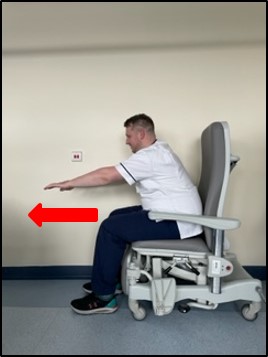
The picture illustrates an important principle: the direction and setup of a movement matter. A seated forward reach may be a low-impact coordination task, but it still needs to be comfortable, controlled, and compatible with your individual rehabilitation plan. It is not automatically suitable merely because it is seated.
2. Can you set it up safely?
A permitted movement can become unsafe through poor setup. Before standing practice:
- Use a stable kitchen counter, heavy table, fixed rail, or other surface that will not slide or roll.
- Keep the area clear of loose rugs, pets, bags, and other trip hazards.
- Wear footwear if it helps you feel steadier or your physiotherapist recommends it.
- Begin with enough hand support that you do not need a sudden grab to recover.
- Keep your eyes open while learning a new standing task.
In the balance videos often found online, closing the eyes is presented as a possible progression. That is not a default challenge for you right now. It removes visual information that helps compensate for uncertain body-position sense. Do not introduce it unless you are already safe with the task, have reliable support, and it is compatible with your clinician’s guidance.
3. Is the dose appropriate today?
Dose means the total amount of stress imposed by the drill. It includes more than repetitions:
- duration;
- number of sets;
- frequency per week;
- size of movement;
- speed;
- amount of support;
- amount of concentration or sequencing required;
- rest between attempts.
A short, slow, well-supported weight shift can be more useful for present coordination goals than a longer practice that produces rushed movement, gripping, limping, or fatigue. For coordination, stop the set while you can still produce reasonably good repetitions; training sloppy movement rehearses sloppiness.
General safety guidance: useful, but not a substitute for your plan
The Newcastle Hospitals guide gives sensible general principles on symptoms, gradual progression, and modifying activity. Read it with one key idea in mind: general advice helps you form cautious rules, but your own clinician’s directions remain more specific.
Exercise and your health: A guide to getting started - Newcastle Hospitals NHS Foundation Trust
Read the Newcastle Hospitals NHS Foundation Trust guide for its practical distinction between symptoms that call for stopping, adaptation, or professional advice. It also introduces a deliberately gradual approach to progression.
In “When not to exercise (contraindications),” read the warning-symptom guidance, then read the following list of symptoms requiring GP or physiotherapist consultation. Next, in “Progressing exercise,” read the progression guidance. Finally, in “Pain with exercise,” read the pain guidance. Notice the guide’s distinction between long-term musculoskeletal discomfort and an acute traumatic injury: do not turn its general numerical suggestion into a personal rule that overrides your physiotherapist.
The guide’s “one factor at a time” principle is especially valuable. If you increase repetitions and reduce hand support and make the movement faster, you will not know which change caused a problem or a success.
For this course, change one of the following at a time:
- Support: two hands, one hand, fingertips, or a nearby hand without gripping.
- Range: smaller or larger weight transfer; shorter or longer reach.
- Speed: slower or slightly faster while remaining controlled.
- Complexity: one simple action, then a two-part sequence, then a rhythm or cue.
- Dose: repetitions, time, sets, or practice frequency.
Do not use “one variable at a time” as permission to progress every session. It means that when a task is consistently controlled and well tolerated, any future adjustment is clear and reversible.
The modification ladder: make the same task safer
Modification is not failure or “taking the easy version.” It is how you keep the purpose of a drill while reducing the demand that currently exceeds your tolerance.
The E3 Rehab video gives a broad framework for adapting exercise by changing range, speed, total work, rest, and the specific variation. Its examples are often strength-training oriented, but the modification logic applies well to coordination practice.
How To Train Around Pain or Injuries (10 Best Exercise Modifications)
Watch “How To Train Around Pain or Injuries” from E3 Rehab for a general framework for retaining the purpose of exercise while changing the part that creates excessive stress. Apply the principles conservatively and within your physiotherapist’s restrictions.
Watch range modification to see why reducing range can preserve practice without repeatedly entering an aggravating position. Then watch speed and dose for ways to slow movement, reduce total work, and distribute practice. Finish with longer rests; for coordination practice, rest is also time to reset posture, breathing, and attention.
Here is a practical modification ladder for your current stage.
| If the problem is… | First modification | Further regression if needed |
|---|---|---|
| You feel unsteady | Add hand support; slow down | Use a wider stance, reduce the weight shift, or choose a seated version |
| The knee becomes uncomfortable | Reduce range and repetitions | Return to a previously approved task or stop and follow your clinical plan |
| You begin gripping, holding your breath, or tensing your shoulders | Pause and reset; use fewer repetitions | Simplify the pattern and allow longer rests |
| You lose the movement sequence | Remove rhythm, arm movements, or extra steps | Practise one component at a time, perhaps seated |
| You cannot avoid twisting | Redesign the task so the foot is placed straight down | Do not perform that version of the drill |
| You are tired, distracted, or rushed | Keep the drill very simple or postpone it | Choose seated awareness practice instead |
For example, suppose you want to practise a supported side-to-side weight shift but notice that you move too far, grab the counter, and feel apprehensive. The correct response is not to push through until you “get used to it.” Keep both hands on the counter, make a smaller transfer, slow the movement, and use fewer repetitions. The skill you are practising is still weight transfer; you have simply adjusted its difficulty.
Similarly, if a slow standing march is permitted but your knee starts to rotate as you lift and replace a foot, return to a simpler task. You might practise a small weight transfer from one foot to the other without lifting either foot, or use a seated alternating foot-tap pattern for timing. Do not solve the coordination problem by practising a prohibited pivot.
A traffic-light rule for each practice session
The following system turns body signals into decisions. It is a guide for action, not a diagnosis.
Green: continue as planned
Continue when:
- the task is within your cleared movement categories;
- you can maintain the intended support and slow, controlled pace;
- symptoms are absent or within the limits your clinician has agreed;
- you can breathe normally enough to avoid bracing and breath-holding;
- there is no new limping, giving way, or worsening loss of control.
“Green” does not mean “make it harder.” It means the present version is an appropriate training dose.
Amber: pause, simplify, and reassess
Modify when you notice:
- growing wobble or repeated need to grab for support;
- altered movement quality, such as rushing, holding your breath, twisting, or shifting away from the affected side;
- rising discomfort that is still below your clinician’s stop threshold;
- fatigue that makes you less accurate;
- uncertainty about whether a movement is within your restrictions.
Your response is:
- Stop the set safely.
- Rest and check breathing, tension, and symptoms.
- Reduce one variable: range, speed, complexity, dose, or support demand.
- Resume only if the simpler version feels controlled and appropriate.
If you are unsure, the conservative choice is to end the drill and use an already approved rehabilitation exercise or a seated coordination activity instead.
Red: stop the drill and seek appropriate advice
Stop the exercise rather than trying another repetition if you experience:
- new sudden pain;
- new, marked, or unusual swelling, redness, or bruising around the joint;
- a sense that the knee gives way, locks, or cannot safely take weight;
- dizziness, faintness, fever, or acute illness;
- symptoms that are clearly escalating rather than settling with rest.
Intense chest pain or pressure, severe or unexplained shortness of breath, and unexplained faintness require urgent medical assessment rather than a rehabilitation adjustment. Follow local emergency guidance if these occur.
For knee-related symptoms, follow any action plan your physiotherapist has already given you. If you have no specific plan and a new or concerning symptom does not settle as expected, contact your physiotherapist, GP, or other appropriate clinician before testing the drill again.
Turn your current restrictions into personal if–then rules
Vague reminders such as “listen to your body” are not enough in the middle of a movement. Write the following rules in your notes, adapting the wording to your physiotherapist’s exact instructions.
My selection rules
- If a drill involves jumping, hopping, running, or impact, then I do not select it.
- If a drill requires me to turn on a planted foot or twist through the knee, then I do not select it.
- If I want to practise standing balance, then I set up beside a stable support and begin with the amount of hand contact needed for control.
- If standing practice is not feeling safe or well tolerated today, then I choose a seated rhythm, sequencing, upper-body coordination, or clinician-approved non-weight-bearing alternative.
- If I cannot describe why a drill is permitted, then I do not add it until I have checked with my physiotherapist.
My modification rules
- If I wobble, grip, rush, or hold my breath, then I slow down, use more support, or make the movement smaller.
- If the knee becomes more uncomfortable during a task, then I reduce range or dose rather than forcing the full version.
- If I lose the sequence, then I remove one element and practise the simpler part slowly.
- If I make any task harder, then I change only one variable and leave the rest unchanged.
- If I have a rehabilitation appointment or a demanding physiotherapy session that day, then I keep extra coordination practice short and easy, or omit it.
My stopping rules
- If I feel new sudden pain, instability, unusual swelling, or a significant loss of control, then I stop the drill.
- If I develop dizziness, faintness, fever, or acute illness, then I stop exercising and respond according to medical advice.
- If a movement cannot be performed without breaking my no-impact or no-pivot restriction, then I stop that version immediately.
- If a simplified version still feels unsafe or aggravates symptoms, then I end the session and return to my clinician-approved plan.
These rules are meant to reduce decision fatigue. You do not need to analyse every sensation at length; you need a pre-decided, proportionate response.
A short planning activity: build a one-page practice card
Take five to ten minutes to make a personal “coordination practice card.” Keep it somewhere visible near your usual practice area.
Include these four headings:
-
Today’s permitted options
For example: supported weight shifts, supported single-leg stance, seated foot taps to a steady beat, or controlled stepping without pivots. -
My non-negotiables
No jumping, running, hopping, knee twisting, or pivots. -
My quality cues
For example: “move slowly,” “feet placed, not turned,” “light hand support is allowed,” “breathe,” and “stop before form deteriorates.” -
My amber and red signs
Write your own physiotherapist’s symptom threshold if you have one, plus “new pain, swelling, instability, dizziness: stop and follow my plan.”
This is not a performance log. Its purpose is to make safe choices automatic enough that your attention can return to sensing movement quality.
Key takeaways
- Physiotherapy restrictions are the boundaries within which coordination practice should be designed; they are not optional cautions.
- Select a drill only when its movement demands, setup, and dose fit your current clearance.
- For now, exclude impact, running, jumping, hopping, pivots, and twisting through a planted knee.
- Make a task safer by increasing support, reducing range, slowing it down, simplifying the sequence, or reducing total practice. Change one variable at a time.
- Use a traffic-light approach: continue when movement is controlled and symptoms are acceptable; modify when quality or comfort deteriorates; stop for new or concerning symptoms.
- General pain and progression guidance can be useful, but your own physiotherapist’s instructions override it.
Next, you will put these rules into action by performing a clinician-approved supported weight-shifting drill and using a simple movement-quality checklist.
Can't find a good explanation? Sign up and we'll make it for you
Sign up