
Welcome. This course is about building more capable, confident movement—not trying to reproduce the training history or performance of elite gymnasts and dancers. In this first module, we will establish two foundations: why coordination and body awareness remain trainable after 50, and how to begin training without working against your knee rehabilitation.
The short answer to your central question is yes: meaningful improvement in balance, coordination, body-position awareness, movement sequencing, and confidence is possible later in life. The realistic target is not “becoming naturally athletic overnight,” but steadily becoming more accurate, stable, adaptable, and less mentally overloaded by everyday movement—and eventually better prepared to return to permitted judo practice.
Learning changes the movement system throughout life
Coordination is not a single trait that a person either has or lacks. It is a learned capacity to organise timing, direction, force, and sequence: for example, shifting weight before taking a step, placing a foot accurately, or using the right amount of muscular tension rather than stiffening everything at once.
Body awareness has several parts. Two especially relevant ones are:
- Proprioception: sensing where a limb is and how it is moving, often without looking directly at it.
- Interoception: noticing internal signals such as breathing, effort, tension, fatigue, steadiness, discomfort, and recovery.
These capacities depend on sensory information, the nervous system’s interpretation of it, and repeated movement experience. They can all be practised.
The biological basis is neuroplasticity: the nervous system changes its functioning and connections in response to experience. In the early phase of learning, you may need deliberate attention: “Shift to the left foot; keep the knee pointing forward; breathe; then step.” With suitable repetition, the movement becomes more efficient and requires less conscious management. That is not merely “getting used to it”; it is skill learning.
After watching this, your brain will not be the same | Lara Boyd | TEDxVancouver
Watch “After watching this, your brain will not be the same” from TEDx Talks. Lara Boyd gives a useful, accessible account of why adult learning remains possible and why repeated, appropriately challenging practice matters more than searching for a universal exercise.
First watch plasticity basics. Focus on the distinction between immediate, short-term performance changes and the longer-term changes needed to retain a skill. Then watch practice and individuality. Notice two points especially relevant here: behaviour and practice drive change, and people differ substantially in how quickly they learn or recover.
The useful correction to a common slogan is this: age is not an absolute barrier to learning, but it does affect the conditions under which learning happens. Children usually acquire some skills more quickly because of development, opportunity, and immense early-life practice. Adults may need more repetitions, clearer feedback, and more recovery time. But adult brains and nervous systems still adapt, including after injury and periods of inactivity.
That means it is sensible to expect progress—but not to set a deadline based on someone else’s body, training history, or social-media highlight reel.
What research supports—and what it does not promise
Research in adults aged 55 and over supports the idea that sensorimotor and proprioceptive exercise can improve practical balance and mobility outcomes. These studies typically involve tasks such as controlled standing, weight shifts, stepping, and balance variations—not advanced dance choreography or gymnastics skills.
Read selected findings from this 2024 systematic review and meta-analysis. It is useful because it looks across several studies rather than relying on one exercise programme or a single enthusiastic claim.
In the results section, read from the subsection “Effects on Berg balance scale” through the subsection “Effects on single-leg stance.” Follow the reported balance tests. Focus on what changed: clinical balance scores, mobility, and supported single-leg-standing ability—not athletic performance. Then move to the Discussion section. Read the protocol summary. Notice the typical programme duration and frequency, and the authors’ caution about the quality of the evidence.
The review reported average improvements in measures such as:
| Measure | What it broadly represents | Average change reported |
|---|---|---|
| Berg Balance Scale | Functional balance across everyday tasks | About 6.5 points |
| Timed Up and Go | Standing, walking, turning, and sitting | About 2.3 seconds faster |
| Single-leg stance, eyes open | Static balance capacity | About 5.5 seconds longer |
Those findings are encouraging, but they need careful interpretation:
- They are group averages, not forecasts. One person may improve rapidly in supported standing but slowly in stepping rhythm; another may show the reverse.
- The certainty of several findings was low or very low. The studies differed in participants, programme design, and measures.
- The outcomes are specific. Better balance-test scores do not automatically produce dancer-like timing, pain-free pivoting, or readiness for a judo fall.
- The programmes usually lasted 8–18 weeks, often with two or three sessions weekly. Progress is generally built across weeks, not discovered in one perfect exercise session.
Your planned 10–15-minute practice blocks are shorter than many research sessions. That does not make them pointless. It means the key is to accumulate safe, high-quality practice over time and integrate it with your physiotherapy programme rather than treating a single short session as decisive.
The review also describes unstable surfaces and eyes-closed tasks used in some studies. These are research examples, not a recommendation for your current stage. With a recent knee injury and an existing rehabilitation plan, increasing instability or removing vision would be an unnecessary and potentially unsafe way to make practice harder. We will use safer ways to create an appropriate challenge.
A practical model: learning, aging, and health interact
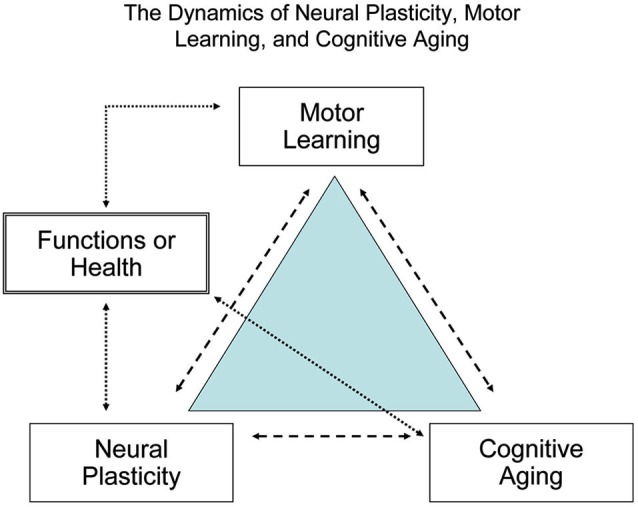
The “Dynamics of Neural Plasticity, Motor Learning, and Cognitive Aging” diagram is best treated as a map, not as a prediction machine. It makes three important points:
- Neural plasticity provides the capacity to change.
- Motor learning is the process through which practice becomes more reliable skill.
- Aging can change sensory, physical, and cognitive conditions for learning.
Together, these influence everyday function: getting up from a chair, navigating a crowded pavement, recovering from a small misstep, or later moving with more confidence in a judo setting.
A decline in one component does not cancel the others. For example, reduced balance confidence after injury can make you move stiffly and cautiously. That may reduce movement experience, which in turn limits learning opportunities. Conversely, safe, repeated success with a small task can improve both the skill and willingness to practise it.
What affects your rate of progress?
Think of coordination practice as a project with several interacting constraints. Progress is rarely a straight line: a task may feel easier one week, awkward after a poor night’s sleep, and easier again after a few more exposures. The useful question is not “Why am I not progressing perfectly?” but “Which condition should I adjust while keeping the task safe?”
1. Specific, repeated practice
The nervous system learns the task it repeatedly encounters. If the goal is accurate multidirectional stepping, then practising permitted stepping is more directly useful than doing only general fitness work.
Walking, swimming, cycling, and strength work can support health and rehabilitation. But they do not fully substitute for practising balance, timing, weight transfer, and movement sequence. Coordination improves through coordination practice.
2. Appropriate challenge—not maximum difficulty
Learning requires some errors. If a movement is completely automatic, it may maintain a skill but provide little new information. If it is so difficult that you repeatedly grab for support, lose alignment, hold your breath, or become fearful, the task is poorly calibrated.
For your current stage, a good challenge is likely to feel attentive but controlled:
- You can keep a hand on support where your physiotherapist has approved it.
- You can move slowly enough to notice your position.
- You make occasional small errors but can correct them without panic.
- Your knee remains within its agreed restrictions.
Challenge can later come from accuracy, rhythm, a small change in direction, fewer verbal reminders, or a slightly longer sequence. It does not need to come from impact, pivots, or unstable equipment.
3. Attention, feedback, and simple instructions
New coordination tasks draw on attention and working memory. A long checklist can therefore make movement worse, even if every instruction is sensible.
At first, use one main focus—for example, “smooth weight transfer” or “quiet, controlled foot placement”—rather than trying to monitor five body parts. Immediate, simple feedback also helps: “That was steadier when I slowed down,” or “I lost knee alignment when I rushed.”
Your experience in project administration may be useful here: record a few observable indicators, not an essay about every session. A minimal log makes patterns visible without turning practice into a reporting burden.
4. Baseline ability, previous experience, and confidence
People begin in different places because of health, prior activity, sensory changes, fear of falling, pain, and past opportunities to learn movement skills. Your short experiences of judo and tai chi may not have made the movements automatic, but they can still provide familiar reference points: stance, deliberate weight shift, posture, and attention to direction.
Confidence matters, but not as forced optimism. Confidence grows from evidence: repeated experiences of “I performed this safely and understood what made it work.”
5. Physical capacity and rehabilitation status
Coordination requires enough available range of motion, strength, and endurance to carry out the movement. But strength is a supporting capacity, not the same thing as coordination.
Your current injury status is a major design constraint, not a personal failure or a reason to postpone all learning. Clinician-approved weight shifts, controlled stepping without pivots, and supported single-leg standing can still provide meaningful sensory and coordination information. The task is to practise within the safe movement options you have now.
6. Recovery, fatigue, and general health
Fatigue, pain, stress, poor sleep, medications, illness, and competing demands can affect attention, reaction time, balance, and willingness to practise. Motor learning also includes what happens between sessions: a skill may feel less smooth at the start of the next practice but become more stable over repeated exposures.
Treat a difficult day as information. It may call for a simpler version of the task, not abandoning the process or forcing through warning signs.
7. Individual variability
There is no fixed number of repetitions, weeks, or “hours to mastery” that applies to everyone. The most productive plan is personalised: retain what produces controlled improvement, simplify what produces repeated loss of quality, and progress one feature at a time.
For body awareness specifically, the evidence base is stronger for proprioception and balance than for broad claims about interoception in healthy older adults. That is a reason to be precise: we can train noticing and naming internal signals, but we should judge progress by practical outcomes—steadier movement, better self-regulation, clearer recognition of effort or discomfort—not by assuming an internal sensation must feel dramatic.
A small observation practice for this week
Use this only with a movement already approved in your physiotherapy programme—perhaps a supported weight shift or controlled step. This is not a new exercise and not a performance test.
Before one brief set, pause for 20–30 seconds and note:
- where your weight seems to be distributed between your feet;
- whether you are holding your breath or bracing unnecessarily;
- your knee’s comfort and sense of stability;
- one chosen movement-quality focus, such as “slow and even.”
After the set, record only three items:
- Task: what approved movement you did.
- Quality: one word or short phrase, such as “smooth,” “rushed,” “more even,” or “uncertain.”
- Response: whether your symptoms and breathing returned to their usual level.
Do not close your eyes, reduce support, add speed, or introduce twisting to make this more “proprioceptive.” The purpose is simply to begin linking attention, movement, and a brief factual record.
Key takeaways
- Coordination and body awareness remain trainable after 50 because the nervous system retains capacity to adapt through experience and practice.
- Age may affect rate, recovery, and average performance, but it does not eliminate the capacity to learn meaningful new movement skills.
- Research supports sensorimotor and proprioceptive training for improving balance-related outcomes in older adults, while also showing that individual results and evidence certainty vary.
- Progress depends on task-specific repetition, a safe level of challenge, simple feedback, recovery, baseline health, and the constraints of rehabilitation.
- Your relevant comparison is your own starting point and practical goals—everyday confidence and a future, clinician-cleared return to judo—not elite athletic performance.
Next, we will separate the related terms that are often blurred together: balance, coordination, agility, proprioception, interoception, strength, and cardiovascular fitness. That distinction will make it much easier to choose practice that actually serves your goals.
Can't find a good explanation? Sign up and we'll make it for you
Sign up