Hello! Welcome back to our course.
In our last lesson, we developed a scenario matrix to map out different possible futures for your woodworking business. We used this to explore the idea of a robust strategy—one that performs well across multiple scenarios, particularly for your critical early decisions on production capacity and pricing.
Today, we'll address a question that naturally follows: How much should you plan, and when should you just act? Launching a business is filled with moments where you have to decide whether to spend another week gathering data or to move forward with the information you have. This lesson is about creating a mental toolkit for that exact trade-off.
By the end of our session, you'll be able to apply a cost-benefit framework to decide between gathering more information and acting immediately. This will help you balance the need for careful planning with the startup's need for speed and momentum.
The Default Mindset: Action Over Perfection
As an entrepreneur, you face a constant tension between wanting to make the perfect decision and needing to make progress. Waiting for complete certainty is a luxury a new business can't afford, as opportunities can be fleeting.
This idea is powerfully articulated by Amazon's founder, Jeff Bezos. Let's start by reading a short piece that explains his "70% Rule."
Decision-Making Under Uncertainty: The 70% Rule
The article 'Decision-Making Under Uncertainty: The 70% Rule' provides a compelling argument for why speed is often more important than precision in business.
Please read the first section, 'Don’t Wait for Perfect Information.' Focus on the trade-off between speed and accuracy and the core idea of the 70% rule.
The key takeaway is that most decisions should be made when you have about 70% of the information you wish you had. If you wait for 90%, you're probably too slow. The remaining 30% is what you learn by doing. For a startup, this bias toward action is your default setting.
But does this apply to every decision? Clearly, some choices are more significant than others. Choosing a font for your business card is different from signing a five-year lease. We need a way to sort decisions to know when to apply the 70% rule and when to be more cautious.
A Framework for Sorting Decisions: Reversibility and Consequence
A simple but powerful way to categorize decisions is based on how reversible they are. This is another concept popularized by Jeff Bezos, known as "One-Way vs. Two-Way Doors."
Decision-Making Under Uncertainty: The 70% Rule
Let's continue with the same article, which now introduces the framework for categorizing decisions.
Now, read the section 'Framework 1: One-Way Door vs. Two-Way Door Thinking.' Pay close attention to the definition of each decision type and the examples provided.
This gives us two clear buckets:
- Two-Way Doors: Reversible decisions. If you make a mistake, you can back out and try something else without major damage. For these, you should act quickly.
- One-Way Doors: Irreversible (or very costly to reverse) decisions. You walk through and can't easily come back. These demand slow, careful deliberation.
For your woodworking business:
- Two-Way Door Example: Setting the price for your first batch of cabinet doors. If they don't sell, you can offer a discount. If they sell too fast, you can raise the price on the next batch.
- One-Way Door Example: Buying a highly specialized, multi-axis CNC machine that costs tens of thousands of dollars and is only good for making one specific type of product. Selling it if you pivot would mean a significant financial loss.
We can refine this model by adding a second dimension: consequence. This gives us a more nuanced 2x2 matrix for decision-making.
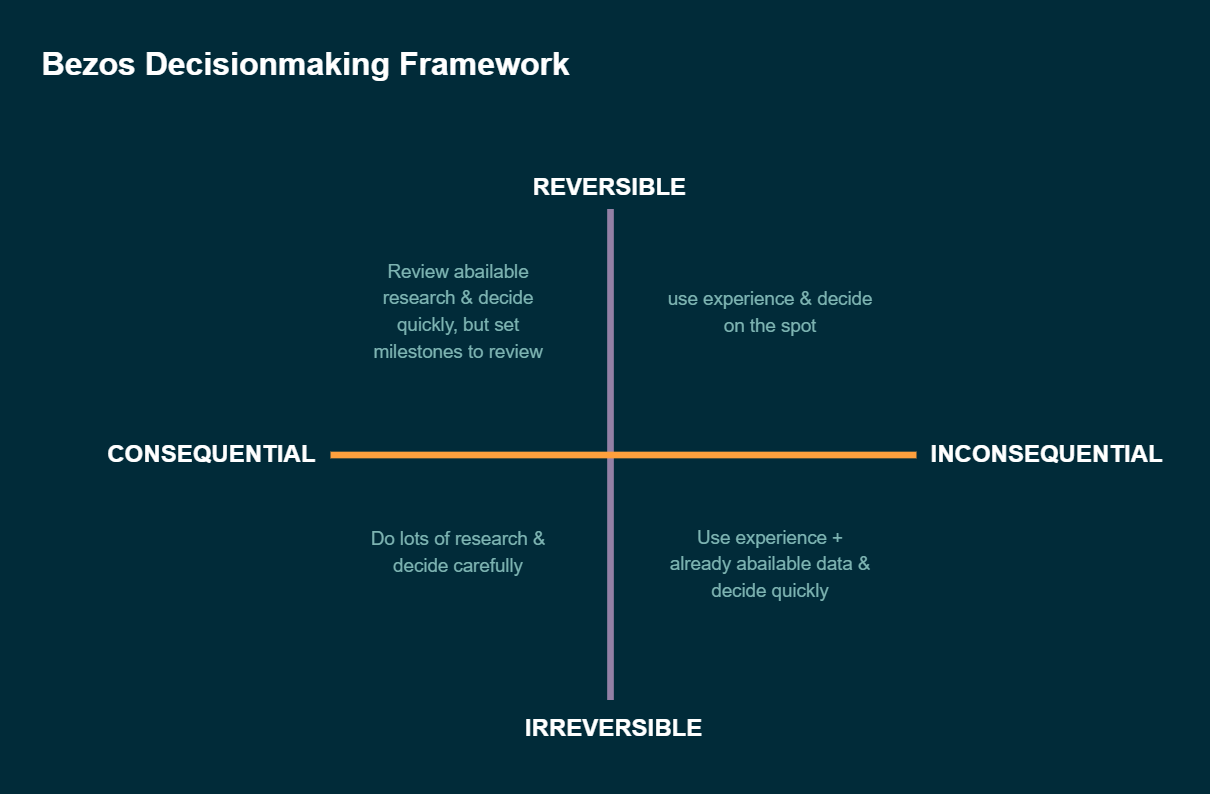
Let's break down how you'd use this for your business:
-
Irreversible & Consequential (e.g., Buying the main CNC machine, signing a long-term workshop lease): These are classic "One-Way Doors." This is where you don't use the 70% rule. You slow down, do extensive research, and get as close to 90-100% certainty as possible. The cost of being wrong is very high.
-
Reversible & Consequential (e.g., Deciding on your initial product line—doors vs. cabinets): This decision has major consequences for your business, but it's reversible. You can start with doors and add cabinets later, or vice-versa. Here, you should act quickly to test the market but set clear milestones to review your decision.
-
Irreversible & Inconsequential (e.g., Registering your business name): Once you register the name, changing it is a hassle (irreversible), but the consequence of getting it slightly wrong is low. Use your experience and available data to decide quickly and move on.
-
Reversible & Inconsequential (e.g., Trying out a new social media ad): The cost and consequence are both low, and you can easily stop the ad. These decisions should be made instantly, using your gut and experience. Delegate or automate them if you can.
Test your understanding!
You're considering partnering with a specific local supplier for your premium walnut wood. This supplier offers a slight discount but requires a one-year exclusive contract. Where would you place this decision in the 2x2 framework, and what decision-making approach would you take?
Show answer
This decision falls into the Irreversible & Consequential quadrant.
- Irreversible: The one-year exclusive contract makes it a "one-way door" for that time period. You can't easily switch suppliers if you find better quality or pricing elsewhere.
- Consequential: The quality of your primary raw material directly impacts the quality of your premium products and your brand reputation. Being locked into a poor supplier could have significant negative consequences.
Approach: You should slow down and be deliberative. This means gathering more information. You would want to vet the supplier thoroughly, perhaps by ordering a few smaller, non-contract batches first to test their quality and reliability. You'd also want to research alternative suppliers to understand your opportunity cost before signing an exclusive agreement.
The Cost-Benefit Analysis: Weighing Delay vs. Information
For those critical, "One-Way Door" decisions, your choice isn't just "act vs. wait." It's a calculated trade-off. You should only wait if the expected value of the new information outweighs the cost of delaying the decision.
1. The Cost of Delay (CoD)
This is the tangible and intangible price you pay for waiting. It includes:
- Lost Revenue: Every week you delay launching is a week of potential sales you'll never get back.
- Missed Opportunities: A competitor might enter the market while you're still analyzing.
- Changing Conditions: Material costs could rise, or customer tastes might shift.
Thinking like an engineer, you can structure this problem without needing a complex financial model.

For your business, a simple estimation might be:
- Variable: Profit from selling custom doors.
- Metric: Estimated weekly profit.
- Data: You estimate you can make and sell 5 doors a week at a profit of $300 each.
- Estimate: Your Cost of Delay is approximately $1,500 per week.
2. The Value of Information
Now, weigh that cost against what you'd gain by waiting. What critical piece of information could you acquire? For example, by waiting a month, you could:
- Visit a trade show to see new machinery in person, potentially finding a machine that's 10% more efficient.
- Conduct a detailed survey of local interior designers to confirm demand for your premium style.
- Discover a new competitor is about to launch a similar product.
The decision rule is simple: Is the potential value of this new information worth more than the cost of the delay?
If waiting a month (costing you ~$6,000 in lost profit) allows you to find a machine that saves you $20,000 over its lifetime, the delay is worth it. If you're just waiting to reduce your uncertainty from 80% to 85%, the delay is likely not worth it. This is the trap of Analysis Paralysis.
Enhancing Strategic Decision Quality for Better Business ...
The article 'Enhancing Strategic Decision Quality' describes this common trap and how to avoid it.
Please read the section 'The Avoidance Trap: How Comfort Kills Companies,' focusing on the behavior of 'Analysis Paralysis' and its antidote.
As the article notes, the best antidote to analysis paralysis is to set information deadlines. Give yourself a fixed amount of time (e.g., one week) to research the decision, and then commit to making a choice.
Conclusion
You will never have all the information, and that's not a bug—it's a feature of entrepreneurship. Your advantage lies in navigating that uncertainty better than your competitors.
Key Takeaways:
- Bias toward action: For most decisions, aim to act with ~70% of the information you wish you had.
- Sort your decisions: Use the Reversibility/Consequence framework to identify which decisions need more deliberation ("One-Way Doors") and which can be made quickly ("Two-Way Doors").
- Weigh the trade-off for big decisions: For critical, irreversible choices, consciously weigh the Cost of Delay against the potential Value of New Information.
- Avoid analysis paralysis: Don't seek perfect information. Set deadlines for your research phase to force a decision and maintain momentum.
Preview of the Next Lesson:
Now that we have frameworks for making decisions under uncertainty, we'll begin the next module, "Market Entry and Positioning." In our first lesson, we will apply these ideas to one of the biggest "one-way door" decisions you'll make: how to enter the market. We'll use a powerful game theory tool called a game tree with backward induction to map out your choices and potential competitor responses, helping you decide how and when to launch your business.