Hello! Welcome to the next lesson in our module on Decision Making Under Uncertainty.
In our last session, we created a powerful tool: the scenario matrix. We mapped out four plausible futures for your new woodworking business based on the critical uncertainties of market demand and competitor reaction:
- The Open Field: High demand, passive competition.
- The Battlefield: High demand, aggressive competition.
- The Niche Struggle: Low demand, passive competition.
- The Squeeze: Low demand, aggressive competition.
Having this map is one thing; using it to make decisions is the next crucial step. Today, we'll analyze how these uncertainties should directly influence two of your most immediate and significant choices: your production capacity (e.g., which CNC machines to buy) and your pricing strategy.
By the end of this lesson, you will be able to analyze how uncertainty about market demand and competitor costs affects your pricing and capacity decisions, helping you choose a path that is resilient no matter which future unfolds.
1. Capacity Decisions: The Trade-off Between Commitment and Flexibility
Your decision on what machinery to purchase is a classic capacity decision. This isn't just an operational choice; it's a strategic one that signals your intentions to the market and can lock you into a certain path.
Think about two potential options for your CNC machine:
- Option A (High Commitment): A large, highly specialized, and expensive machine optimized for producing kitchen cabinets at high speed.
- Option B (High Flexibility): A smaller, more versatile but slower machine that can handle both doors and cabinets, but is less efficient for large-scale production.
This choice represents a fundamental trade-off between commitment and flexibility. To explore this concept, please read the following brief guide.
Capacity Decisions and Commitment | Game Theory ...
The article 'Capacity Decisions and Commitment' from Fiveable provides a clear and concise overview of the strategic implications of capacity choices.
Please read the sections titled 'Strategic importance of capacity decisions', 'Role of commitment in capacity', and 'Flexibility vs commitment trade-offs'. Focus on how capacity signals intent and how market uncertainty influences whether commitment or flexibility is more valuable.
As the article explains, a large, irreversible investment (like the specialized CNC machine) acts as a strong commitment. It can deter competitors because it signals you're serious and can produce at a scale that would make a price war painful for them. However, it also reduces your flexibility.
Let's apply this to your scenario matrix:
- In "The Open Field" (High Demand, Passive Competition), the high-commitment machine is a clear winner. You can meet soaring demand and maximize profits.
- In "The Squeeze" (Low Demand, Aggressive Competition), this same machine could be a disaster. Its high fixed costs become an albatross around your neck when sales are slow, and you lack the flexibility to easily pivot to different, more profitable products.
This shows that the "best" capacity decision depends entirely on the future. Since we can't know the future, what should we do? The goal is to find a robust strategy.
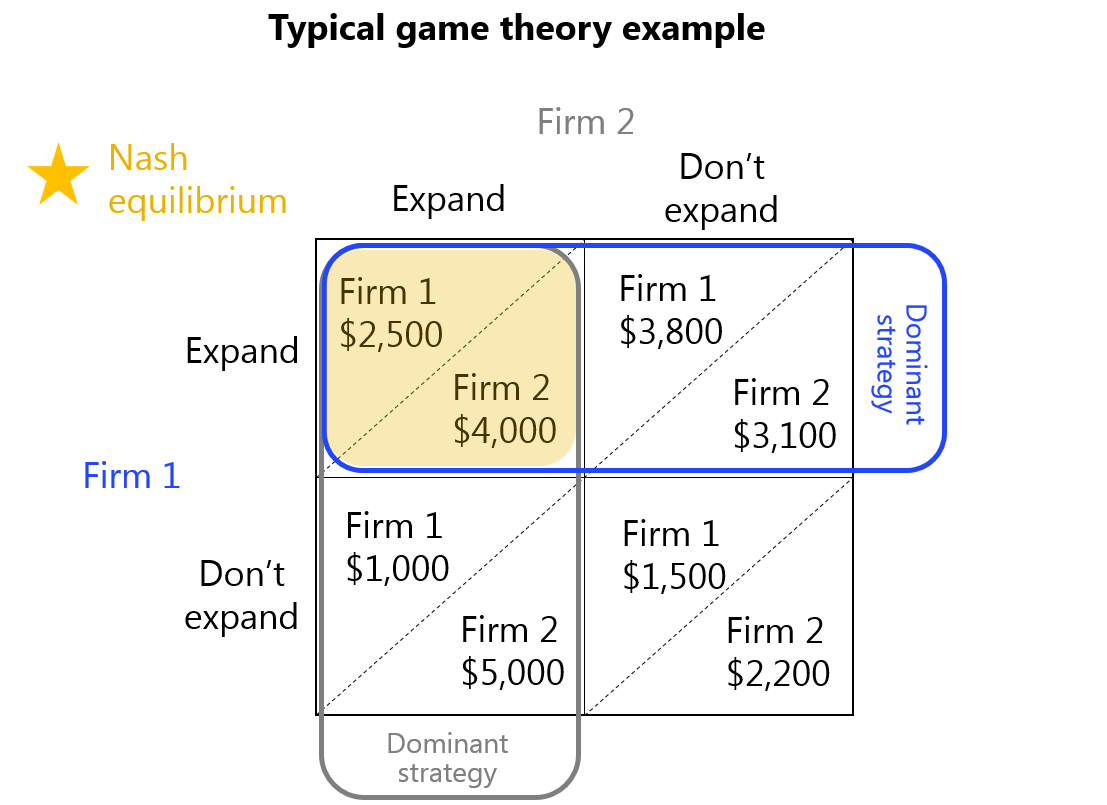
A robust strategy isn't necessarily the one with the highest possible payoff in the best-case scenario. Instead, it's a strategy that performs reasonably well across all plausible scenarios and, most importantly, avoids catastrophic failure in the worst-case scenario.
The following article from McKinsey, while analyzing a different industry, provides an excellent framework for thinking about robust options in the face of uncertainty.
Making game theory work for managers
The article 'Making game theory work for managers' describes how to move beyond trying to find a single 'correct' answer and instead find strategies that are resilient under different conditions. The European rail deregulation example is a great analogy for your market entry.
First, read the introduction (up to 'Decades old—and misunderstood') to understand the idea of finding a 'best robust option'. Then, read the section starting with 'These initial steps...' that lists the four factors affecting the outcome (demand, costs, etc.). Notice how these are the same uncertainties you're facing.
The key takeaway is to shift your thinking from "What is the most likely future?" to "What strategy gives me the best chance of success across all the likely futures?" In your case, the more flexible CNC machine might be the more robust choice. It might cap your profits in "The Open Field," but it ensures you can survive and adapt in "The Squeeze."
2. Pricing Decisions: Navigating Demand and Competitor Costs
Just like capacity, pricing is a strategic decision made under uncertainty. Your price signals the quality of your work but also positions you relative to competitors.
- Uncertainty in Demand: If demand for premium products is high, a high price captures that value. If demand is low, a high price might mean zero sales.
- Uncertainty in Competitor Costs: If your competitors have high overhead, they can't afford a price war. If they are lean and efficient, they might slash prices to drive you out of the market.
So, how do you set a price when you don't know the answers? A powerful strategy is to not choose a single price point, but to offer options.
Pricing Strategies for Uncertain Times | HBR IdeaCast
The HBR IdeaCast 'Pricing Strategies for Uncertain Times' offers practical advice on this exact problem. Listen to how expert Rafi Mohammed suggests using creative pricing to manage uncertainty.
Please watch the segment from 2:37 to 4:53. Pay close attention to the 'good, better, best' strategy. Think about how you could apply this to your woodworking business.
The "Good, Better, Best" model is a brilliant way to create a robust pricing strategy. It allows you to test the market's price sensitivity and capture value from different customer segments simultaneously.
For your business, this could look like:
- Good: A selection of standard-sized premium cabinet doors in a few popular wood types. This offers a clear, accessible price point for customers who value quality but have a fixed budget.
- Better: Custom-sized doors and a wider variety of materials and finishes. This caters to clients who need more specific solutions.
- Best: Full-service custom kitchen design and fabrication. This is your high-end offering for clients who want a completely bespoke solution and are less price-sensitive.
This structure is robust. In a low-demand market ("Niche Struggle"), your "Good" option might be the only thing that sells, keeping your business afloat. In a high-demand market ("Open Field"), the "Best" option will likely be very popular, allowing you to capture maximum profit. This tiered offering makes your business resilient to demand uncertainty.

Considering Competitor Costs
The McKinsey article on rail deregulation (LINK) provides insight here. It showed that the best strategy for the incumbent railway depended heavily on the cost structure of the new entrant.
- If you believe your competitors (e.g., large-scale cabinet manufacturers) have high overhead and legacy costs, they may be unable or unwilling to engage in a price war over a small niche. This suggests you might have more freedom to maintain premium pricing, even in "The Battlefield" scenario.
- If you suspect a competitor is lean and efficient (perhaps another small, agile shop), then you must be prepared for aggressive price competition. In this case, your own cost structure, determined by your capacity choice, becomes paramount.
Test your understanding!
Imagine you are in "The Battlefield" scenario (High Demand, Aggressive Competition). You discover your main competitor is a large, established company with high fixed costs from a massive showroom and a large sales staff.
How does this information about their cost structure influence your pricing strategy?
Show answer
The knowledge that your competitor has a high cost structure is a significant piece of intelligence.
Even though they are aggressive, their high costs give them less room to maneuver on price. A deep price cut to compete with you would hurt their profitability much more than it would hurt your leaner operation.
Therefore, you might be able to adopt a strategy of differentiation rather than head-on price competition. You could confidently hold your premium price, focusing your marketing on the unique value you offer (e.g., direct-from-the-maker service, superior craftsmanship, unique designs). You are betting that they cannot afford to match your value proposition and significantly undercut you on price. Your strategy exploits their cost disadvantage.
Conclusion
Today we've moved from mapping the future to making concrete decisions within it. We've seen that when facing uncertainty, the goal isn't to predict the future perfectly but to build a business that can withstand multiple futures.
Key Takeaways:
- Under uncertainty, you should aim for robust strategies that perform reasonably well across all your scenarios, rather than optimizing for a single best-case outcome.
- Capacity decisions involve a critical trade-off between commitment (high-risk, high-reward) and flexibility (lower-risk, potentially lower reward). Your choice here is a major strategic signal.
- A robust pricing strategy like "Good, Better, Best" allows you to hedge against demand uncertainty by appealing to different customer segments simultaneously.
- Your analysis of competitor reactions must include an assessment of their likely cost structure, as this determines their ability to engage in price wars.
Preview of the Next Lesson:
We've focused on making decisions with the uncertainty we have. But what if we could reduce that uncertainty? Sometimes it's worth spending time and money to get more information before acting. In our next lesson, we will explore the cost-benefit analysis of gathering more intelligence versus acting decisively with the information at hand.