Hello! Welcome to the final lesson of our module on Decision Making Under Uncertainty.
Over the last few lessons, we've built a solid foundation for navigating the unknown. We started by identifying critical uncertainties for your woodworking business and organizing them into a scenario matrix. Then, we tackled the crucial trade-off between gathering more information and acting decisively, establishing a framework for when to move fast and when to be deliberate.
Today, we bring these threads together. You've mapped out possible futures, but how do you choose a single path forward? This lesson is about crafting a strategy that doesn't just hope for the best but is built to withstand challenges and seize opportunities across multiple possible futures.
Our learning outcome is to develop a robust strategy that performs reasonably well across multiple possible scenarios. This is the bridge between analyzing uncertainty and making a concrete strategic commitment for your new venture.
What Is a Strategy, Really?
Before we can build a robust strategy, we need to be clear on what a strategy is. It's a term that is often used loosely. Is buying a new CNC machine a strategy? Is deciding to focus on kitchen cabinets a strategy? Not quite. Those are actions or choices, but a strategy is what weaves them together into a coherent plan to win.
Let's start with a short, insightful video from Harvard Business Review that distinguishes between "planning" and "strategy."
This video, 'A Plan Is Not a Strategy,' features Roger Martin, a leading thinker on strategy. He explains why a list of activities is not a strategy and what a true strategy entails.
Please watch from the beginning until 06:39. Focus on the distinction between planning (which you control) and strategy (which aims for a competitive outcome you don't control). Pay attention to the Southwest Airlines example as a case study of a coherent strategy.
As the video explains, a plan is often a list of internal actions you control: "We will buy a machine," "We will launch a website," "We will hire a part-time helper."
A strategy, on the other hand, is an integrative set of choices that explains why you will win in the marketplace. It's a theory about how you will create unique value for a specific set of customers better than anyone else.
For your business, a plan might be:
- Buy a 5-axis CNC router.
- Source premium walnut and oak.
- Market on Instagram.
A strategy would sound more like:
- "We will target high-end interior designers and architects who serve clients valuing unique, custom-made cabinet doors. We will use a state-of-the-art 5-axis CNC router to create complex, contemporary designs that local competitors with older machinery cannot replicate. Our online portfolio and rapid prototyping will allow us to win by offering superior design flexibility and faster lead times than larger, more established firms."
This is a coherent theory of how you'll win. Now, how do we make sure this theory holds up no matter what the future throws at us?
Stress-Testing Your Strategy Against the Future
In a previous lesson, you created a scenario matrix for your business. The power of this tool comes from using it to "stress-test" your strategic options. A robust strategy isn't necessarily the one that performs best in the most optimistic future; it's one that performs acceptably in all plausible futures and doesn't lead to catastrophic failure in the worst-case scenario.
Traditional game theory often aims to find a single, optimal equilibrium. However, the real world is messy and uncertain. A more practical approach is to use game theory thinking to identify a "best robust option."
Let's explore this idea further.
Making game theory work for managers
The McKinsey article 'Making game theory work for managers' explains how to adapt game theory for practical business use by focusing on a range of outcomes rather than a single prediction.
Please read the introduction, the section 'Decades old—and misunderstood,' the section beginning with 'We have developed a model that addresses these objections,' and the final paragraph starting with 'Finally, at each moment...'. Focus on how this approach shifts from finding a single 'best' answer to finding a 'best robust option' that balances risks and opportunities across different futures.
The key idea is to find a strategy that represents the best compromise between risks and opportunities across all likely futures.
Imagine you're considering two strategies for your woodworking business:
- "All-In Growth": Buy the largest, most expensive CNC machine, lease a large workshop, and launch with both doors and cabinets simultaneously.
- "Niche Specialist": Buy a smaller, more affordable machine, focus exclusively on custom cabinet doors, and operate from a smaller workshop.
Now, let's stress-test these against two of your scenarios:
- Scenario A: Economic Boom. High demand for home renovations. Your "All-In Growth" strategy is perfect; you capture massive market share and profits soar. The "Niche Specialist" strategy does well but misses a huge opportunity.
- Scenario B: Economic Downturn. Home renovation projects are cancelled. Your "All-In Growth" strategy is a disaster; you have high overhead and can't cover your costs. The "Niche Specialist" strategy survives; your lower overhead and specialized focus allow you to win the few premium jobs available.
The "All-In Growth" strategy is brittle—it's great in one scenario but fatal in another. The "Niche Specialist" strategy is more robust. It performs acceptably in both scenarios.
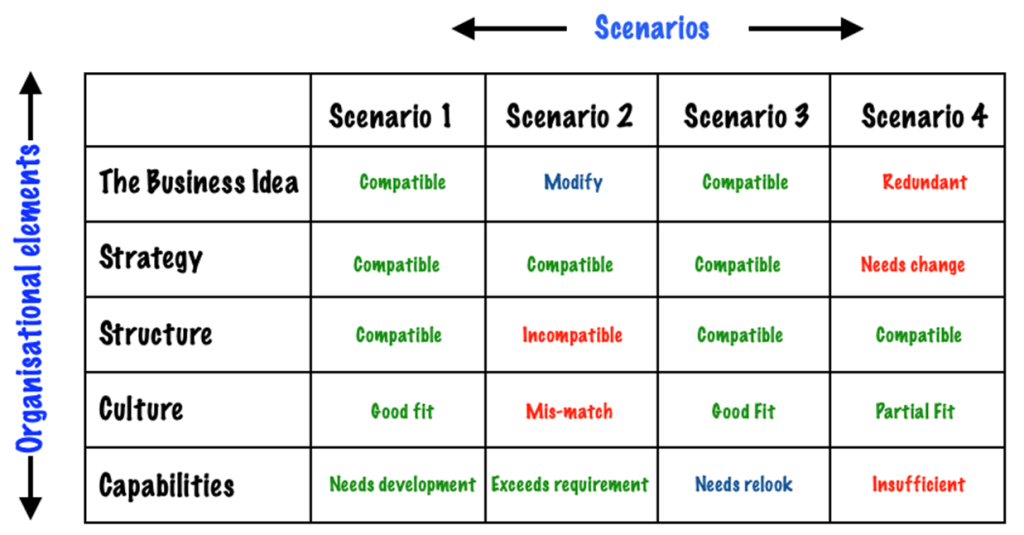
A useful tool to visualize this process is a compatibility matrix. For each strategic option, you evaluate how well it fits with each potential scenario.
How to Choose: What's Your Risk Appetite?
You've stress-tested your options and have a few robust candidates. How do you pick the winner? The "best" choice often depends on your personal risk tolerance as a founder. We can formalize this decision using a few classic criteria.
To illustrate, let's create a simplified payoff table. Imagine you have three strategic choices, and you've estimated the potential annual profit under two key scenarios.
| Strategy Choice | Scenario 1: High Demand for Premium Woodwork | Scenario 2: Low Demand / Price-Sensitive Market |
|---|---|---|
| A: Aggressive Growth | $120,000 | -$30,000 |
| B: Cautious Niche | $50,000 | $20,000 |
| C: Flexible Hybrid | $80,000 | $10,000 |
Let's analyze this table through three different lenses. The following article explains these decision-making mindsets.
What kind of risk-taker are you: Maximax, Minimin, or Minimax?
This article, 'What kind of risk-taker are you...?', provides a simple yet powerful framework for making decisions under uncertainty based on your attitude toward risk and reward.
Please read the introduction and the sections on Maximax, Maximin, and Minimax regret. Focus on understanding the goal of each criterion.
Now let's apply these criteria to our table:
1. The Maximax Criterion (The Optimist)
- Motto: "Go for the highest possible reward."
- Method: Find the maximum possible payoff for each strategy, then choose the strategy with the highest of these maximums.
- Max payoff for A: $120,000
- Max payoff for B: $50,000
- Max payoff for C: $80,000
- Choice: The highest possible payoff is $120,000, so the Maximax choice is Strategy A: Aggressive Growth. This approach ignores the potential for a $30,000 loss.
2. The Maximin Criterion (The Pessimist)
- Motto: "Protect against the worst-case scenario."
- Method: Find the minimum possible payoff for each strategy, then choose the strategy with the highest of these minimums.
- Min payoff for A: -$30,000
- Min payoff for B: $20,000
- Min payoff for C: $10,000
- Choice: The best of the worst-case outcomes is a $20,000 profit. The Maximin choice is Strategy B: Cautious Niche. This guarantees you'll make at least $20,000.
3. The Minimax Regret Criterion (The Sore Loser)
- Motto: "Minimize my post-decision disappointment."
- Method: This is a bit more involved. First, calculate a "regret" for each cell. Regret is the difference between the payoff you got and the best payoff you could have gotten in that same scenario.
Regret Table:
| Strategy Choice | Regret in Scenario 1 (Best was $120k) | Regret in Scenario 2 (Best was $20k) | Maximum Regret |
|---|---|---|---|
| A: Aggressive | $120k - $120k = $0 | $20k - (-$30k) = $50,000 | $50,000 |
| B: Cautious | $120k - $50k = $70,000 | $20k - $20k = $0 | $70,000 |
| C: Flexible | $120k - $80k = $40,000 | $20k - $10k = $10,000 | $40,000 |
Now, find the maximum regret for each strategy and choose the one with the minimum of these maximum regrets.
- Choice: The lowest maximum regret is $40,000. The Minimax Regret choice is Strategy C: Flexible Hybrid. This strategy ensures you'll never look back and feel you missed out by more than $40,000.
Notice how the Maximin and Minimax Regret criteria often point towards the most robust strategies—those that provide a good balance of risk and reward.
Test your understanding!
As a founder starting your first business with limited capital, which decision criterion (Maximax, Maximin, or Minimax Regret) do you think would be most appropriate for your most critical "one-way door" decisions, and why?
Show answer
For a first-time founder with limited capital, the Maximin criterion is often the most prudent choice for critical, irreversible decisions.
The reasoning is based on survival. The Maximax strategy ("Aggressive Growth") might offer the highest reward, but its worst-case scenario (a $30,000 loss) could bankrupt your new business. A first-time founder's primary goal is often to stay in the game long enough to learn and adapt. The Maximin strategy ("Cautious Niche") guarantees a positive outcome, ensuring the business survives even in the worst-case scenario. It prioritizes survival over maximizing potential upside.
Minimax Regret is also a very strong candidate as it provides a great balance, but Maximin is the ultimate "safety-first" approach when capital is tight.
Conclusion
We've reached the end of our module on making decisions under uncertainty. The goal was never to predict the future, but to prepare for it. By building a truly robust strategy, you give your business the resilience to survive the unexpected and the flexibility to thrive when opportunity knocks.
Key Takeaways:
- A strategy is not a to-do list; it's a coherent theory of how you will win in the marketplace.
- A robust strategy is one that performs acceptably well across a range of different future scenarios, not just the most optimistic one.
- You can stress-test your strategic options by evaluating them against the scenarios you've developed.
- The choice of strategy depends on your risk tolerance, which can be clarified using decision criteria like Maximax (optimist), Maximin (pessimist), and Minimax Regret (balanced). For a new venture, focusing on Maximin or Minimax Regret for key decisions often leads to the most robust path.
Preview of the Next Lesson:
This lesson provided the "what"—the content of your robust strategy. In our next lesson, we will kick off the "Market Entry and Positioning" module by focusing on the "how" and "when." We will take your chosen strategy and use a powerful game theory tool, the game tree, to analyze the sequence of your moves and your competitor's potential responses. This will help you map out your entry into the market step-by-step.