Hello! Welcome back.
In our last lesson, we established how to find the Nash Equilibrium in a pricing game. We saw that it represents a stable outcome where no one has a unilateral incentive to change their strategy. However, we also know from the Prisoner's Dilemma that this stable outcome isn't always a good one—it can be a mutually destructive price war.
This raises a crucial question for your new business: How do you avoid getting trapped in an unfavorable equilibrium? The answer lies in making a fundamental strategic choice. Today's lesson is designed to help you determine when to compete on price versus non-price factors like quality and service. This decision is at the heart of shaping the "game" you play with your competitors, rather than just playing the hand you're dealt.
The Problem with Price-Only Competition
When customers see products as interchangeable, their decision boils down to one factor: price. This dynamic forces competitors into a race to the bottom. In game theory terms, you're stuck in a Prisoner's Dilemma where cutting your price is always the tempting move, leading to a disastrous outcome for everyone.
So, how do businesses avoid this? They compete on other things.
Game Theory and Oligopoly: Crash Course Economics #26
To start, let's watch a segment from Crash Course Economics that introduces the idea of non-price competition.
Please watch from 00:57 to 03:26 and then from 04:42 to 05:54. As you watch, focus on the different ways companies try to make their products stand out without changing the price. Notice how the boardwalk example illustrates the futility of competing on location or price alone when products are identical.
As the video explains, competing on style, quality, location, service, and advertising are all forms of non-price competition. The goal is to differentiate your product, making it distinct from your competitors' offerings. This breaks the cycle of pure price comparison and allows you to build a defensible market position. For your business, this could mean emphasizing the unique grain of the wood you use, your precision CNC machining, a proprietary finish, or your personalized design service.
A Framework for Your Competitive Strategy
Choosing to compete on price or on non-price factors is a deliberate strategic decision. Michael Porter, a renowned business strategist, developed a classic framework that clarifies these choices. He argues that a successful business must choose one of two fundamental sources of competitive advantage: lower cost or differentiation.
Porters generic strategies is about how a firm can achieve a competitive position in the industry
This video provides an excellent overview of Porter's Generic Strategies. It will give you a clear framework for thinking about your business's position in the market.
Watch the video from the beginning until 09:47. Pay close attention to the definitions of the four strategies: Cost Leadership (competing on price for a broad market) Differentiation (competing on uniqueness for a broad market) Cost Focus (competing on price for a niche market) Differentiation Focus (competing on uniqueness for a niche market) Think about which of these best describes your vision for a 'premium' woodworking business.
Let's break this down for your business:
- Cost Leadership: This would mean trying to become the absolute cheapest producer of standard cabinets and doors in your region. This strategy requires immense scale, operational efficiency, and relentless cost-cutting—think IKEA or a massive factory supplier for big-box stores. As a startup, this is likely an unwinnable game.
- Differentiation: This would involve creating unique, high-quality products that appeal to a wide market, justifying a higher price. For example, developing a line of signature door designs that become widely popular.
- Focus Strategies: This is where it gets interesting for a new venture. Instead of serving the entire market, you target a specific segment.
- Cost Focus: You'd serve a niche, but still be the cheapest option within it (e.g., offering the lowest-cost MDF cabinets for landlords).
- Differentiation Focus: You'd serve a niche with a unique, premium product. This aligns perfectly with your plan to create high-end doors and cabinets. Your target market isn't everyone; it might be architects, luxury home builders, or clients with very specific aesthetic demands. You aren't just selling a cabinet; you're selling bespoke design, superior craftsmanship, and premium materials to a segment willing to pay for that unique value.
The following matrix provides a simple way to visualize these strategic choices. A business is most viable when it plays either the "Cost game" or the "Differentiation game." Trying to do both, or charging a high price for standard quality, is generally unsustainable.
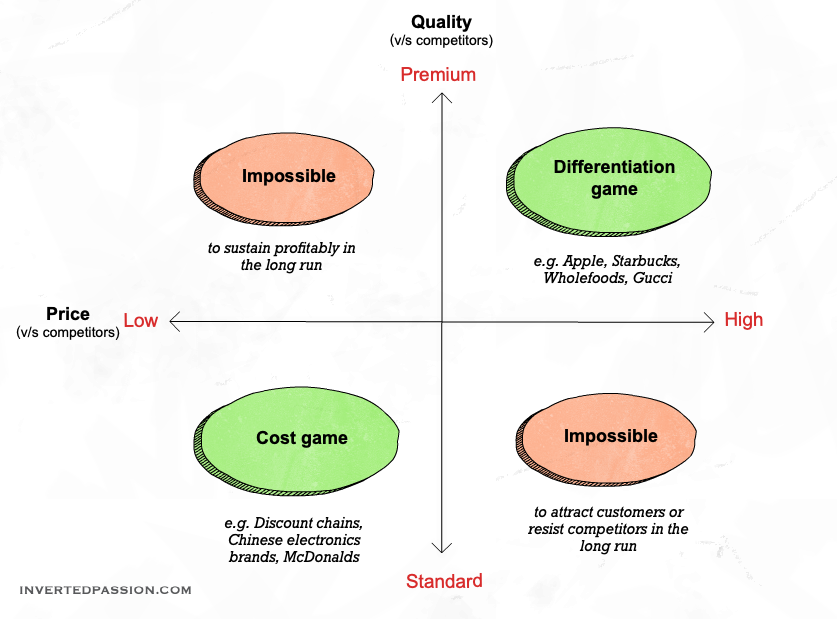
Choosing a differentiation focus strategy is a conscious decision to avoid competing on price. You are signaling to the market that your value proposition is fundamentally different.
How Differentiation Helps You Escape the Price War
By now, it's conceptually clear that differentiation is the path away from price wars. But how does this work in practice? How do you ensure you don't get dragged into a price battle even if you have a better product?
The key is to create value that can't be easily compared on a price tag alone.
Prisoner's Dilemma: Why Price Competition Is a Game You ...
The article 'Prisoner's Dilemma: Why Price Competition Is a Game You Cannot Win' provides concrete steps for breaking free from the price-matching trap.
Please read the sections titled 'The Price War Death Spiral,' 'Beyond Price: Creating Unmatched Value,' and the 'Case Study: Escaping the Price War.' Focus on the actionable strategies for creating value and note how the furniture retailer in the case study successfully implemented them.
The article lays out a clear path. Instead of just reacting to a competitor's price cut, you can proactively make your offering difficult to compare. For your woodworking business, this could mean:
- Unique Product Configurations: Offering cabinet doors in a unique wood species or with custom CNC-carved patterns that competitors don't have.
- Service Integration: Bundling your products with an in-home design consultation, 3D visualization of the final kitchen, and a white-glove installation service. This shifts the focus from the price of the cabinet to the value of the entire solution.
- Expertise and Curation: Positioning yourself as the local expert on sustainable wood or modern kitchen design. Your advice and curated selections become part of the value, justifying a premium.
The furniture retailer case study is a powerful example. They didn't win by being cheaper; they won by changing the game. They developed exclusive product lines, invested in superior service, and sold "solutions" (room collections) instead of just items. This is the essence of a successful differentiation strategy.
Test your understanding!
Imagine you've launched your premium cabinet business. A large competitor, who mass-produces standard cabinets, announces a 20% discount on their entire product line to drive volume. Based on today's lesson, which of the following is the least effective long-term response for your business?
A) Match their 20% discount on your custom cabinets.
B) Launch a social media campaign showcasing your superior joinery techniques and the quality of your materials.
C) Begin offering a new service package that includes a personal consultation with a certified interior designer for any full kitchen project.
D) Partner with a local granite countertop supplier to offer exclusive, bundled kitchen packages.
Show answer
The least effective long-term response is A) Match their 20% discount.
This action pulls you directly into a price war with a competitor who operates on a cost leadership model. They are structured to win this kind of fight. Responses B, C, and D are all forms of differentiation. They reinforce your premium positioning by highlighting quality (B), enhancing service (C), and creating unique value bundles (D), all of which help you avoid competing solely on price.
Conclusion
Today, we've established a crucial principle for your business strategy: to avoid destructive price wars, you must deliberately choose your basis of competition.
Key Takeaways:
- Competing on price is the default when products are seen as interchangeable and often leads to a Prisoner's Dilemma where all firms lose profit.
- The alternative is to compete on non-price factors through a strategy of differentiation, making your offering unique and valuable in the eyes of the customer.
- Porter's Generic Strategies provide a framework for this choice. As a premium startup, a Differentiation Focus strategy—serving a niche market with a unique product/service—is often the most powerful position.
- You can differentiate through product features, service, brand, and expertise to create value that can't be easily price-matched.
Preview of the Next Lesson:
Choosing a differentiation strategy is your best defense against price wars. But what happens if a competitor acts aggressively and tries to start one anyway? In our next lesson, we will focus on tactics to evaluate and implement strategies to avoid or de-escalate a price war, giving you the tools to manage your pricing even when under pressure.