Hello! Welcome back to our course.
In our last lesson, we established that the most effective way to avoid a price war is to build a differentiated business—in your case, a premium woodworking brand focused on unique quality and service. By doing this, you're not playing the same game as mass-market producers.
But what happens if a competitor, even another custom shop, acts aggressively and lowers their price? Simply having a better product doesn't make you immune to competitive pressure. Today, we'll focus on the tactics you can use to evaluate and implement strategies to avoid or de-escalate a price war. We'll move from the high-level strategy of differentiation to the on-the-ground tactics of managing a competitive pricing environment.
This lesson will help you stay out of the mutually destructive race to the bottom, ensuring your premium business can remain profitable.
Pricing as a Repeated Game
First, let's revisit a core concept. In the last module, we explored the Prisoner's Dilemma, which showed why rational players might end up in a bad outcome (like a price war). The key assumption in the classic dilemma, however, is that it's a one-time interaction. Business, especially in a local market, is rarely like that. You and your competitors will be making pricing decisions over and over again.
This turns the pricing problem from a one-shot game into a repeated game, and that changes everything. In a repeated game, your actions have consequences for the future. Reputation and trust become valuable, and the possibility of cooperation emerges.
The Prisoner's Dilemma: Pricing
This article, 'The Prisoner's Dilemma: Pricing', does an excellent job of applying this concept directly to business. It explains why the logic shifts when the game is played repeatedly.
Please read from the beginning of the article down to the end of the section that introduces the 'tit for tat' strategy. Focus on how the payoffs in the pricing matrix create a dilemma, and why the fact that pricing is a repeated decision opens the door for a better solution.
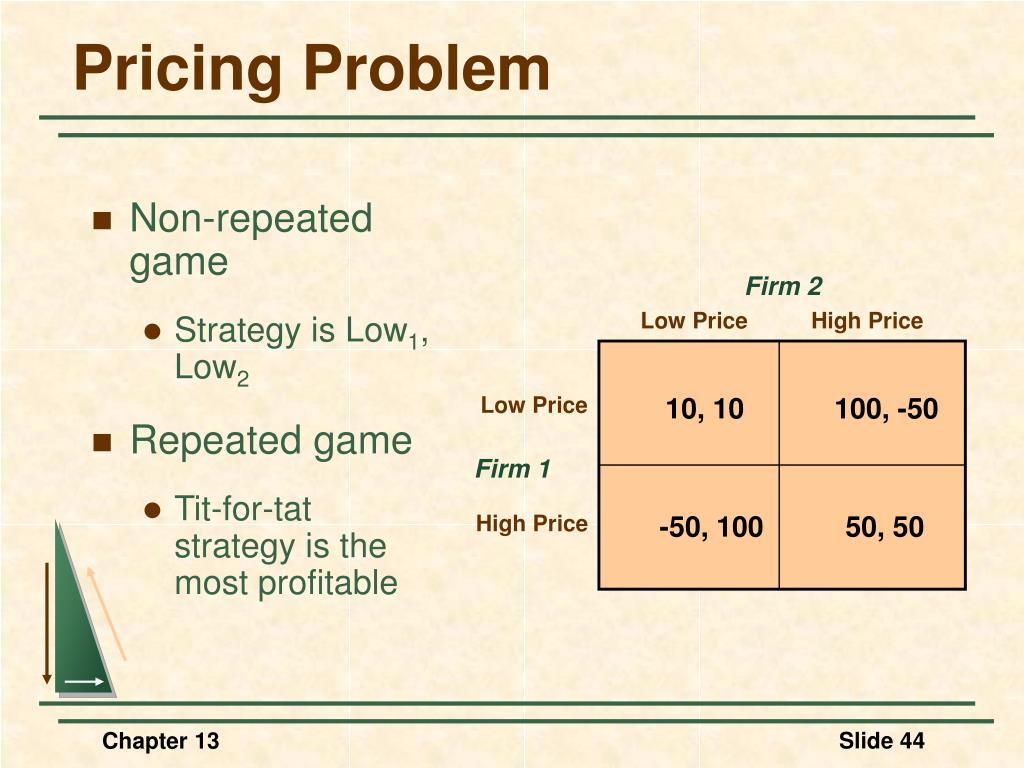
As the article highlights, while both you and your competitor have a short-term incentive to cut prices to gain market share, you're both better off if you can find a way to maintain higher, more profitable prices. In a repeated game, this becomes possible through a strategy of "implicit collusion," where competitors cooperate on price without ever explicitly (or illegally) communicating. The image below shows how the cooperative "High Price" outcome is better for both firms than the competitive "Low Price" outcome, which is the inevitable result of a one-time game.
The Tit-for-Tat Strategy: A Blueprint for Cooperation
So, how do you achieve this "implicit collusion"? A powerful and surprisingly simple strategy emerged from a famous computer tournament designed by political scientist Robert Axelrod. The winning strategy was called Tit for Tat.
The Most Powerful Game Theory Strategy is Actually... Super Simple?
This video gives a fantastic, non-technical explanation of the Tit for Tat strategy and why it is so effective in repeated interactions.
Please watch from 01:43 to 04:53, and then from 08:55 to 10:34. As you watch, pay attention to: How the 'iterated' Prisoner's Dilemma mirrors real-world business competition. The four simple rules of Tit for Tat. The summary of why this simple strategy is so mathematically powerful.
Let's translate the rules of Tit for Tat directly into a pricing strategy for your woodworking business:
- Be Nice (Start Cooperatively): Enter the market with your planned premium pricing. Don't immediately try to undercut existing custom shops. This signals your intention to compete on quality, not price.
- Retaliate (Punish Defection): If a direct competitor aggressively cuts their prices to target you, you must respond. This doesn't necessarily mean matching their price cut—which could be ruinous for a premium brand—but it means taking an action that punishes them. This could be a targeted price drop on a single product line that competes directly with theirs, or launching a marketing campaign that highlights a weakness in their offering. The key is to show that their aggressive move will not go unanswered. This is the "tat."
- Forgive (Restore Cooperation): If the competitor raises their prices back to the previous level, you should immediately cease your retaliatory action. This signals your willingness to return to the more profitable, cooperative state. Holding a grudge is counterproductive.
- Be Clear (Don't Be Too Clever): Your strategy should be easy for your competitors to understand. If your responses are too complex or seem random, they won't be able to learn the pattern, and cooperation becomes impossible.
The core idea is to teach your competitors that cooperation is more profitable for them than aggression.
Tactic 1: Don't Overreact—Interpret the Signal Correctly
The "retaliate" rule of Tit for Tat comes with a massive caveat in the real world: not every price cut is an act of war. A competitor might lower their price for many reasons that have nothing to do with attacking you. For example, they might be:
- Clearing out old inventory of a particular door style.
- Running a seasonal promotion that they run every year.
- Responding to a temporary drop in their own material costs.
The Prisoner's Dilemma: Pricing
The Pragmatic Institute article we looked at earlier offers excellent advice on this point. It's crucial to avoid starting a price war by accident.
Please re-read the section that begins 'Let’s assume you and your competitor start out with high prices...' Focus on the part that discusses mistaking a competitor's moves and the importance of signaling when you have a good reason to temporarily lower your own price.
Before you retaliate, your first job is to investigate. Is this a broad, strategic price reduction across their whole business, or is it a limited, tactical sale? Acting rashly and misinterpreting the signal is one of the fastest ways to trigger a price war that nobody wanted.
Tactic 2: Use Clear Communication and Signaling
Just as you need to read your competitors' signals, you must send clear signals of your own. This is a key de-escalation tactic.
Let's say you've built up an overstock of a specific type of cabinet door and want to run a sale. To avoid spooking your competitors, you should clearly signal that your price cut is temporary and limited. You can do this through your marketing:
- "30% off our Classic Shaker Doors, this month only!"
- "Spring Clearance Event: Special pricing on in-stock cabinet styles."
- "While supplies last."
This language tells competitors that you are not changing your fundamental premium pricing strategy.
This kind of signaling is a core part of avoiding and de-escalating price conflicts.
How Does Game Theory Apply to Competitive Pricing ...
This article on competitive pricing strategy details several tactics, including signaling, that businesses use to manage competition without resorting to all-out war.
Please read the section titled 'Strategic Pricing Tactics Informed by Game Theory.' Pay special attention to the subsections on 'Signaling and Price Leadership' and 'Commitment Strategies.'
The article also introduces price leadership, where a dominant firm signals a price change and others follow. As a new player, you won't be a price leader, but you should watch for this behavior from established companies in your market. It can be a way for the industry to coordinate on higher prices.
Another tactic mentioned is a commitment strategy, like a "price-match guarantee." This is essentially a public promise to play Tit for Tat automatically. It discourages competitors from cutting prices because they know they will gain no advantage. While a price-match guarantee probably doesn't fit your premium brand image, it's a powerful example of using commitment to enforce cooperation.
Test your understanding!
A competing custom woodworking shop, "Builder's Best Cabinets," suddenly drops the price of their oak cabinets by 15%. This is a product very similar to one of your main offerings. Based on today's lesson, what should be your first step?
A) Immediately lower your price on all your oak products by 15% to show them you will not be pushed around.
B) Immediately lower your price on all your products by 15% to send a strong signal.
C) Do nothing and assume your superior quality will win out.
D) Investigate the nature of the price cut. Check their website, advertising, and maybe even visit their showroom to see if this is a limited-time sale or a permanent change.
Show answer
The correct first step is D) Investigate the nature of the price cut. This is the crucial step of interpreting the signal before reacting. Actions A and B are examples of overreacting without full information and could trigger a price war. Action C (doing nothing) might be the right final move, but it's a passive decision. The first active step should always be to gather intelligence.
Conclusion
Today we moved from the strategic defense against price wars (differentiation) to the tactical tools for de-escalation. You don't have to be a victim of a competitor's aggressive pricing. By understanding the dynamics of repeated games, you can actively shape the competitive environment.
Key Takeaways:
- Pricing is a repeated game, which makes cooperation possible and profitable.
- The Tit-for-Tat strategy (cooperate, retaliate, forgive) provides a simple but powerful blueprint for managing competitor pricing.
- Don't overreact. A competitor's price cut may not be an attack. Investigate before you retaliate.
- Use clear signaling to communicate your own intentions, especially for temporary price changes, to avoid accidentally starting a price war.
- Understand that strategies like price leadership and commitments are ways that competitors try to enforce cooperation in the market.
Preview of the Next Lesson:
We've now completed our deep dive into pricing and competitive dynamics. You have tools to set your prices, position your brand, and manage conflict. But competitors aren't the only players in your game. In our next module, we'll turn our attention to another critical set of interactions: negotiations. We will start by learning how to identify your sources of bargaining power in supplier and customer negotiations.