Hello! Welcome back.
In our last lesson, we explored the Prisoner's Dilemma and saw how it can lead to mutually destructive price wars. We identified the (Cut Price, Cut Price) outcome as a "Nash Equilibrium"—a stable but undesirable result. That scenario, however, represents a specific type of competitive trap.
Today, we will generalize this powerful idea. Your goal for this lesson is to use the Nash Equilibrium concept to identify stable pricing strategies in any market scenario. This moves beyond just identifying price wars and helps you predict where prices are likely to settle in your market. Understanding this "strategic equilibrium" is essential for positioning your new woodworking business, whether you're pricing premium doors or custom cabinets.
Beyond the Dilemma: What is a Nash Equilibrium?
In the Prisoner's Dilemma, the Nash Equilibrium was the result of both players choosing their "dominant strategy." But what happens when a dominant strategy doesn't exist?
The core idea of a Nash Equilibrium, named after mathematician John Nash, is much broader.
How Does Game Theory Apply to Competitive Pricing ...
The article 'How Does Game Theory Apply to Competitive Pricing...' provides a concise and business-focused definition of this concept.
Please read the section titled 'The Nash Equilibrium: Finding Stable Pricing Points'. Focus on the core definition: what makes an outcome a Nash Equilibrium?
As the article states, a Nash Equilibrium is a stable outcome where no player can get a better payoff by unilaterally changing their strategy. It's a point of strategic balance. If you find your business in a Nash Equilibrium, you're doing the best you can, given what your competitor is doing, and they are doing the best they can, given what you are doing. There is no immediate incentive for anyone to move.
A Practical Method for Finding Stable Prices
So, how do we find this equilibrium point in a payoff matrix if there isn't an obvious dominant strategy? We use a systematic process of checking each player's best response to every possible move by the other player.
Let's apply this to a new scenario for your business. Imagine you're deciding between two pricing tiers for your custom cabinets: a "Premium Price" or a "Standard Price". Your main competitor is a larger company, "Budget Cabinets," that traditionally focuses on the lower end of the market.
Here is a hypothetical payoff matrix showing your potential profits (in thousands of dollars).
| Budget Cabinets | ||
|---|---|---|
| Standard Price | Premium Price | |
| You (Premium Woodworks) | ||
| Premium Price | (You: 100, Budget: 80) | (You: 80, Budget: 20) |
| Standard Price | (You: 60, Budget: 50) | (You: 120, Budget: 10) |
To find the equilibrium, we'll go through each player's choices and underline their best possible payoff in each situation.
1. Analyze Your Best Responses (You are the first number in each pair):
- If Budget Cabinets chooses
Standard Price(the first column), your choices arePremium(profit 100) orStandard(profit 60). Your best response isPremium. Let's underline 100. - If Budget Cabinets chooses
Premium Price(the second column), your choices arePremium(profit 80) orStandard(profit 120). Your best response isStandard. Let's underline 120.
2. Analyze Budget Cabinets' Best Responses (They are the second number):
- If you choose
Premium Price(the first row), their choices areStandard(profit 80) orPremium(profit 20). Their best response isStandard. Let's underline 80. - If you choose
Standard Price(the second row), their choices areStandard(profit 50) orPremium(profit 10). Their best response isStandard. Let's underline 50.
Now, let's look at the matrix with all the best responses underlined:
| Budget Cabinets | ||
|---|---|---|
| Standard Price | Premium Price | |
| You (Premium Woodworks) | ||
| Premium Price | (100, 80) | (80, 20) |
| Standard Price | (60, 50) | (120, 10) |
The Nash Equilibrium is the cell where both payoffs are underlined: (Premium Price, Standard Price).
This outcome is stable because neither player has an incentive to move.
- If you are at this equilibrium (earning 100), would you unilaterally switch to
Standard Price? No, your profit would drop to 60. - If Budget Cabinets is at this equilibrium (earning 80), would they unilaterally switch to
Premium Price? No, their profit would plummet to 20.
This analysis predicts that the stable market outcome is for you to own the premium niche while your competitor sticks to the standard market. This is a much more attractive equilibrium than the price war in the Prisoner's Dilemma.
To see this method explained again, the following video provides a good summary.
Game Theory I: Static Game, Dominant Strategy, Nash Equilibrium
The video 'Game Theory I' from Economics in Many Lessons offers a clear definition of Nash Equilibrium and walks through an example.
Watch the segment from 05:10 to 07:05. Pay attention to how the narrator checks whether either player would want to change their strategy from the proposed equilibrium. This is the key test for stability.
Test your understanding!
Let's analyze a new pricing game between two firms, Alpine and Squaw. Use the "underlining method" to find the Nash Equilibrium in the payoff matrix below. What is the stable pricing outcome?
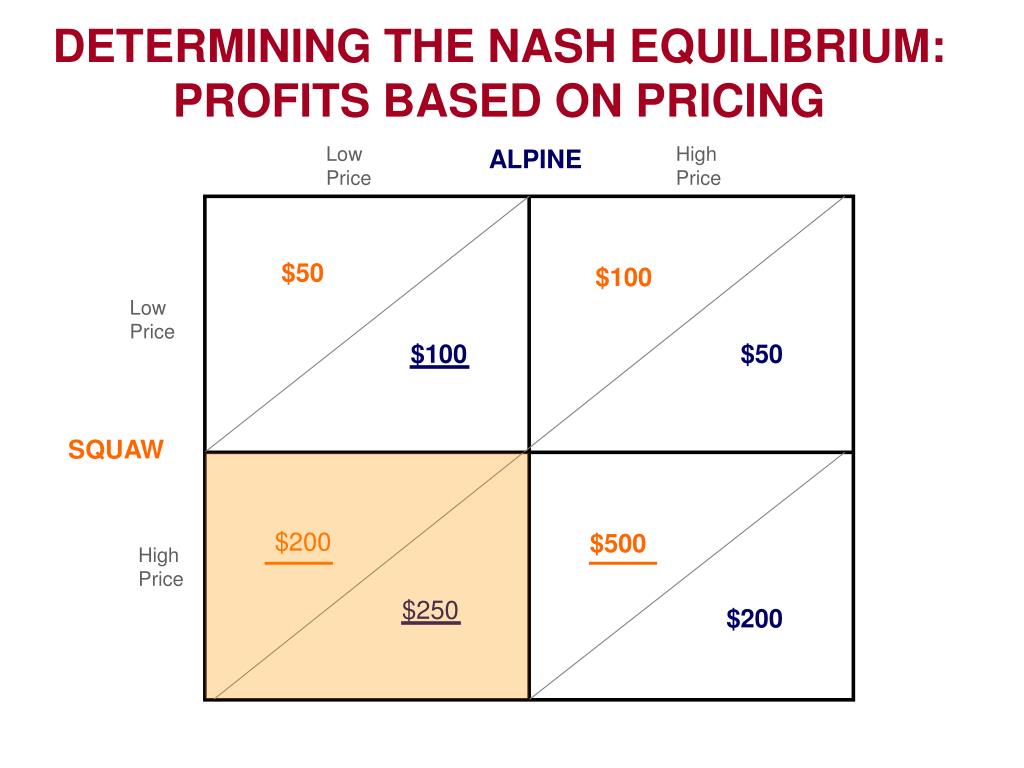
Show answer
Here is the matrix with the best responses underlined:
| Squaw | ||
|---|---|---|
| Low Price | High Price | |
| Alpine | ||
| Low Price | (50, 100) | (300, 75) |
| High Price | (100, 250) | (250, 200) |
Analysis Steps:
- Alpine's Best Responses (first number):
- If Squaw plays
Low Price, Alpine prefersHigh Price(100 > 50). Underline 100. - If Squaw plays
High Price, Alpine prefersLow Price(300 > 250). Underline 300.
- If Squaw plays
- Squaw's Best Responses (second number):
- If Alpine plays
Low Price, Squaw prefersLow Price(100 > 75). Underline 100. - If Alpine plays
High Price, Squaw prefersLow Price(250 > 200). Underline 250.
- If Alpine plays
The Nash Equilibrium is the cell where both numbers are underlined: (High Price, Low Price). The stable outcome is for Alpine to set a high price and Squaw to set a low price, with profits of 100 for Alpine and 250 for Squaw.
What Nash Equilibrium Means for Your Business Strategy
Identifying the Nash Equilibrium is not just an academic exercise. It gives you a powerful prediction of where your market is likely to end up if all players act in their own best interest.
- It reveals the path of least resistance. The market will naturally be pulled toward the equilibrium point.
- It highlights strategic challenges and opportunities. If the predicted equilibrium is unfavorable for you (like in a price war), it tells you that simply changing your price won't fix the problem. You need to change the game itself—perhaps by differentiating your product, building a stronger brand, or making a strategic investment that alters the payoffs for everyone.
By anticipating the stable outcome, you can make more informed decisions before you enter the game, choosing a market position and strategy that leads to a favorable equilibrium.
Conclusion
Today we broadened your understanding of strategic stability beyond the narrow case of the Prisoner's Dilemma. You now have a robust method for analyzing any simple pricing game.
Key Takeaways:
- A Nash Equilibrium is a stable strategic outcome where no player can benefit by changing their strategy alone.
- You can find the Nash Equilibrium using the "best response" analysis (the underlining method), even when no dominant strategies exist.
- Identifying the equilibrium helps you predict the likely stable pricing structure in your market.
- If the predicted outcome is poor, it signals that you need a strategy that changes the game, rather than just a different move within the current game.
Preview of the Next Lesson:
Now that you have the core tools for analyzing both sequential and simultaneous games (game trees and payoff matrices), we will begin Module 3: Market Entry and Positioning. In the next lesson, you will apply a game tree and backward induction to analyze your market entry decision for your woodworking business. This will help you think through how incumbents might react to your arrival and how to choose the best path forward.