
Hello! Welcome to the next lesson in our exploration of sleep's architecture.
In our previous lessons, we've taken a deep dive into the individual components of sleep, examining the quiet, restorative phases of NREM sleep and the active, dream-filled world of REM sleep. We've treated them as separate states, but of course, a full night of sleep is not spent in just one stage.
Today, our goal is to explain the concept of sleep cycles and their typical duration. We will see how the brain and body don't just pick a stage and stay there, but rather journey through them in a predictable, repeating pattern. This cyclical structure is the fundamental blueprint of a night's sleep. Understanding this pattern is essential before we can analyze how it changes throughout the night, and it lays the groundwork for knowing when certain states of consciousness, like dreaming, are most likely to occur.
The Rhythm of the Night: Introducing the Sleep Cycle
Sleep isn't a single, monolithic state. Instead, as you sleep, your brain cycles through the different stages in a remarkably consistent rhythm. Think of it as a recurring program that runs multiple times each night.
To introduce this idea, let's watch a short, elegant explanation from a TED talk by sleep scientist Matt Walker.
A walk through the stages of sleep | Sleeping with Science, a TED series
In this clip from the TED series 'Sleeping with Science', Matt Walker describes the nightly 'battle for brain domination' between NREM and REM sleep, which results in a standard 90-minute cycle.
Please watch the segment from 02:24 to 02:54. Focus on the core idea that NREM and REM alternate in a predictable, 90-minute pattern.
As the video explains, your sleep is structured around this fundamental 90-minute rhythm. This repeating progression through the sleep stages is known as a sleep cycle.
The Journey Through a Single Cycle
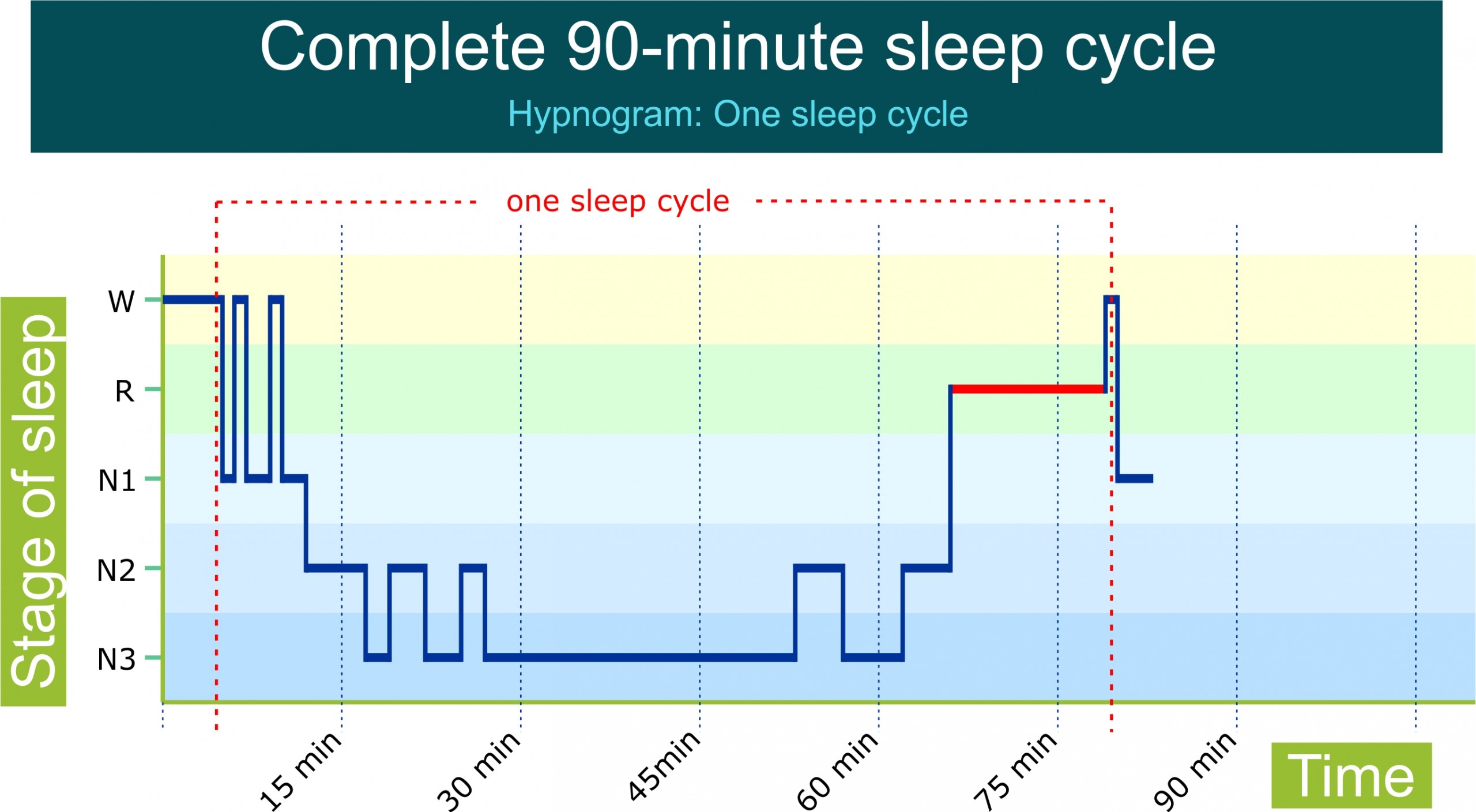
So, what does one of these 90-minute cycles look like? You don't simply progress from stage N1 to N2 to N3 to REM in a straight line. The path is more of a descent and ascent.
A typical early-night sleep cycle follows this general pattern:
- Descent into NREM: You begin by moving from wakefulness into the light NREM stages (N1 and N2).
- Deep NREM Sleep: You then descend further into the deepest, most restorative stage of sleep, N3 (slow-wave sleep).
- Ascent to REM: After spending time in deep sleep, you begin to ascend back into the lighter NREM stages (typically N2).
- Entering REM: Finally, instead of waking up, you enter your first period of REM sleep, where vivid dreaming occurs.
After the REM stage concludes, the cycle begins again. The following image, called a hypnogram, provides a visual representation of this journey through a single 90-minute cycle.
Duration, Repetition, and Variation
Now that we have the concept of a single cycle, let's zoom out and look at how this fits into a full night's sleep.
Stages of Sleep: What Happens in a Normal Sleep Cycle?
This article from the Sleep Foundation, 'Stages of Sleep', provides precise details on the duration and number of sleep cycles in a typical night.
Please read the first section, 'What Is the Sleep Cycle?'. Pay attention to the average number of cycles per night, the average duration of a cycle, and how the length of cycles can change as the night progresses.
As the article explains, the key numbers to remember are:
- Average Cycle Duration: About 90 minutes.
- Cycles per Night: In a typical 7-8 hour night, you will go through four to six of these cycles.
- Variation in Length: The cycles are not perfectly identical. The first cycle of the night is often the shortest (around 70-100 minutes), while later cycles can be longer (90-120 minutes).
The Changing Architecture of Sleep Cycles
Crucially, not only does the length of the cycles change, but their internal composition—the amount of time spent in each stage—also changes dramatically as the night goes on.
This is a key concept that we will explore in detail in the next lesson, but it's important to introduce it here. The "battle" between NREM and REM that Matt Walker mentioned has a different winner depending on the time of night.
- Early Night (First Half): The first few sleep cycles are dominated by deep NREM sleep (N3).
- Late Night (Second Half): The later cycles feature much less deep sleep and are instead dominated by REM sleep and lighter N2 sleep.
Let's watch a clear visualization of this principle.
Sleep Stages, Sleep Cycle, and the Biology of Sleep
Returning to the 'Psych Explained' video, this final segment visually demonstrates how the proportions of deep sleep and REM sleep change across multiple cycles during the night.
Please watch from 20:44 to 21:59. Notice how the presenter's drawing shows deep sleep (N3) decreasing in later cycles while REM periods become progressively longer.
This changing ratio has very important practical consequences. For example, if you consistently get 8 hours of sleep but one night you have to wake up 2 hours early, you haven't lost 25% of each sleep stage. Because REM sleep is concentrated in the final hours of sleep, you might lose 50% or more of your total REM sleep, disproportionately affecting emotional processing and creativity.
Test your understanding!
An individual goes to bed at 11 PM and wakes up at 7 AM, completing a full 8-hour sleep period.
- Approximately how many 90-minute sleep cycles did they complete?
- During which part of the night (the hours closer to 11 PM or the hours closer to 7 AM) did they likely spend the most time in deep, slow-wave sleep (N3)?
- During which part of the night did they experience the longest periods of REM sleep?
Show answer
- An 8-hour (480-minute) sleep period allows for approximately five to six 90-minute sleep cycles.
- They spent the most time in deep sleep (N3) during the first half of the night, closer to 11 PM.
- They experienced the longest periods of REM sleep during the second half of the night, in the hours leading up to 7 AM.
Conclusion
In this lesson, we've pieced together the individual sleep stages into their repeating structure: the sleep cycle. This gives us the basic blueprint for how a night of sleep is organized.
Key Takeaways:
- Sleep is not a static state; we progress through NREM and REM stages in a recurring pattern called a sleep cycle.
- A single sleep cycle lasts approximately 90 minutes on average, and we typically complete four to six cycles per night.
- A typical cycle involves a descent into deep NREM sleep, followed by an ascent into REM sleep.
- The composition of sleep cycles is not static. The first half of the night is rich in deep NREM sleep, while the second half is dominated by REM sleep.
Preview of the Next Lesson:
We have now established all the essential components: the stages themselves and the cyclical pattern they follow. In our final lesson for this module, we will put it all together and describe how sleep stages progress throughout a typical night across multiple cycles. We'll use a full-night hypnogram to create a complete map of the night's journey, solidifying our understanding of sleep architecture.