
Hello! Welcome to our final lesson in the module on sleep architecture.
In our last session, we established the fundamental building block of a night's sleep: the sleep cycle, a recurring 90-minute journey through the stages of sleep. We also touched upon the idea that these cycles aren't identical copies of each other.
Today, we will put all the pieces together. Our learning outcome is to describe how sleep stages progress throughout a typical night across multiple cycles. We'll create a complete map of an entire night's sleep, visualizing the journey from when your head hits the pillow until your alarm goes off. Understanding this full "sleep architecture" is the culmination of this module and provides the essential foundation for understanding the functions of sleep, which we'll explore next.
The Blueprint of a Full Night's Sleep: The Hypnogram
Scientists use a graph called a hypnogram to map out a person's progression through the sleep stages over an entire night. Think of it as a blueprint or a skyline of your sleep.
Let's look at a typical example for a healthy young adult.
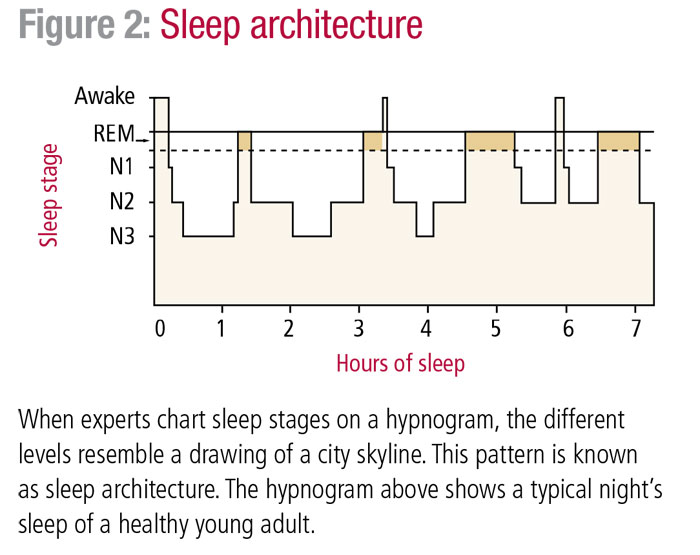
As you can see, the night is not a flat line. It's a dynamic and structured journey with a clear, predictable pattern. The most striking feature is how the "shape" of the cycles changes from the beginning of the night to the end.
The Changing Landscape of Sleep Cycles
To understand the pattern shown in the hypnogram, let's examine how the time spent in the most important stages—deep NREM sleep (N3) and REM sleep—evolves as the night unfolds.
Stages of Sleep: What Happens in a Normal Sleep Cycle?
The article 'Stages of Sleep' from the Sleep Foundation provides excellent details on how the duration of deep sleep and REM sleep changes across the night.
Please read the final paragraph of the section 'Stage 3 (N3 or Deep Sleep)' and the second paragraph of the section 'What Happens During REM Sleep?'. Focus on how the time spent in each of these stages changes during the first half versus the second half of the night.
The reading highlights the core principle of sleep architecture:
- First Half of the Night: This period is dominated by deep sleep (N3). The body prioritizes physical restoration and growth early in the night. The N3 stages in the first two cycles are the longest and deepest.
- Second Half of the Night: Deep sleep (N3) becomes much shorter or disappears entirely. This time is reallocated to lighter N2 sleep and, most significantly, longer and more frequent periods of REM sleep.
Now, let's watch a video that draws this progression out, making the changing balance between the stages very clear.
Sleep Stages, Sleep Cycle, and the Biology of Sleep
The 'Psych Explained' video we've seen before provides a great visual summary of a full night's sleep architecture.
Please watch the segment from 20:44 to 22:10. Notice how the presenter's drawing shows the deep sleep portions (the lowest points of the cycle) getting smaller, while the REM periods get progressively longer as the night continues.
The Typical Path Through the Night
Let's synthesize this information by tracing the path on the hypnogram more formally. A complete sleep cycle doesn't just go N1 → N2 → N3 → REM. There's a slight ascent before you enter REM.
Sleep stages and circadian rhythms | Processing the Environment | MCAT | Khan Academy
This short clip from Khan Academy clearly states the common order of stages within a single cycle.
Watch from 04:48 to 05:25. Pay attention to the specific order of the stages the narrator describes.
As the video explains, the typical order of progression is:
N1 → N2 → N3 → N2 → REM
After the REM stage, the cycle begins again, usually starting back at N2. Let's trace this across the night:
- First Cycle (0-90 mins): You fall asleep, quickly passing through N1 into N2. You then enter a long, deep period of N3 sleep. You ascend back to N2 and have a very short REM period (perhaps only a few minutes).
- Second Cycle (90-180 mins): The pattern repeats, but the N3 stage is typically a bit shorter, and the REM stage is a bit longer.
- Later Cycles (180 mins onward): As you move into the second half of the night, the N3 stages become very short or vanish completely. The time you previously spent in deep sleep is now allocated to much longer periods of REM sleep, which can last up to an hour by the final cycle. You also spend a large portion of this time in N2 sleep.
You might also notice the small spikes that go all the way up to the "Awake" stage on the hypnogram. These are brief arousals, and they are a perfectly normal part of sleep. Most of the time, they are so brief that you don't even remember them in the morning.
Test your understanding!
Imagine a person's sleep is disrupted by a loud, recurring noise only during the first three hours of the night. In the second half of the night, they sleep peacefully.
Based on your understanding of sleep architecture, which sleep stage would be most significantly reduced by this disruption? What might be the primary consequence of this loss?
Show answer
The sleep stage most significantly reduced would be deep sleep (N3), as it is concentrated in the first half of the night. The primary consequence would likely be a reduction in physical restoration, cellular repair, and growth, as these are key functions of deep sleep.
Why This Architecture Matters
This specific, predictable architecture isn't random; it's a highly optimized system. The alternating focus between deep NREM and REM sleep allows the body and brain to accomplish a wide range of critical tasks.
- For Physical Health: Prioritizing deep sleep early in the night ensures that essential physical repair and immune system maintenance happen reliably, even if sleep is cut short.
- For Mental Health: Prioritizing REM sleep later in the night supports emotional processing, memory consolidation, and creativity. A full night's sleep gives you the long REM periods needed for these cognitive functions. When you wake up two hours early, you aren't just losing two hours of sleep; you might be losing 50% or more of your total REM sleep for that night.
From the perspective of our course goal, this architecture is profoundly important. The first half of the night, dominated by the profound unconsciousness of N3 sleep, presents a different landscape for consciousness than the second half. The latter part of the night, rich in brain activity and the vivid internal world of REM sleep, is the natural window for practices like lucid dreaming. As we'll explore in later modules, understanding when these states are most likely to occur is the first step toward potentially engaging with them consciously, a key element in Acharya Mahapragya's teachings on transforming sleep.
Conclusion
This lesson concludes our exploration of sleep architecture. We've moved from identifying individual stages to understanding the repeating 90-minute cycle, and finally to mapping how these cycles evolve over a full night.
Key Takeaways:
- A full night's sleep consists of 4 to 6 sleep cycles.
- The progression within a cycle is typically N1 → N2 → N3 → N2 → REM.
- Sleep architecture changes dynamically: the first half of the night is dominated by physically restorative deep sleep (N3).
- The second half of the night is dominated by cognitively crucial REM sleep and lighter N2 sleep.
Preview of the Next Module:
Now that we have a complete answer to the question "What happens when we sleep?", we are ready to ask "Why do we sleep?". In the next module, we will begin exploring the many functions of sleep. We'll start with one of its most fascinating roles: how sleep helps us learn and consolidate memories, connecting the stages we've just mapped to the processes that help us retain knowledge and skills.