
Hello! Welcome to the third lesson in our "Architecture of Sleep" module.
In the last two lessons, we established the scientific methods for observing sleep (polysomnography) and took a detailed tour of the "quiet" side of sleep: the NREM stages. We saw how the brain and body progressively slow down, culminating in the deep, physically restorative state of NREM Stage 3, or slow-wave sleep.
Today, we switch our focus to the most enigmatic and active phase of sleep. Our goal is to explain the characteristics and functions of REM sleep. This stage is a world away from the quiet depths of NREM sleep. It's a time of intense brain activity, vivid dreaming, and complete muscle paralysis—a state of fascinating contradictions.
Understanding REM sleep is absolutely critical for our journey. It is the primary stage for dreaming, making it the main arena for the practices of lucid dreaming and, potentially, the advanced contemplative states you're interested in exploring. The stark contrast between the unconscious activity of REM sleep and the conscious relaxation of meditation will be a central theme as we move forward.
Let's begin by getting a visual and auditory introduction to this unique state.
An Introduction to REM Sleep
To start, we'll watch segments from two videos that introduce the core concepts of REM sleep. They cover similar ground, but hearing the ideas twice from different perspectives will help solidify your understanding.
Sleep Stages, Sleep Cycle, and the Biology of Sleep
First, let's return to the 'Psych Explained' video. This segment provides an excellent description of REM sleep, including its EEG signature, its connection to dreaming, and why it's called 'paradoxical sleep'.
Please watch from 18:22 to 20:44. Pay close attention to the three key points: the brain waves resembling wakefulness, the muscle paralysis, and the name 'paradoxical sleep'.
Sleep stages and circadian rhythms | Processing the Environment | MCAT | Khan Academy
Next, this clip from Khan Academy offers another concise explanation, reinforcing the concepts of muscle paralysis and the active brain state during REM.
Please watch from 04:11 to 05:00. Note the explanation for why muscle paralysis during REM sleep is a protective mechanism.
The Defining Characteristics of REM Sleep
As the videos highlighted, REM sleep is a stage of stark contrasts. Let's break down its defining features in more detail.
1. Paradoxical Sleep: An Active Brain
The most striking feature of REM sleep is the brain's activity level. If you were only looking at an EEG, the brain waves during REM sleep would look remarkably similar to those of a person who is awake and alert.
- EEG Signature: The EEG shows fast, low-amplitude, desynchronized brain waves. This is a dramatic shift from the slow, high-amplitude, synchronized delta waves of NREM Stage 3 sleep.
- Brain Metabolism: Energy consumption by the brain during REM sleep is equal to, or even greater than, its energy use during wakefulness.
This combination of a highly active, 'awake-looking' brain within a deeply sleeping body is why REM sleep is often called paradoxical sleep.
2. Rapid Eye Movements
This is the feature that gives the stage its name. Behind closed eyelids, the eyes dart back and forth rapidly. While the exact reason for these movements is still debated, one popular theory (the "scanning hypothesis") suggests that the sleeper's eyes are moving to "look at" the imagery being generated in the dream.
3. Muscle Atonia
Perhaps the most crucial physiological event in REM sleep is atonia, which is a temporary and near-total paralysis of the body's voluntary muscles.
- Mechanism: Specialised cells in the brainstem actively inhibit motor neurons, preventing signals from the brain from reaching the muscles.
- Function: This paralysis is a critical protective mechanism. With the brain being so active and generating vivid dream narratives, atonia prevents you from physically acting out your dreams, which could be dangerous for you and anyone nearby.
The failure of this paralysis mechanism leads to a condition called REM Sleep Behavior Disorder (RBD), where individuals may shout, kick, or flail around while dreaming.
This state of profound physical stillness is interesting to contrast with the Jain practice of kayotsarga (relaxation with self-awareness). While both involve a deeply relaxed body, one is an unconscious, automatic process, and the other is a state of conscious, willful surrender.
4. Physiological Instability
Unlike the steady, slow state of NREM deep sleep, the body's autonomic systems become irregular and variable during REM.
- Breathing and Heart Rate: Both become faster and more variable.
- Blood Pressure: Tends to rise and fluctuate.
- Thermoregulation: The body's ability to regulate its temperature is suspended. You don't shiver or sweat effectively, making your body temperature drift towards that of the room.
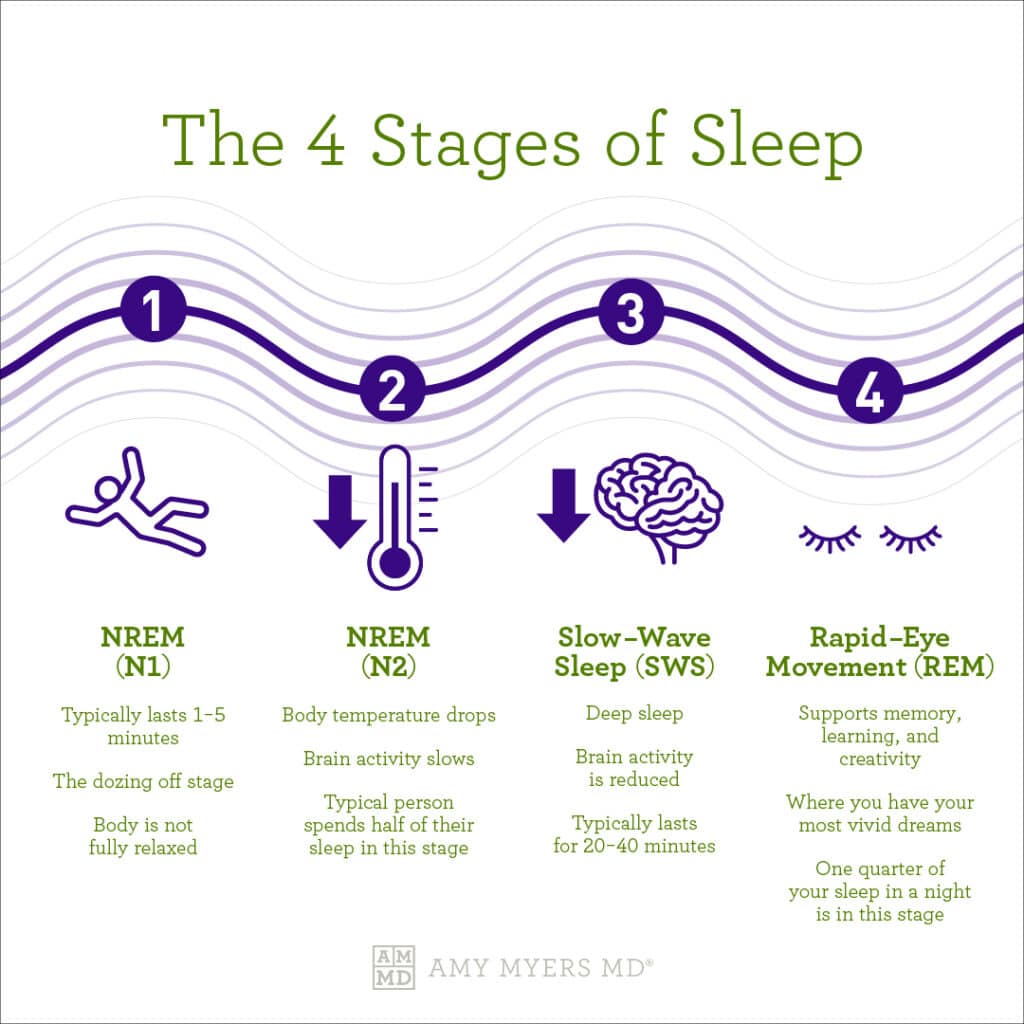
Functions of REM Sleep
Now that we understand what REM sleep is, let's explore what it does. This stage is not just for dreaming; it serves several vital functions for our mental and emotional health.
To get a comprehensive overview, please read the following article.
REM Sleep: What It Is and Why It's Important
This article from the Sleep Foundation, titled 'REM Sleep: What It Is and Why It's Important', is an excellent resource that covers both the characteristics and the critical functions of this sleep stage in a clear and detailed manner.
Please read the sections titled 'What Happens During REM Sleep?' and 'Why Is REM Sleep Important?'. As you read, focus on connecting the physiological characteristics (like brain activity and paralysis) to the functions they support (like memory consolidation and emotional processing).
Based on that reading and our other resources, let's summarize the key functions of REM sleep:
- Dreaming: REM sleep is the home of our most bizarre, vivid, and narrative-rich dreams. While some simpler, thought-like 'dreaming' can happen in NREM stages, the immersive story-like experiences we typically think of as dreams happen here.
- Memory Consolidation: While deep NREM sleep is crucial for solidifying factual (declarative) memories, REM sleep appears to be more important for consolidating procedural memory (learning new skills, like playing a musical instrument) and spatial memory.
- Emotional Regulation: REM sleep is critical for processing the emotional experiences of the previous day. It helps to soften the emotional charge of difficult memories and integrate them, which is vital for maintaining mental and emotional balance. Some scientists refer to this as a form of "overnight therapy."
- Brain Development: The intense neural activity of REM sleep is thought to be essential for forming and strengthening neural connections in the developing brain. This is why newborns spend around 50% of their sleep time in REM, compared to about 20-25% for adults.
Test your understanding!
Imagine you are a sleep researcher observing two individuals.
- Sleeper A is very difficult to awaken. Their heart rate is slow and steady, and their EEG shows large, synchronized, high-amplitude waves.
- Sleeper B is also asleep, but their heart rate is fluctuating, and their EEG shows fast, low-amplitude waves similar to an awake person.
Which sleeper is in REM sleep, and which is in NREM Stage 3? What is the single most definitive physiological feature (besides the EEG) that would confirm your identification of Sleeper B as being in REM?
Show answer
- Sleeper A is in NREM Stage 3 (slow-wave sleep). The slow heart rate and high-amplitude (delta) waves are the classic signs.
- Sleeper B is in REM sleep. The fluctuating heart rate and fast, "awake-like" EEG are key indicators.
The single most definitive feature to confirm Sleeper B is in REM would be the presence of muscle atonia (paralysis of voluntary muscles) coupled with rapid eye movements.
Conclusion
In this lesson, we have illuminated the paradoxical and active world of REM sleep, the crucial counterpart to the quiet rest of NREM sleep.
Key Takeaways:
- REM sleep is called "paradoxical sleep" because it involves a highly active, awake-like brain within an almost completely paralyzed body.
- Its key characteristics are rapid eye movements, fast and low-amplitude brain waves, muscle atonia, and irregular heart rate, breathing, and blood pressure.
- REM sleep serves vital functions, including processing emotions, consolidating procedural and spatial memories, and facilitating our most vivid dreams.
Preview of the Next Lesson:
We have now examined all the individual building blocks of sleep: NREM stages 1, 2, 3, and REM. But how do these pieces fit together across a whole night? In our next lesson, we will explore the concept of sleep cycles, learning how we journey through these different stages repeatedly and how the "architecture" of our sleep changes from when we first fall asleep to when we wake in the morning.