
Hello. In the previous lesson, you established the basic structure of your planned five-subject aggregate: English must contribute at full value, your best three non-English subjects also contribute fully, and the remaining subject contributes at 10%.
This lesson focuses on the three labels that sit at different points in that process: the VCE study score (often called the raw score), the scaled study score, and the ATAR. Keeping them separate will stop a lot of common misunderstandings—especially the idea that a school percentage, a study score, and an ATAR are interchangeable.
Three numbers with three different jobs
The simplest way to understand the system is as a chain:
Here is the key distinction.
| Term | Who produces it? | Scale | What it tells you | What it is used for |
|---|---|---|---|---|
| VCE study score (“raw score”) | VCAA | 0–50 | How you performed relative to other students in the same subject | Input to scaling |
| Scaled study score | VTAC | 0.00–55.00 | A result made comparable across different subjects | Used in your aggregate |
| ATAR | VTAC | 0.00–99.95 | Your percentile rank relative to the Year 12 age group | Used by tertiary institutions in admissions |
The aggregate is the missing middle step. It is the total created from your eligible scaled study scores, using the primary-four and increment rules from the previous lesson. It is then converted into an ATAR.
The important rule is:
Your ATAR is calculated from scaled study scores, not directly from school percentages and not directly from raw study scores.
VTAC ATAR and Scaling Guide 2027
Read the relevant sections of VTAC's ATAR and Scaling Guide 2027. It gives the official definitions and explains why the system has separate study-score, scaling, aggregate, and ATAR stages.
Start with the section “What is the ATAR?” and read the reporting explanation, then the short “What the ATAR isn't” subsection. Next, read the full “Scaling: keeping things fair” section. Focus on why scaling exists, and on the numbered explanation of how VTAC compares performance across studies. Then find “Definitions” under “What would happen if there was no scaling?” Read both definitions in full: the VCE study score begins with VCAA's role, while the scaled-study-score definition begins with VTAC's role. Finally, in “From aggregate to ATAR”, read the aggregate-to-ATAR process. Do not try to memorise every rule yet; identify which organisation produces each number and what that number is designed to compare.
The guide is currently published for 2027. Since you will receive your final results in 2028, you should check VTAC’s current guide and conversion table in your final year. The core distinction between study scores, scaled scores, aggregates, and ATARs is what matters now.
1. The raw study score: your result within one subject
Students commonly say raw score, but VTAC’s formal term is a VCE study score.
A VCE study score is a number from to , calculated by VCAA from your VCE assessment results. It shows how you performed compared with everyone else who completed that same study.
For example:
- a raw English study score of compares you with other English students;
- a raw Accounting study score of compares you with other Accounting students;
- a raw Mathematical Methods study score of compares you with other Methods students.
Those are meaningful results within their own subjects. But they are not automatically equivalent for ATAR purposes, because the groups taking each subject differ.
A study score is not a percentage
This is especially important while you are in Year 10 and looking at school marks.
A test result of does not simply turn into a raw study score of . Likewise, a raw study score of does not mean you averaged across SACs and exams.
Your eventual study score depends on your performance in VCE assessments and examinations relative to the statewide group doing that subject. Your Year 10 English average of roughly –, advanced maths average of roughly –, and current Accounting improvement are useful evidence for identifying strengths and gaps. They are not yet a formula for predicting study scores.
A useful translation is:
- School percentage: “How well did I do on this particular task?”
- Study score: “How did I perform in this VCE subject compared with the statewide subject cohort?”
The average VCE study score in each study is standardised at . This does not mean a is “30 percent”; it means a result around the middle of that particular VCE cohort.
2. The scaled study score: making subjects comparable
VTAC receives the VCAA study scores and applies scaling. This produces a scaled study score between and .
Scaling is not a personal bonus for choosing a supposedly difficult subject. It is a comparison process intended to make results from different subjects fair to compare.
VTAC examines how the students in a subject performed in their other studies. If a subject’s cohort tends to perform strongly across their other subjects, that indicates a relatively competitive cohort. Scores in that subject may be scaled upward. If the cohort tends to perform less strongly in their other studies, the subject may be scaled downward.
The key idea is:
Scaling responds to the overall performance of a subject cohort, not to how difficult you personally found the subject.
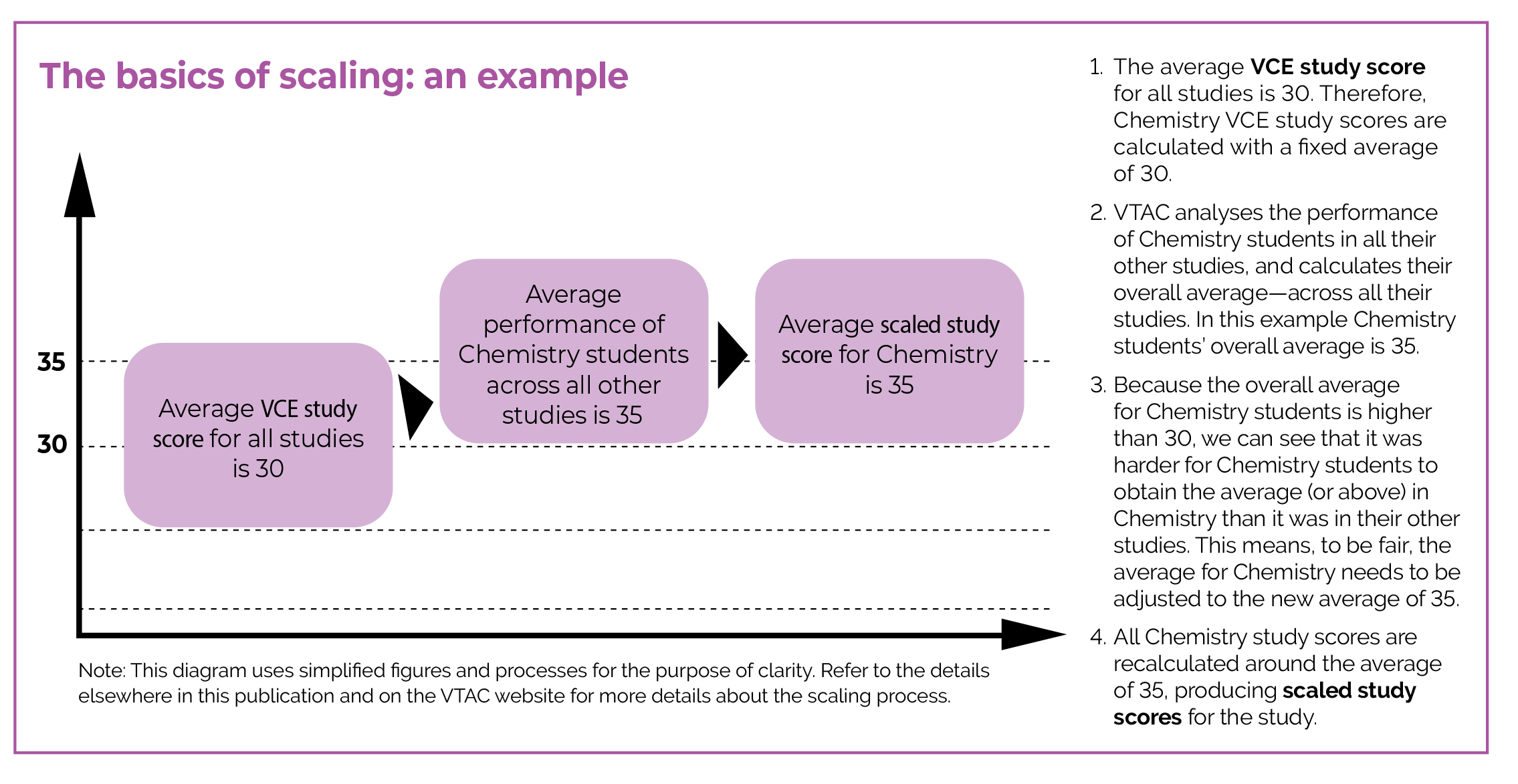
In the diagram, Chemistry students have:
- an average Chemistry study score of ;
- an average performance of across their other subjects;
- a resulting average scaled Chemistry score of .
Treat this as an illustration of the logic, not as a promise that every Chemistry student gains five points. Actual scaling varies by subject, year, and score level. In some subjects a particular raw score may rise, in others it may fall, and the pattern is not necessarily a simple fixed number of points.
What scaling does not mean
Avoid these shortcuts:
-
“A scaled-up subject is always the best subject for my ATAR.”
No. A strong result in a subject you understand and can sustain is generally more useful than a weak result in a subject chosen only for scaling. -
“Scaling says one subject is more valuable than another.”
No. Scaling aims to compare achievement across cohorts fairly. It is not a judgement about whether a subject is worthwhile, interesting, or important. -
“If I take Methods, scaling will automatically give me a high ATAR.”
No. Mathematical Methods has additional scaling rules because of the hierarchy of VCE mathematics studies, but the main driver remains your performance. Your current advanced maths results are encouraging, but your future Methods study score will still depend on strong VCE-level understanding and assessment performance. -
“A raw score of 35 always becomes the same scaled score.”
No. Scaling differs between subjects and can change from year to year.
For your subject choices, the practical conclusion is not “chase scaling.” You have already chosen a sensible set of subjects that includes areas with different purposes: English is required, Methods may support future prerequisites, Accounting is accelerated, and Psychology and Chemistry give you additional pathways. Your task is to become genuinely strong in them.
3. The aggregate: where scaled scores are actually used
Recall last lesson’s formula for your planned five scored subjects:
Imagine the following illustrative only set of final results:
| Subject | Raw study score | Hypothetical scaled score | Contribution to aggregate |
|---|---|---|---|
| English | 36 | 34.20 | 34.20 |
| Accounting | 38 | 36.80 | 36.80 |
| Psychology | 34 | 32.10 | 3.21 |
| Mathematical Methods | 37 | 41.00 | 41.00 |
| Chemistry | 35 | 38.40 | 38.40 |
English is included in full because it is compulsory in the primary four. Of the other subjects, Methods, Chemistry, and Accounting are the three highest scaled scores, so they are also included in full. Psychology is the 10% increment.
Notice what changed and what did not:
- The raw study score tells us about performance within the subject.
- The scaled score is the number VTAC uses to compare studies and form the aggregate.
- The aggregate contribution may be the full scaled score or just 10% of it.
- The ATAR is not yet shown. It is determined only after aggregates are ranked for that year’s cohort.
Do not convert this made-up aggregate into a fixed ATAR using an old table. Aggregate-to-ATAR conversions vary slightly between cohorts, so a table from a previous year is evidence of the kind of aggregate needed, not a guarantee for 2028.
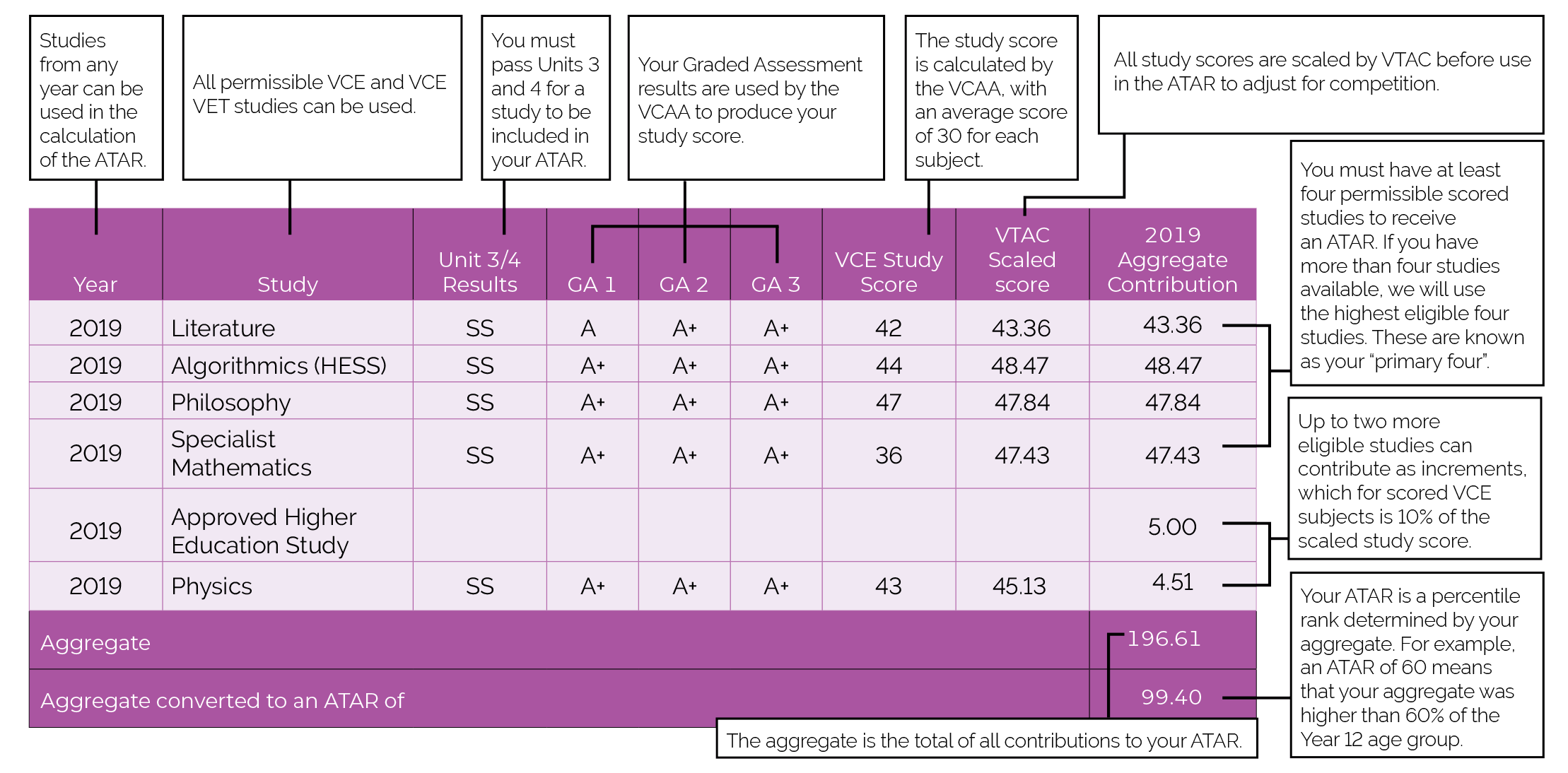
The final two subject-result columns are worth reading carefully:
- VTAC scaled score is the full comparable result.
- Aggregate contribution shows the amount that actually enters the aggregate.
A subject can have a high scaled score but a small aggregate contribution if it falls into the increment position. In the image, Physics has a scaled score of , but contributes:
displayed as .
4. The ATAR: a rank, not a mark
Once VTAC has calculated each eligible student’s aggregate, it places aggregates in order and converts them into ATARs.
An ATAR is a percentile rank. It indicates the percentage of the Year 12 age group whose results you performed above.
So:
- an ATAR of means you performed above of the age group;
- an ATAR of means you performed above of the age group;
- the highest possible ATAR is , not .
An ATAR is not:
- an average of your five subject percentages;
- an exam mark;
- the percentage of questions you answered correctly;
- a pass or fail result;
- a measure of your worth or intelligence.
For your goal, “90+” means an ATAR at or above . It does not mean “get 90% in every subject.” A student can achieve a 90+ ATAR with different combinations of raw and scaled study scores, depending on their subject mix and the relevant year’s aggregate-to-ATAR conversion.
A quick decoding method
When you encounter a result or prediction online, identify these four things before drawing a conclusion:
-
What number is being discussed?
A school percentage, raw study score, scaled study score, aggregate, or ATAR? -
Who produces it?
Your school, VCAA, or VTAC? -
Who is the comparison group?
Your class, the statewide subject cohort, all studies, or the Year 12 age group? -
What does it affect next?
Your next class task, scaling, aggregate, or university ranking?
For instance:
- “I got on my Accounting Unit 2 assessment” is a school result.
- “I received a study score of in Accounting” is a VCAA result relative to the Accounting cohort.
- “My Accounting scaled to ” is a VTAC comparable score.
- “My ATAR was ” is a rank after the aggregate has been converted.
That sequence is the vocabulary you will need when you start setting realistic targets.
Key takeaways
A raw study score—formally, a VCE study score—is a – result showing performance relative to students in the same subject. It is not the same as a school percentage.
A scaled study score is calculated by VTAC, usually on a – scale, so achievements across different subjects can be compared fairly. Scaling is based on subject-cohort performance across other studies, not on a simple label of “hard” or “easy.”
Your scaled study scores create an aggregate. For your five planned subjects, that will normally be English plus your best three other scaled scores at full value, plus 10% of the remaining score.
Finally, the ATAR is a percentile rank created by ordering students’ aggregates. A 90+ ATAR is not an average mark of 90%; it means performing above at least 90% of the relevant Year 12 age group.
Next, you will use this structure to construct realistic indicative study-score ranges for a 90+ ATAR goal—without pretending that any one score combination guarantees a particular ATAR in 2028.
Can't find a good explanation? Sign up and we'll make it for you
Sign up