
Hello, and welcome to the first lesson in your 90+ ATAR roadmap. This module starts by making the ATAR system concrete: before setting score targets or building a study plan, you need to know exactly how your five planned VCE subjects are weighted.
Your planned scored Unit 3–4 subjects are:
- English
- Accounting
- Psychology
- Mathematical Methods
- Chemistry
By the end of this lesson, you should be able to explain how each of these five results can enter an ATAR aggregate—and, crucially, why English has a special role.
From VCE subjects to an ATAR
An ATAR is not an average of your school percentages, and it is not a score created directly from your five subjects. It is a rank, produced through several stages:
- You complete Unit 3–4 studies and receive VCE study scores.
- VTAC converts those to scaled study scores.
- VTAC combines eligible scaled scores into an aggregate.
- The aggregate is converted into an ATAR percentile rank.
For now, focus on the aggregate. It is the number your subjects directly build.
To receive an ATAR, you must qualify for the VCE and have study scores in at least four permissible Unit 3–4 studies, including one subject from the English group. With five planned scored subjects, you would have five possible contributors, provided you complete the required sequences and receive study scores.
One important distinction for your current situation: your Year 10 Accounting Units 1–2 results do not go into the ATAR. They are preparation. If you complete Accounting Units 3–4 in Year 11, the resulting Accounting study score can contribute to the aggregate alongside the subjects you complete in Year 12.
Read VTAC’s Year 10 Guide for the official overview of eligibility, the primary four, increments, and scaling. It gives the framework behind the calculation we will apply to your five-subject plan.
In “ATAR rules and restrictions”, first read the eligibility requirements, beginning the requirements. Then, under “How is the ATAR calculated?”, read the four-step calculation, paying particular attention to the distinction between the primary four and increments. Finally, in “Scaling”, read the explanation of scaling. Do not try to predict your own scaling yet; just establish that the aggregate uses scaled, rather than raw, study scores.
The primary four: English is locked in
For a standard five-subject VCE program, the aggregate contains:
- 100% of an English-group scaled score
- 100% of the three highest permissible scaled scores from your other subjects
- 10% of the remaining subject’s scaled score
The first four full-value results are called the primary four. The last, partial contribution is an increment.
The rule that matters most for you is this:
English must be in the primary four, even if its scaled score is lower than all four of your other subjects.
So, your primary four are not necessarily the four numerically highest scores. English is compulsory, and then VTAC takes the best three of Accounting, Psychology, Methods, and Chemistry.
If we call your scaled English score , and sort the other four scaled scores from highest to lowest as , your five-subject aggregate is:
This is the whole structure of your planned five-subject ATAR aggregate.
What that means for each of your subjects
| Subject | Possible contribution to your aggregate |
|---|---|
| English | Always contributes at 100% as part of the primary four. |
| Accounting | Contributes at 100% if it is among your best three non-English scaled scores; otherwise at 10%. |
| Psychology | Contributes at 100% if it is among your best three non-English scaled scores; otherwise at 10%. |
| Mathematical Methods | Contributes at 100% if it is among your best three non-English scaled scores; otherwise at 10%. |
| Chemistry | Contributes at 100% if it is among your best three non-English scaled scores; otherwise at 10%. |
Because you plan only five scored subjects, exactly one non-English subject will normally become the 10% increment.
A worked five-subject example
Suppose these are your scaled study scores:
| Subject | Hypothetical scaled score | Aggregate contribution |
|---|---|---|
| English | 31.00 | 31.00 |
| Accounting | 39.00 | 39.00 |
| Psychology | 35.00 | 3.50 |
| Mathematical Methods | 42.00 | 42.00 |
| Chemistry | 38.00 | 38.00 |
English is included in full because it is compulsory in the primary four. Of the other four subjects, Methods, Accounting, and Chemistry are the three highest, so they are also included in full. Psychology is the lowest of the four non-English results, so it contributes 10%.
Notice two things.
First, Psychology still matters. Its result is not discarded; a scaled score of adds aggregate points. But it has less influence than the primary-four subjects.
Second, if English were your lowest result overall, it would still contribute in full. For instance, English at counts as , while the lowest non-English score becomes the 10% increment.
That is why improving English is particularly important in your plan. It is not simply “one of five subjects”: its full contribution is guaranteed, so it cannot be pushed down into the 10% position.
Reading a VTAC-style results table
The table below is a VTAC example showing raw study scores, scaled scores, and the final aggregate contributions.
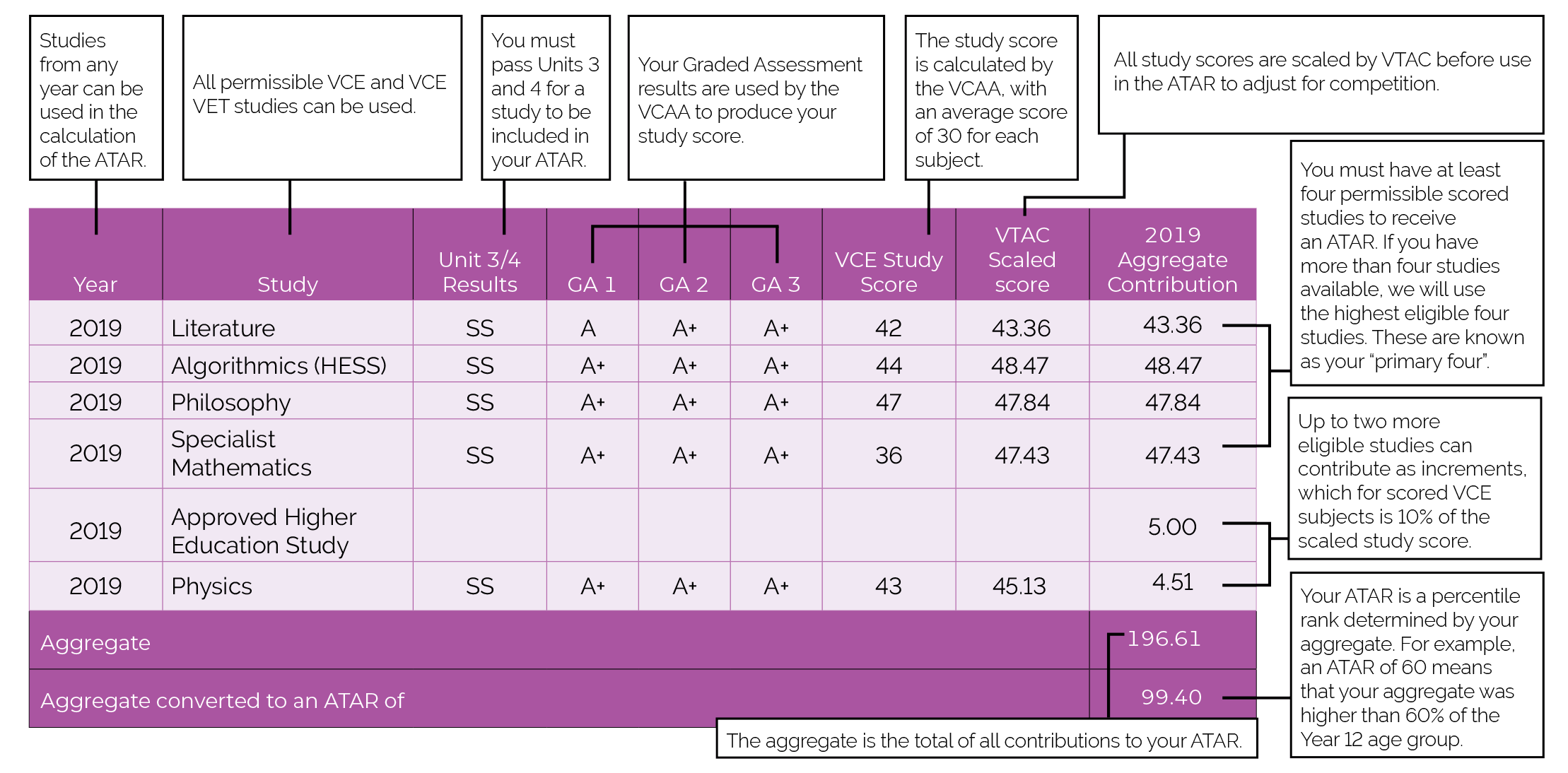
Look at the final two columns:
- VTAC Scaled Score is the score VTAC uses for the aggregate.
- Aggregate Contribution shows how much of that scaled score actually enters the aggregate.
For example, Physics has a scaled score of , but its aggregate contribution is . That is because it is being used as an increment:
which is displayed as .
The top four studies in that table contribute their full scaled score. The approved higher education study is a special type of increment, so do not use that row as a model for your own subjects. The Physics row is the useful comparison for your planned fifth subject.
Applying the structure to your plan
Your five subjects give you a sensible, broad VCE program:
- English supplies the required English-group result.
- Accounting may be completed early, creating a scored result before Year 12.
- Mathematical Methods supports many future course prerequisites and is currently one of your stronger areas.
- Psychology and Chemistry give you two science-based options, while allowing you to discover where your strongest performance develops.
However, the aggregate structure creates a practical priority order.
1. English needs sustained improvement
English will count at 100%, regardless of whether it is your highest or lowest study score. At the moment, English is the clearest academic risk because you have described difficulty across comprehension, evidence use, analysis, and writing. This course will therefore give English substantial attention—not because it is the only subject that matters, but because its contribution cannot be reduced to a 10% increment.
2. Aim for three strong non-English results
Of Accounting, Psychology, Methods, and Chemistry, your strongest three contribute fully. This means you do not need to decide now which one will be “the increment subject.” Your job is to build competence in all four, then allow your eventual scaled results to determine the order.
At present:
- Mathematics is an early strength, based on your advanced maths results of roughly 80–85%.
- Accounting is improving: the move from lower Unit 1 results to 76% in Unit 2 suggests that your understanding can improve substantially with better methods and feedback.
- Psychology and Chemistry are still uncertain because you have not yet built a results history in them.
3. Do not treat the fifth subject as unimportant
A fifth result at 10% is smaller, but it is not meaningless. More importantly, you cannot know in advance which non-English subject will become the increment. A poor result in one subject may become the 10% contribution—but only if the other three are stronger.
The useful mindset is:
- treat English plus your best three other subjects as the major aggregate drivers;
- build enough capability in the remaining subject that it can act as a reliable increment;
- keep all subjects viable until you have real assessment evidence.
4. Completing Accounting early does not reduce its value
If you complete Accounting Units 3–4 in Year 11, it does not automatically become an increment simply because you took it earlier. It is assessed alongside your other eligible results when your aggregate is formed. If Accounting is one of your strongest three non-English scaled results, it contributes in full.
That makes accelerated Accounting a potential advantage: it gives you earlier experience of VCE assessment and one completed scored subject before your Year 12 workload. But it still needs to be a strong result to make the largest possible contribution.
Four misunderstandings to avoid
-
“My ATAR is the average of five study scores.”
No. English and three other subjects count at full value; one subject counts at 10%. -
“English only counts if it is one of my top four subjects.”
No. An English-group study must be in the primary four. -
“My raw score goes straight into the ATAR.”
No. VTAC uses scaled study scores to form the aggregate. The next lesson will separate raw study scores, scaled scores, and the ATAR carefully. -
“The subject that contributes 10% does not matter.”
Not quite. It still contributes, and you cannot reliably know in advance which non-English result will be fifth.
Key takeaways
With your planned five subjects—English, Accounting, Psychology, Mathematical Methods, and Chemistry—your aggregate will normally be:
English is compulsory in the primary four, so its scaled score always contributes in full. Accounting, Psychology, Methods, and Chemistry compete for the other three full-value positions; the lowest of those four becomes the 10% increment. Completing Accounting early does not change this weighting.
Next, you will unpack the three terms that are easy to confuse: raw study score, scaled study score, and ATAR. That distinction is essential before building realistic score ranges for a 90+ goal.
Can't find a good explanation? Sign up and we'll make it for you
Sign up