
Hello again. You now have the key structure: an ATAR comes from a scaled aggregate, and for your planned five subjects that aggregate will normally be English plus the best three other scaled scores, with the remaining subject contributing 10%.
This lesson turns the 90+ goal into an indicative score plan. The point is not to predict your 2028 ATAR precisely—no one can do that yet—but to identify a combination of VCE study-score ranges that would give you a realistic target to work towards.
By the end, you should have a useful planning statement such as: “For a 90+ ATAR, I am aiming for approximately this range in English, Accounting, Methods, Chemistry, and Psychology, while recognising that the exact scaled results will change by year.”
Start with an aggregate target, not an ATAR guess
An ATAR of is a rank, so it cannot be built directly from subject percentages. Instead, work backwards:
VTAC publishes a scaling report each year. It includes both:
- the relationship between selected raw study scores and scaled scores for each subject; and
- the minimum scaled aggregate associated with each ATAR in that year.
Read the final page of VTAC's 2025 Scaling Report to see how an aggregate is related to an ATAR. This gives us a sensible current benchmark, while not pretending that the 2028 conversion will be identical.
On page 3, read the short explanation above the "2025 Scaled Aggregate to ATAR Table." Focus on how VTAC describes the table's purpose. Then locate the row for an ATAR of 90.00: its minimum scaled aggregate is 155.19. Also note the nearby 91.00 and 92.00 rows.
For the 2025 cohort, the minimum aggregate for an ATAR of was:
That is a reference point, not a promise. Scaling patterns and aggregate-to-ATAR conversion shift slightly each year. Since you will finish Year 12 in 2028, it would be risky to plan for exactly and assume it guarantees a 90.00.
A better planning principle is:
Treat an aggregate of roughly – as a practical buffer zone for a 90+ goal, then update the estimate using the current VTAC data in your final year.
This buffer matters especially because you are planning only five scored subjects. You will not have a sixth subject that can provide another 10% increment if one subject is weaker than expected.
Use current scaling data carefully
Before building a combination, inspect the pattern of scaling in your five planned subjects. The following report uses 2025 data and shows rounded scaled scores for raw study scores of 20, 25, 30, 35, 40, 45, and 50.
Use VTAC's subject tables to compare the 2025 scaling patterns for your five intended subjects: English, Accounting, Mathematical Methods, Chemistry, and Psychology. The values are rounded and will not be the same in every year, but they are useful for constructing an evidence-based planning range.
First read the explanation at the top of page 1, especially what the listed figures represent. Then find the Accounting and English rows on page 1: review the Accounting and English values. On page 2, locate Mathematical Methods, Chemistry, and Psychology; compare their listed scaling values. Read across each row: the columns correspond to raw scores of 20, 25, 30, 35, 40, 45, and 50.
Here are the most useful 2025 anchor points for your subjects:
| Subject | Raw score of | Raw score of | What this suggests for planning |
|---|---|---|---|
| English | scaled | scaled | English often scales down somewhat, but it is compulsory at full value. |
| Accounting | scaled | scaled | A strong Accounting result can be a valuable full contribution. |
| Mathematical Methods | scaled | scaled | Methods may scale up, but the study score still needs to be earned. |
| Chemistry | scaled | scaled | Chemistry can also provide a strong full contribution. |
| Psychology | scaled | scaled | Psychology may be the 10% increment in some combinations, but this can change. |
Two cautions are essential:
- These figures are rounded 2025 examples, not exact predictions for your cohort.
- You should not treat scaling as a reason to neglect a subject. A raw in Methods may scale well, but a raw in English is often more valuable than a lower English result because English must be in your primary four.
A balanced 90+ planning combination
Let’s construct one sensible working profile for your current five-subject plan:
- English
- Accounting
- Mathematical Methods
- Chemistry
- Psychology
Suppose your eventual raw study scores were approximately:
| Subject | Indicative raw study-score target | Approximate 2025 scaled result |
|---|---|---|
| English | ||
| Accounting | ||
| Mathematical Methods | ||
| Chemistry | ||
| Psychology |
English is compulsory in the primary four. Of the other four subjects, Accounting, Methods, and Chemistry have the three strongest scaled scores, so they contribute fully. Psychology becomes the 10% increment.
Using the 2025 aggregate table as a guide, sits above the benchmark for an ATAR of .
This is therefore a useful first conclusion:
A broadly balanced profile around English , Accounting , Methods , Chemistry , and Psychology is consistent with a 90+ ATAR goal under recent scaling patterns.
It is not the only route. It is simply a clear, evidence-based target combination.
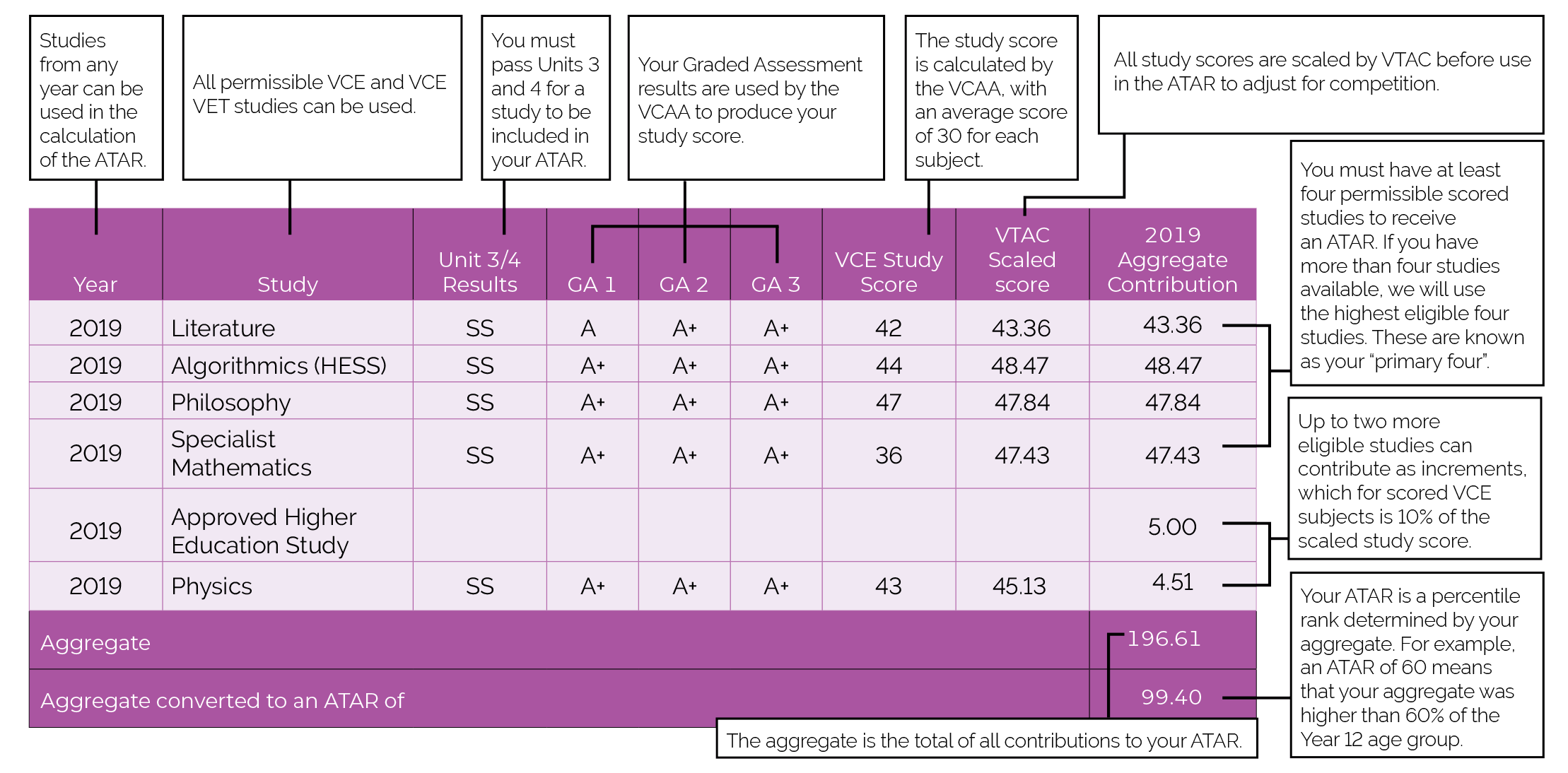
Notice something important in the image: the subject with the 10% contribution is not “irrelevant.” It still adds to the aggregate, but its impact is smaller. A Psychology scaled score of , for example, contributes:
That is useful, but a one-point improvement in a full-contribution subject adds about one full aggregate point, whereas a one-point improvement in the increment subject adds only about .
Why English is the central risk to manage
The balanced profile above does not require every subject to have the same raw score. In fact, your subjects serve different roles in the aggregate.
| Subject | Indicative planning band | Why it matters |
|---|---|---|
| English | – | Compulsory full contribution; improvement here has a direct aggregate effect. |
| Accounting | – | A potential strength, particularly if your current Unit 2 improvement becomes consistent. |
| Mathematical Methods | – | Likely to be a strong contributor if you maintain your current mathematics foundation. |
| Chemistry | – | A potentially strong contributor, but you will need Year 11 evidence before trusting this target fully. |
| Psychology | – | A useful fifth-subject contribution, with potential to move into the primary four if it becomes stronger than another subject. |
These ranges are working targets, not predictions. They are deliberately ambitious because an ATAR of 90+ is ambitious.
Your present mathematics results of around – provide reasonable evidence that a strong Methods target is worth pursuing. Your Accounting result improving to in Unit 2 is also more encouraging than the earlier Unit 1 scores, though it needs to become consistent before treating a raw as likely.
English requires the most deliberate long-term attention. Your current average of roughly – cannot be converted into a VCE study score, but it does signal that English needs rebuilding rather than passive maintenance. Because English is compulsory at full value, it cannot simply be “covered” by good scaling in Methods or Chemistry.
To see why, return to the balanced model. If English fell from raw to raw , the 2025 report suggests its scaled score could fall from about to . The aggregate would become approximately:
That is below the 2025 benchmark.
By contrast, if Psychology moved from raw to raw , its scaled score might move from to , changing the increment by only:
This does not mean Psychology can be ignored. It means the priority order is clear:
- Build English to a reliable full-contribution level.
- Develop Methods, Accounting, and Chemistry into strong primary-four candidates.
- Keep Psychology strong enough to provide a useful increment and possible backup primary-four result.
The same goal can be reached by different combinations
A 90+ ATAR does not demand one identical score profile. For example, consider this more English-heavy combination, again using 2025 rounded scaling figures:
| Subject | Raw score | Approximate scaled score |
|---|---|---|
| English | ||
| Accounting | ||
| Mathematical Methods | ||
| Chemistry | ||
| Psychology |
The primary four would be English, Methods, Chemistry, and Accounting:
This also reaches the approximate buffer zone.
The lesson is not that you should choose one subject to be weak. Rather:
Stronger performance in one full-contribution subject can partly offset a weaker performance in another, but English must always be included and no scaling outcome is guaranteed.
For you, the balanced profile is more useful than relying on a huge English or Methods score. It gives you several pathways to the goal: solid English growth, strong mathematical performance, continued Accounting improvement, and genuine development in Chemistry and Psychology.
Turn the profile into a practical target card
Write the following as your current 90+ ATAR planning profile:
Indicative 90+ profile: English –, Accounting –, Mathematical Methods –, Chemistry –, Psychology –.
Aggregate aim: approximately , using recent VTAC scaling only as a guide.
Keep two things beside this statement:
- A minimum benchmark: around , based on the 2025 threshold.
- A safer planning zone: around –, acknowledging yearly variation and the lack of a sixth scored subject.
You can also test combinations using Monash’s calculator. It uses recent VTAC data, so it is useful for experimenting with trade-offs, not forecasting your 2028 result.
Use Monash University's calculator to test the balanced profile against a second, altered profile. The exercise will make the primary-four and 10% increment rules more concrete.
At the "ATAR Calculator," follow the input-order instruction. Enter English first, then your expected three full-contribution subjects, and add Psychology as the fifth subject. Test the balanced profile from this lesson, then alter only one score—for example, reduce English or increase Methods—and record how the estimated ATAR changes. Treat every output as an estimate based on past data, not as a 2028 prediction.
Key takeaways
For the 2025 cohort, an ATAR of required a scaled aggregate of at least . Because you will complete Year 12 in 2028, a more sensible planning target is an aggregate around –, rather than aiming exactly at a historical cutoff.
A balanced score combination consistent with that goal is approximately:
under recent scaling patterns. This is not a guarantee, and it is not the only possible route, but it provides a concrete destination for your study planning.
Most importantly, English is your compulsory full-contribution subject. Improving it is therefore one of the highest-leverage parts of your 90+ plan, alongside sustaining your mathematics strength and making Accounting improvement consistent.
Next, you will assess your current English, mathematics, Accounting, and science evidence more directly to identify which targets are presently supported, which are risks, and where your effort should go first.
Can't find a good explanation? Sign up and we'll make it for you
Sign up