
Hello. You now have an honest GRE baseline and a short record of how the session felt. The score alone is not yet a study plan. The useful next step is to identify why each important question went wrong.
This lesson gives you a five-part classification system: knowledge, interpretation, strategy, pacing, and carelessness. By the end, you should be able to review your diagnostic without defaulting to vague conclusions such as “I need to get better at Quant” or “I made silly mistakes.” That distinction matters: a vocabulary gap, an inefficient method, and a rushed final five minutes require different responses.
Plan for roughly 40–55 minutes, depending on how many missed or uncertain questions you review.
Treat the diagnostic as evidence, not a verdict
When reviewing a missed GRE question, it is tempting to jump straight to the official answer and conclude, “Oh, I see it now.” That feeling can be misleading. Once the correct logic is visible, a difficult question often appears obvious—but that does not reveal what prevented you from seeing it under timed conditions.
First, use a short self-audit:
- Re-read the question and your scratch work before consulting an explanation.
- Spend about 30–60 seconds reconstructing what you thought at the time.
- Identify the exact decision that led to your answer.
- Then compare your reasoning with the correct solution.
The Tested Tutor’s video models this discipline, including a Sentence Equivalence example in which a seemingly plausible word fails because it does not create the sentence’s required contrast.
GRE 340 Score: How to Deal with Mistakes on the GRE [with examples!]
Watch “GRE 340 Score: How to Deal with Mistakes on the GRE” by The Tested Tutor. It shows why the important question is not merely why the correct answer works, but why your chosen answer seemed convincing at the time.
Begin with the contrast example, focusing on how a plausible vocabulary choice can still fail the sentence’s logic. Then watch the self audit for the recommendation to investigate your own reasoning briefly before reading a solution. Finish with the error entry, noting how the example separates an unfamiliar word from an error in applying the Sentence Equivalence rule.
A useful standard is this:
An explanation tells you how the test writers solved the problem. Your review must identify why you did not solve it that way at the time.
That “why” is your error category.
The five error categories
Many prep sources use broad labels such as content, technique, timing, and careless errors. For your diagnostic, we will separate interpretation from carelessness because it is especially useful for GRE Verbal and data-based Quant questions.
How to Learn from Your Errors - GRE
Read Manhattan Prep’s “How to Learn from Your Errors” for a clear distinction between content, technique, and careless errors, followed by a practical process for recording the reason behind an error.
In “How To Learn From Your Errors,” read the definitions under “Careless Errors,” “Content Errors,” and “Technique Errors.” Follow the category discussion, especially the distinction between not knowing material and using an unsuitable method. Then go to “The Error Log” and read steps 1–3, from the recording process. For now, focus on identifying the reason; the next lesson will turn that information into a full error log.
Use the following definitions consistently.
| Category | What it means | Typical diagnostic evidence | First response |
|---|---|---|---|
| Knowledge | You lacked a fact, rule, formula, word meaning, or grammatical principle needed to solve the question. | You cannot solve the question accurately even untimed, without looking anything up. | Learn and later retrieve the missing knowledge. |
| Interpretation | You misunderstood what the prompt, passage, graph, condition, or answer choices were saying. | You knew the relevant material but built the wrong meaning or logical relationship from the words or data. | Slow down at the meaning-making stage; state the task or claim precisely. |
| Strategy | You understood the question and had the necessary knowledge, but chose an ineffective or incomplete method. | A different approach would have been clearer, more reliable, or substantially faster. | Learn a better decision rule or method for that question type. |
| Pacing | Your allocation of time across the section prevented you from doing your best work. | You spent too long on one item, ran out of time, or rushed a set of later questions. | Use a time limit, make a deliberate guess/skip decision, and protect time for later questions. |
| Carelessness | You had the knowledge, understood the task, and selected a reasonable approach, but made a momentary execution slip. | Sign error, transcription mistake, choosing the wrong option on screen, overlooking “NOT,” or answering for when asked for . | Add a specific checking habit targeted at that exact slip. |
The labels are not judgments about ability. They are explanations of a process failure. A knowledge error says, “This material is not yet secure.” A pacing error says, “My decision about time harmed later performance.” Both are trainable.
Make the distinctions that matter
Knowledge versus interpretation
A knowledge error concerns something you did not know well enough.
- You did not know what languishing means.
- You forgot the formula for the area of a circle.
- You did not recognize a ratio relationship.
- You did not know that a particular grammatical construction requires a certain form.
An interpretation error occurs when the needed information was available to you, but you used it incorrectly.
- In Reading Comprehension, you choose an answer that the passage mentions, rather than one the author actually supports.
- In a Text Completion question, you miss a contrast word such as “although” or “despite.”
- In a data question, you read a chart’s percentage as a raw number.
- In Quant, you overlook that a variable is restricted to integers or positive values.
Ask:
“If I had correctly understood every word, condition, and relationship in the prompt, would I still have missed this?”
If the answer is no, classify it as interpretation.
Be cautious about calling every misread word “careless.” If you repeatedly confuse an author’s view with a view described in the passage, that is not an isolated slip. It is a repeatable interpretation pattern that deserves a process fix.
Strategy versus pacing
These categories can overlap, but they point to different causes.
A strategy error is about how you attacked a particular question. For example, on a Quantitative Comparison question, you might use lengthy algebra when testing a few strategic values would expose the answer more safely. Or, in Sentence Equivalence, you might choose two words that each seem acceptable individually but fail to check whether they are genuine synonyms.
A pacing error is about when to persist and when to move on. Suppose you spend three minutes forcing a difficult Quant problem, then guess on two manageable questions at the end of the section. Even if you eventually solved the difficult item, your time allocation was costly.
Use this diagnostic rule:
- “A faster or more reliable method was available for this question” → strategy.
- “I should have stopped, guessed, marked, and protected the rest of the section” → pacing.
A question can have both. Record one primary category—the first cause you would fix—and, if useful, one contributing category.
For example:
Primary: strategy. Contributing: pacing. I expanded every expression algebraically instead of testing values; this took too long and caused end-of-section rushing.
That is far more useful than “slow at algebra.”
Carelessness is not a useful label until it is specific
“Careless” is often used as a catch-all for an error that feels embarrassing. Do not let it become an excuse that hides the actual cause.
A true careless error has three features:
- You knew the relevant content.
- You understood what the question asked.
- You used an appropriate method but made an identifiable slip.
Examples:
- You correctly found , but entered 41.
- You calculated as 5 rather than .
- You selected answer B after your notes clearly supported answer D.
- You answered a “Which of the following is NOT supported?” question as though it asked what was supported.
The correction must be concrete. “Read more carefully” is too vague to use under timed pressure. Better corrections include:
- “Circle the requested quantity before calculating.”
- “Write negative signs on scratch paper rather than calculating them mentally.”
- “Re-read the final question stem before selecting an answer.”
- “Circle the answer letter on scratch paper, then select the same letter on screen.”
Review your diagnostic with a repeatable protocol
Review all incorrect, marked, and guessed-correctly questions. A lucky answer is not a success you can safely count on; it may reveal a knowledge, interpretation, or strategy vulnerability.
For each question, make a brief provisional note using this format:
Question type:
Result: incorrect / guessed correctly / correct but very slow
Primary category:
Contributing category, if any:
Evidence: I chose ___ because ___.
Corrective insight: Next time, I will ___.
The key field is Evidence. It forces you to name what happened rather than retrospectively claiming that you “almost knew it.”
Here are three examples.
| Review note | Classification | Why |
|---|---|---|
| “I did not know the meaning of mitigate, so I eliminated the correct option.” | Knowledge | The missing word meaning prevented a sound decision. |
| “I chose an answer stated in the passage, but the question asked for the author’s position and the author introduced that view only to reject it.” | Interpretation | The passage was not merely misread; the source of the claim was confused. |
| “I solved the equation correctly but spent nearly three minutes expanding it. Plugging in answer choices would have been much shorter; I then rushed the last two questions.” | Strategy, with pacing contributor | The local method was inefficient, and the time cost harmed the section. |
If you did not track time per question during the diagnostic, do not invent precise timing after the fact. Use only evidence you genuinely have:
- you ran out of time;
- you guessed repeatedly near the end;
- you remember being stuck on a particular question;
- you completed the section comfortably;
- your scratch paper shows unusually long work for a straightforward item.
That is sufficient for an initial pacing classification.
Look for patterns, not isolated disappointments
Once you have classified your questions, count the categories. The point is not to create a perfect statistical report from one test; it is to identify the most plausible starting priorities.
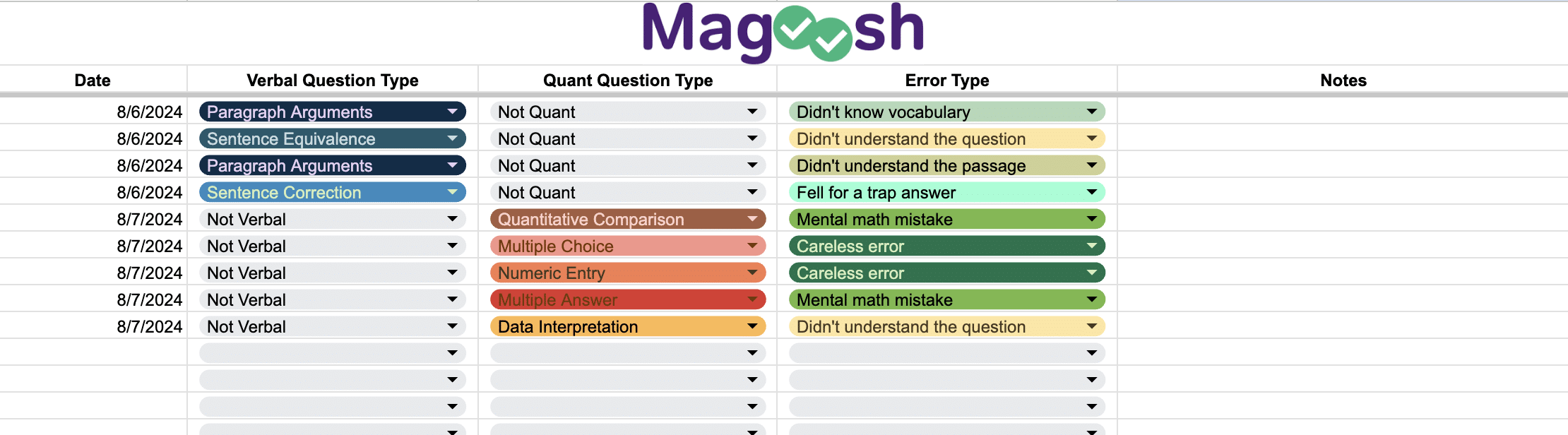
For example, these patterns would lead to very different study priorities:
- Several Quant knowledge errors in fractions, percentages, or algebra: begin with quantitative foundations.
- Repeated Reading Comprehension interpretation errors: practise distinguishing passage evidence, author stance, and answer scope.
- Correct but slow Quant questions: work on strategy and eventually timed decision-making.
- Many final-question guesses: pacing is likely affecting the score more than any single content topic.
- Repeated sign or “EXCEPT” errors: build a targeted checking routine.
For an MBA application, it is particularly useful to separate a lower Quant result caused by missing fundamentals from one caused mainly by time pressure. The first calls for systematic content rebuilding; the second may improve more quickly once your methods and pacing decisions become disciplined.
Do not overreact to one question. A single geometry miss could be an anomaly; four misses involving the same underlying rule are evidence.
A productive stopping point for today
Your classification work is complete when you can say all of the following:
- I reviewed every incorrect, marked, and guessed-correct question from my diagnostic.
- I assigned each one a primary category: knowledge, interpretation, strategy, pacing, or carelessness.
- For each entry, I wrote one sentence explaining why I chose that category.
- I identified two or three recurring patterns worth tracking.
- I distinguished a true careless slip from an interpretation or strategy problem.
The central takeaway is that an error becomes valuable only when it produces a precise explanation. “I got it wrong” is an outcome. “I treated a mentioned claim as the author’s view” is a diagnosis—and therefore something you can improve.
Next, you will convert these classifications into a practical error log that records the question source, cause, and a specific correction for each mistake. That log will become the bridge between your diagnostic and a focused six-hour weekly GRE routine.
Can't find a good explanation? Sign up and we'll make it for you
Sign up