
Welcome back. In the previous lesson, you turned your GRE diagnostic into evidence by classifying errors as knowledge, interpretation, strategy, pacing, or carelessness. Now you will make that analysis usable: an error log turns each missed question into a record of what happened, what the correct reasoning was, and what you will do differently next time.
For an MBA applicant balancing GRE preparation with school research in about six hours a week, the log must be brief enough to maintain and specific enough to guide study decisions. Its purpose is not to catalogue mistakes. It is to prevent you from spending scarce study time on vague goals such as “improve Quant” when the real need may be “rebuild percentage foundations” or “stop doing multi-step arithmetic mentally.”
An error log is a feedback system
A score tells you how many questions went wrong. An error log tells you why—and, crucially, what to change.
Magoosh’s template offers a simple spreadsheet starting point, while its guidance identifies the information that makes an error log useful rather than merely decorative.
GRE Error Log Template: How to Track and Improve Your Mistakes - Magoosh Blog — GRE® Test
Read Magoosh’s overview and template guidance before setting up your own tracker. Its core idea is that a log should expose patterns in question type and mistake type, so you can choose the next study task deliberately.
In the “Magoosh’s Free GRE Error Log Template” section, open the linked spreadsheet only if you would prefer to start from a ready-made sheet. Then read the “Why you need a GRE error log” section, beginning with the purpose of the log. Continue to “Creating your own detailed error log” and read the suggested fields. Focus especially on the distinction between the error type, the reason it happened, and the correct approach.
The spreadsheet below is a helpful visual model: each row captures a date, question type, error label, and notes. Your version will add a more explicit correction plan, because a label such as “careless error” is not yet a method for avoiding the next careless error.
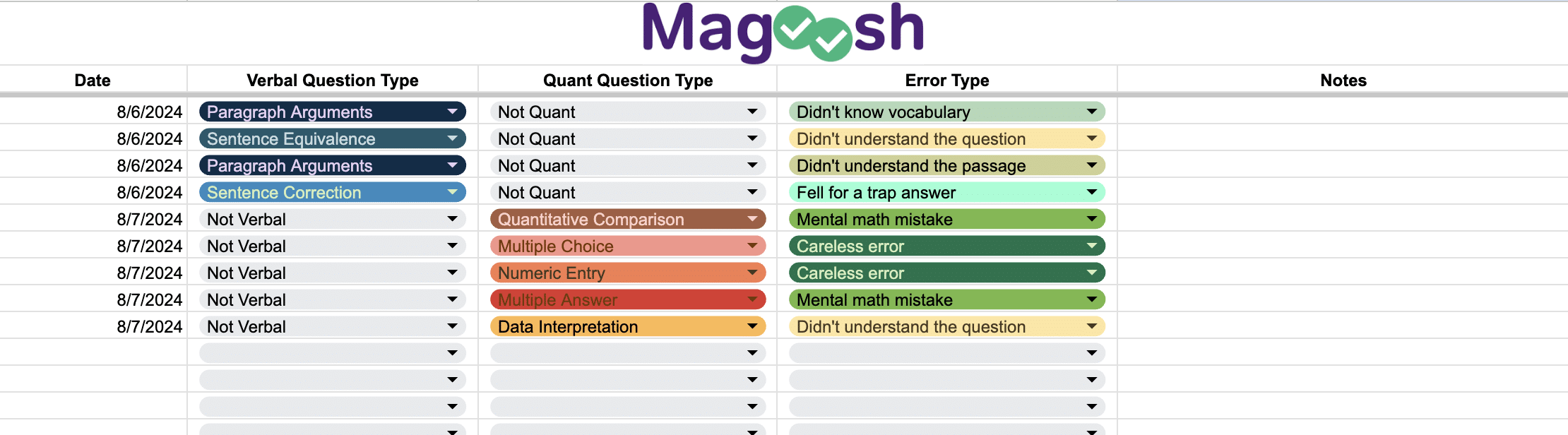
Think of the log as a small project tracker. A project issue is not resolved when it is merely named; it needs a documented cause, a corrective action, and a way to verify that the action worked. Your GRE log should do the same.
Separate the cause from the correction
Every missed question needs two distinct diagnoses.
- Cause: Why did I choose the wrong answer under those conditions?
- Correction: What knowledge, decision rule, or habit will make this less likely on a similar future question?
These are not interchangeable.
| Weak entry | Why it fails | Stronger entry |
|---|---|---|
| “Bad at Reading Comprehension.” | Too broad to guide practice. | “Interpretation: I treated a view described in the passage as the author’s own position.” |
| “Careless.” | Does not identify the actual slip or prevention method. | “Carelessness: I calculated with a negative sign mentally and reversed it. I will write signed intermediate steps whenever negatives appear.” |
| “Need to learn percentages.” | Does not specify the missing relationship. | “Knowledge: I did not know that a decrease followed by a increase does not return to the original value. I will review percent-change multipliers and complete a short untimed set.” |
| “Too slow.” | Does not say where time was lost or what to do. | “Pacing: I kept working after my planned time limit on a difficult data question, then guessed on two later questions. I will make a deliberate best-guess-and-move decision at my time checkpoint.” |
A useful correction has three qualities:
- Observable: You can tell whether you did it. “Write the requested variable on scratch paper” is observable; “pay more attention” is not.
- Triggered: It names when to use the habit. For example, “When a question says EXCEPT or NOT, circle that word before reading the choices.”
- Generalizable: It applies to similar questions, not only the question you missed.
Use this structure:
When I see [trigger], I will [specific action], because [reason].
For example:
When I see a Sentence Equivalence question, I will verify that my two selected words are true synonyms in the completed sentence, because two individually plausible words are not necessarily an acceptable pair.
Use a lean but complete spreadsheet structure
Create one spreadsheet with a tab called GRE Error Log. One row represents one question. Do not copy the entire question or a lengthy solution; the source and location should be enough for you to return to it.
Use these columns:
| Column | What to record | Why it matters |
|---|---|---|
| Date reviewed | The date you analysed the question. | Lets you see whether a pattern is improving over time. |
| Source and location | For example: “Diagnostic, Verbal Section 1, Q7.” | Makes the question easy to revisit. |
| Section and question type | Quant: Quantitative Comparison, Problem Solving, Data Interpretation; or Verbal: Text Completion, Sentence Equivalence, Reading Comprehension. | Reveals whether a weakness belongs to a topic or a format. |
| Result | Incorrect, guessed correctly, or correct but very slow. | A lucky correct answer can still reveal a gap. |
| Primary cause | Knowledge, interpretation, strategy, pacing, or carelessness. | Enables pattern counting later. |
| Evidence: what I did | One sentence beginning, “I chose…” or “I spent time…” | Prevents vague hindsight. |
| Correct approach or learning | The rule, interpretation, or method that should have led to the answer. | Captures the transferable lesson. |
| Correction plan | A concrete action you will use or practise. | Converts learning into a habit. |
| Follow-up status | “Redo correctly,” “review vocabulary,” “practise,” or “recheck next week.” | Keeps entries active until the issue is addressed. |
If you use a spreadsheet, make Primary cause a drop-down list with the five categories from the previous lesson. This preserves consistent labels when you review the data later.
You may add a contributing cause column if it helps, but do not make your tracker so complicated that you stop using it. For now, one primary cause and a precise explanation are sufficient.
What strong entries look like
The most important columns are Evidence, Correct approach, and Correction plan. They make the row useful when you encounter the same trap several weeks from now.
Here are representative entries.
| Source and type | Primary cause | Evidence: what I did | Correct approach or learning | Correction plan |
|---|---|---|---|---|
| Diagnostic, Verbal, Sentence Equivalence | Knowledge | “I did not know languishing, so I chose two positive-sounding words.” | “Languishing and flagging both mean struggling or failing to thrive.” | “Add both words to my vocabulary review. For every Sentence Equivalence question, check that my two choices are close synonyms in the completed sentence.” |
| Diagnostic, Verbal, Reading Comprehension | Interpretation | “I selected a claim mentioned in the passage, but it was a view the author later qualified.” | “A passage can describe a position without endorsing it; I must identify whose view each claim represents.” | “Before answering author-position questions, write a two- or three-word label for the author’s stance: supports, questions, or rejects.” |
| Diagnostic, Quant, Quantitative Comparison | Strategy | “I expanded several expressions algebraically even though the variables were unrestricted.” | “Testing carefully chosen legal values could reveal the relationship more quickly.” | “When variables are unrestricted in Quantitative Comparison, consider testing values before committing to lengthy algebra.” |
| Diagnostic, Quant, Data Interpretation | Pacing | “I spent too long on the first chart and guessed on the final question without reading it fully.” | “The first question was not worth sacrificing later, more manageable questions.” | “At my planned time checkpoint, make the best available choice, mark the question if the platform allows, and move on.” |
| Diagnostic, Quant, Problem Solving | Carelessness | “My setup was correct, but I changed a subtraction with a negative number into addition.” | “The error occurred during mental arithmetic, not in the mathematical method.” | “Write the signed intermediate calculation on scratch paper and take a final sign check before selecting an answer.” |
Notice that a correction is not simply “review the explanation.” The correct explanation tells you what was true for that one question. The correction plan tells you what you will do on the next comparable question.
Build the log from your diagnostic
Because you already classified your diagnostic errors, this should be a transfer task rather than a second full review. Work through the questions in the order below.
1. Start with every incorrect question
For each question you missed:
- enter the source, location, section, and question type;
- choose one primary cause;
- write what you did before you saw the explanation;
- summarize the correct approach in your own words;
- state a correction plan.
Keep the evidence concise. One or two sentences is usually enough.
For example:
Evidence: I calculated the percent increase correctly but answered with the new value when the question asked for the amount of increase.

Correct approach: Separate the requested change from the final total.

Correction plan: Before calculating, box the requested quantity on scratch paper: change, final value, ratio, or percent.
2. Also log guessed-correct and slow-correct questions
A question answered correctly by guessing is not reliable evidence of mastery. A question solved correctly in an unsustainable amount of time can also be an important error, particularly in Quant.
Label the result honestly:
- Incorrect
- Guessed correctly
- Correct but very slow
This will help you avoid a misleading conclusion such as, “I got eight out of ten correct, so this topic is secure.” If four of those answers were guesses or took too long, the topic still needs work.
3. Record the first fixable cause
Some errors have a chain of causes. For example:
“I did not know the formula, tried to invent it, spent too long, and rushed the final calculation.”
The primary cause is usually knowledge, because strengthening that foundation prevents the inefficient approach and its timing consequences. You can write “pacing contributor” in the evidence field, but do not create three separate corrections when one foundational correction comes first.
Conversely, if you knew the formula but used an unnecessarily lengthy approach, the primary cause is strategy, even if the question eventually led to a pacing problem.
4. Redo before closing the entry
Once you understand the solution, cover it and redo the question from the beginning. Then update the follow-up status:
- Redo correctly: You solved it independently and can state the takeaway.
- Review needed: You understand the explanation but could not reproduce the method.
- Target practice needed: You can redo the original but need several similar questions to prove the habit transfers.
A question is not truly “reviewed” merely because its explanation now looks obvious.
Watch how an error entry becomes a reusable lesson
The following short segment gives a particularly clear standard: write down why your original choice was wrong, not just why the official answer was right. Although the video discusses GMAT preparation, the logging process applies directly to GRE practice.
How Do You Use a GMAT Error Log?
Watch GMAT Club’s “How Do You Use a GMAT Error Log?” for a compact explanation of turning an error into an actionable future rule. The speaker explicitly teaches GRE as well as GMAT and illustrates why a completed log should lead to targeted practice.
First watch the three questions that every entry should answer: the error type, the true lesson, and how that lesson generalizes. Continue with causes and fixes, paying close attention to the difference between an inefficient approach and a careless pattern. Finish with the practice loop, which explains why the log should determine later drills rather than become a record you never use.
The central standard is demanding but practical:
A completed row should tell future-you exactly what to notice and what to do.
If you reread an entry in a month and cannot tell how it changes your next decision, revise it.
A sustainable routine for six weekly hours
Your log should support preparation, not consume it. Use two levels of review.
Quick entry: about two minutes
Use this for a normal practice miss:
- Record the question location and type.
- Write the primary cause.
- State what you did.
- Write one correction plan.
- Schedule the follow-up status.
Deep entry: five to eight minutes
Use this when the question exposes a recurring weakness, a major Quant foundation gap, or an important Verbal reasoning trap. In addition to the quick entry:
- redo the problem without help;
- write the underlying rule or reasoning pattern;
- identify a small set of similar questions to practise later;
- add a review date.
Do not wait until the end of the week to create entries. Logging immediately after review preserves the evidence of what you actually thought. A short weekly scan is still useful: filter by primary cause, question type, or follow-up status and look for repeated patterns.
For now, reserve a small part of your GRE time for upkeep:
- After each practice session: log incorrect, guessed-correct, and slow-correct questions.
- Once a week: scan the new rows and highlight the two most recurring issues.
- Before choosing the next practice set: use those highlighted issues, rather than intuition alone, to decide what to study.
Build it now
Set up your spreadsheet and enter your diagnostic questions using the fields above. Aim to complete every incorrect question from the diagnostic, then add guessed-correct and very-slow questions where you can identify a genuine vulnerability.
Before considering the log finished, check that every missed question has:
- a retrievable source and question location;
- one primary cause from the five-category system;
- evidence of what you did or believed at the time;
- the correct rule, interpretation, or approach in your own words;
- a specific correction plan;
- a follow-up status.
Key takeaways
An effective GRE error log does more than label a mistake. Each row should preserve the cause, the correct reasoning, and the specific habit or study action that will prevent repetition.
Keep the distinction clear:
- Cause explains why the question went wrong.
- Learning explains the correct principle or method.
- Correction plan specifies what you will do differently in a future question.
Use concise, evidence-based entries and include guessed-correct or very-slow questions when they reveal an unreliable skill. Over time, the log will show whether your highest-impact issues are foundational knowledge, interpretation, strategy, pacing, or repeated execution slips.
Next, you will select a focused GRE resource set: official ETS material as the core, plus one supplementary source that fits the gaps your new error log has begun to reveal.
Can't find a good explanation? Sign up and we'll make it for you
Sign up