
Introduction
Welcome to your next lesson on the Muisca people. In our previous session, we mapped out the Muisca's physical and social world, identifying their home on the Altiplano Cundiboyacense and the structure of their confederation, led by the paramount rulers, the Zipa and the Zaque.
Today, we will build directly on that foundation to address a central aspect of Muisca society: the deep and inseparable connection between political power and religious authority. Your learning outcome for this lesson is to explain the relationship between Muisca political leaders (Zipa, Zaque) and religious authority.
For your goal of illustrating historical myths, understanding this relationship is essential. The power of a Muisca ruler wasn't just about armies and tribute; it was rooted in the sacred. Their actions were ceremonial, their legitimacy was divine, and their story is one of priest-kings who walked the line between the human and supernatural worlds. This lesson will give you the context to depict these leaders not just as kings, but as key figures in a cosmic drama.
The Priest-King: A Fusion of Power
In many modern societies, we think of political and religious leadership as separate spheres. For the Muisca, this distinction did not exist. The highest rulers, the Zipa and Zaque, were simultaneously the ultimate political and religious figures in their respective confederations. They were considered "priest-kings" who mediated between their people and the divine realm.
This fusion of authority is clearly represented in the Muisca social structure. Take a look at the following social pyramid.
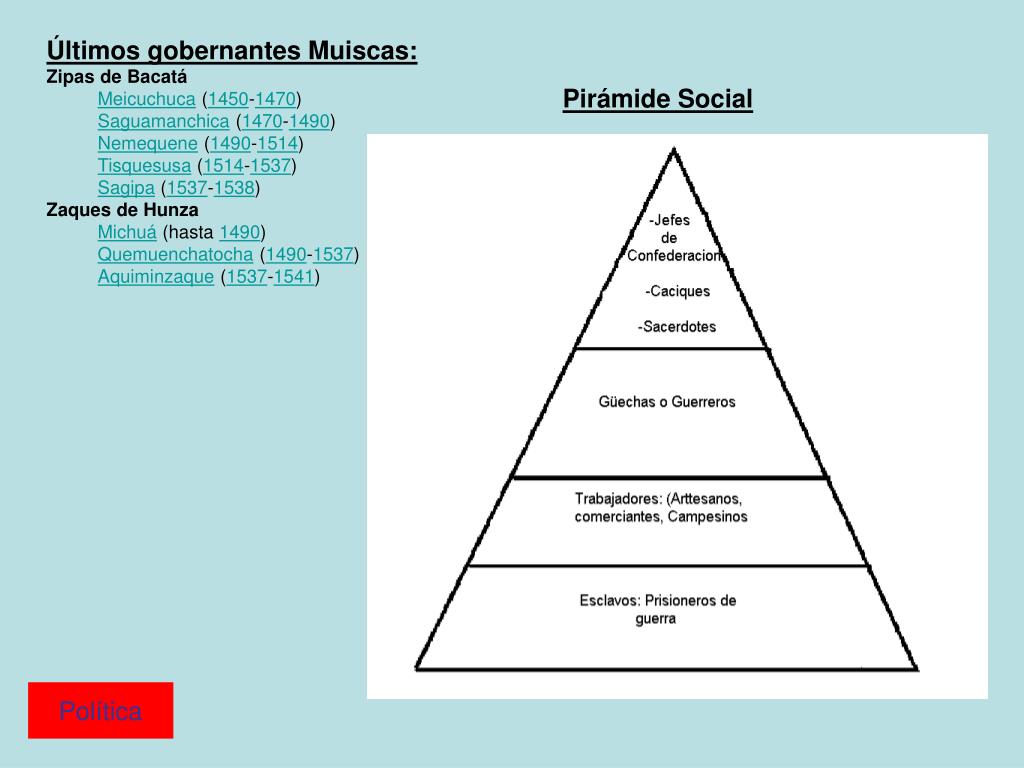
As you can see, priests and political leaders occupy the very top of the social pyramid. This visual proximity signifies their intertwined and complementary authority. The ruler's legitimacy didn't come from popular vote or military might alone; it was fundamentally tied to their sacred status and their role in the cosmic order.
Descendants of the Gods
The most direct source of a ruler's sacred authority was their divine lineage. They were not merely favored by the gods; they were considered their direct descendants. This belief cemented their right to rule in the minds of their people.
To understand these divine connections, let's watch a segment from the video "The Muisca People of Colombia".
This video explains the divine ancestry claimed by the Zipa and Zaque, directly linking them to the Muisca's most important deities.
Watch from 11:21 to 12:12. Pay close attention to the specific deities associated with the Zaque and the Zipa.
As the video highlights, the two main confederations had distinct celestial connections:
- The Zaque, ruler of the northern confederation, was considered a descendant of Sué, the god of the Sun.
- The Zipa, ruler of the southern confederation, was considered a son of Chía, the goddess of the Moon.
This divine ancestry meant that the rulers were living embodiments of the primary cosmic forces that governed the Muisca world. This is a powerful concept for visual storytelling—imagine depicting a Zaque whose regalia is covered in sun symbols, or a Zipa whose ceremonies take place under the full moon.
Power in Practice: The Ruler's Sacred Duties
A ruler's divine status was not just a title; it required active participation in the religious life of the community. They were expected to lead and perform the most important rituals to ensure cosmic balance, agricultural fertility, and the well-being of their people.
The Ceremony of El Dorado
The most famous of these rituals is the investiture ceremony of the new Zipa, which gave rise to the legend of El Dorado ("The Golden One"). This was not a treasure hunt, but a profound religious rite of passage that confirmed the leader's sacred authority.
Let's watch a description of this ceremony.
The Muisca: Legends of Gold (subtitulos en español)
The video 'The Muisca: Legends of Gold' provides a clear account of the El Dorado ceremony, explaining its steps and its significance as an accession ritual for a new ruler.
Watch from 24:31 to 26:00. Notice how the ruler himself is the central figure of the offering, transforming into 'the golden man'.
This ceremony is a perfect illustration of the fusion of political and religious roles. The accession to political power is achieved through a sacred offering where the leader's body itself becomes a conduit to the divine.
To get a more evocative sense of this ritual, which could be incredibly inspiring for your illustrations, read the following article. It describes the ceremony with rich, visual language.
Legend of the Muisca Raft: Gold Ritual at Lake Guatavita
The article 'Legend of the Muisca Raft' describes the El Dorado ceremony in vivid detail, focusing on the spiritual and symbolic aspects of the ritual.
Read the sections beginning 'As seasonal rains whispered...' and 'The Ceremony at Lake Guatavita'. Focus on the descriptions of the preparations, the ruler's transformation, and the atmosphere of the event.
The Festival of the Sun
While the Zipa's most famous ritual was tied to Lake Guatavita, the Zaque, as a descendant of the sun god, had his own crucial religious duties. His most important role was during the summer solstice festival, which honored Sué. This ceremony took place in Suamox (modern Sogamoso), the sacred "City of the Sun," which was a major religious center for all Muisca. As we learned from the video "The Muisca People of Colombia," this was the only day of the year the Zaque would show his face in public, reinforcing his unique and sacred connection to the sun.
The Priests: Keepers of Knowledge
While the rulers held ultimate authority, they did not act alone. A class of religious specialists, known as xeques or she (priests), were the day-to-day spiritual guides of Muisca society.
The relationship between rulers and priests was symbiotic:
- Priests as Advisors: They interpreted omens, managed the calendar, and advised rulers on all important matters, from agriculture to war.
- Priests as Educators: Crucially, the priests were responsible for the rigorous education of the heir. As mentioned in the video "The Muisca: Legends of Gold," before a new chief could take power, he underwent a long period of training and purification under the guidance of the priests. This included fasting, seclusion, and instruction in religious traditions and laws.
This system ensured that by the time a new Zipa or Zaque took power, he was not only the political heir but was also fully indoctrinated into the religious worldview that legitimized his rule. The priests, in turn, derived their power from their specialized knowledge and their essential role in consecrating the ruler.
Test your understanding!
Imagine you are designing a scene depicting a young heir apparent to the Zipa. Based on what you've learned, who would be his primary companions and teachers, and what might his daily life look like during his training?
Show answer
His primary companions and teachers would be the xeques (priests). His daily life would be far from luxurious. It would involve ritualistic isolation, likely in a temple or a secluded place. He would be subject to strict rules, such as abstaining from salt and seeing sunlight, as part of his purification. His education would focus on sacred laws, history, and the performance of rituals, preparing him to be the spiritual and political leader of his people. Visually, you could depict him in a simple, unadorned setting, in deep conversation with an elderly priest, or studying natural phenomena like the stars.
The infographic below helps to synthesize these ideas, showing the distinct territories of the Zipa and Zaque, the location of the religious center of Suamox, and an illustration of the El Dorado ritual—all key elements of this intertwined system of power.

Conclusion
In this lesson, we have explored the integrated nature of Muisca leadership, where the political authority of the Zipa and Zaque was inseparable from their sacred roles.
Key Takeaways:
- Muisca political and religious authority were fused in the figure of the priest-king.
- The Zipa and Zaque derived their legitimacy from their divine ancestry, as descendants of the Moon and Sun gods, respectively.
- Rulers actively performed crucial religious ceremonies to maintain cosmic order and validate their power, most notably the El Dorado ritual for the Zipa's investiture and the Sun Festival for the Zaque.
- A powerful class of priests (xeques) worked alongside the rulers, serving as advisors, ritual specialists, and the educators of future leaders.
Understanding this system is fundamental to interpreting their mythology. The myths are not just stories; they are the charter that explains and justifies this entire social and cosmic order.
Preview of the Next Lesson:
Now that we've seen how central the divine was to Muisca leadership, we will zoom out to look at their broader cosmology. In the next lesson, we will describe the key elements of Muisca cosmology, including their concepts of the upper, middle, and underworlds. This will give us a complete map of the universe in which their myths unfold.
Can't find a good explanation? Sign up and we'll make it for you
Sign up