
Introduction
Hello! Welcome back. In our last lesson, we focused on the figures at the pinnacle of Muisca society: the priest-kings, the Zipa and Zaque. We saw how their power was not merely political but deeply religious, rooted in their divine ancestry as descendants of the Moon and Sun. They were the key human mediators between the people and the gods.
Today, we're going to zoom out from the leaders to the world they inhabited. Your learning outcome is to describe key elements of Muisca cosmology, including the concepts of upper, middle, and underworlds. We will essentially be drawing the "map" of the Muisca universe.
For your goal of illustrating historical myths, this lesson is foundational. It provides the setting, the cosmic stage upon which the gods, spirits, and heroes act. Understanding this structure—the different realms and the connections between them—will allow you to create illustrations that are not just beautiful, but also conceptually rich and authentic to the Muisca worldview. Think of it as the world-building phase of your design process.
The Origin Point: Chiminigagua and the First Light
Before there were worlds, there was darkness and silence. The Muisca cosmos begins not with a physical being, but with a powerful, abstract principle: Chiminigagua, the creator and source of all light.
To understand this foundational concept, please read the short article on Chiminigagua from Mythlok. It clearly explains the nature of this supreme being.
Chiminigagua : The Divine Spark That Formed the Universe
This article, 'Chiminigagua : The Divine Spark That Formed the Universe,' provides a concise overview of the Muisca's ultimate creator deity.
Please read the 'Introduction,' 'Physical Traits,' 'Family,' and 'Powers and Abilities' sections. Focus on how Chiminigagua is described as a formless light and how it initiated creation.
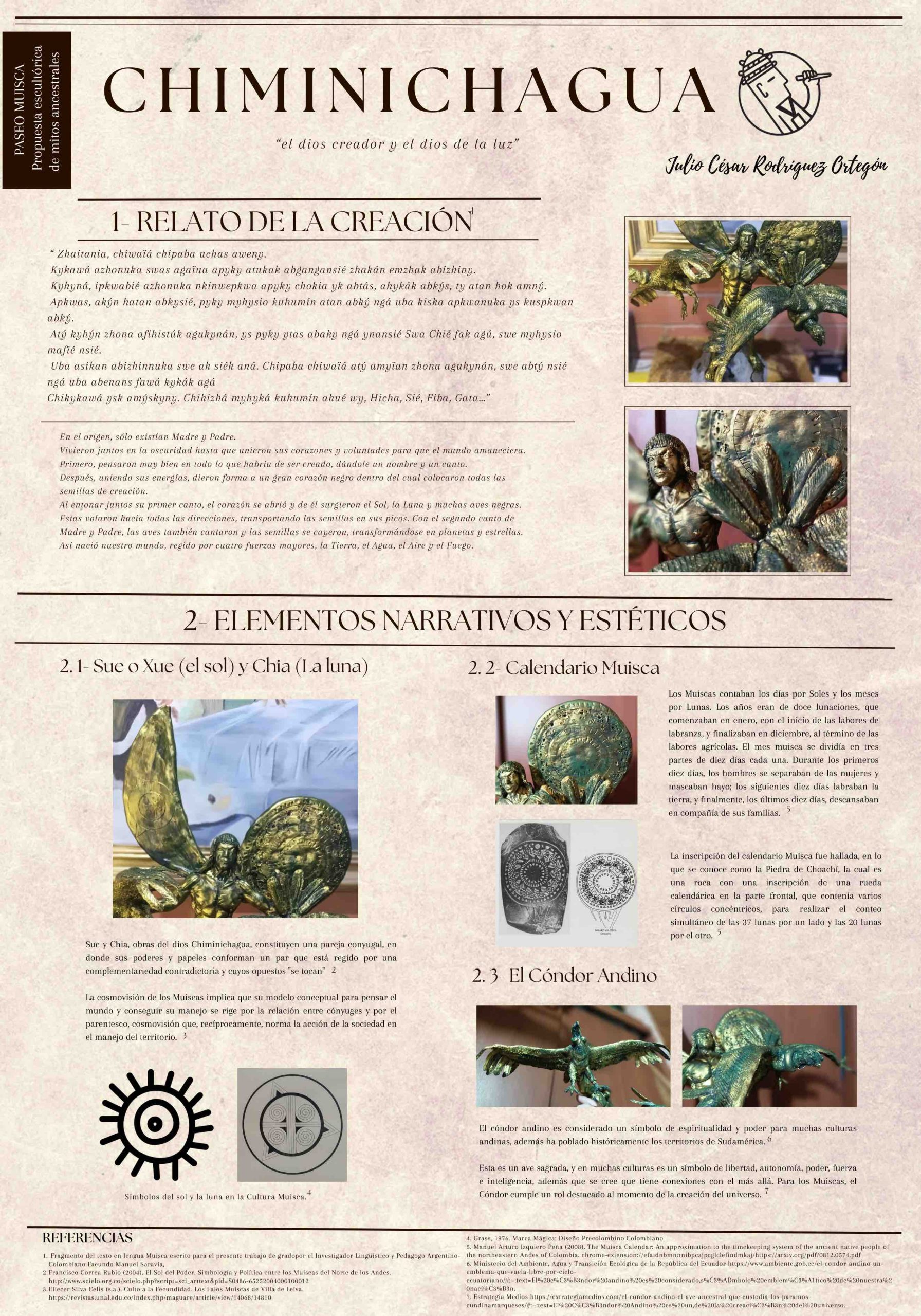
As the article describes, Chiminigagua is an invisible, self-generating force that brought existence into being by creating light. The story of the two great black birds carrying this light across the void is a powerful visual metaphor for the dawn of creation. This act didn't just illuminate the universe; it established the fundamental order and the beings that would govern it, like the sun god Sué and the moon goddess Chía.
This infographic offers a sculptural interpretation of the creation myth, providing some strong visual ideas for how these abstract concepts can be given form.
The Three Worlds: Structuring the Cosmos
From Chiminigagua's act of creation, the Muisca conceived of the universe as being layered into three distinct but interconnected realms. This tripartite structure is common in many indigenous American cosmologies and provided a framework for understanding one's place in the universe.
-
The Upper World: This is the celestial realm, the home of the primary deities and cosmic forces. It's the domain of Sué (the Sun) and Chía (the Moon), who were created by Chiminigagua to govern time and life. This world represents light, order, and divine power. It is the source of the authority of the Zaque and Zipa, as we discussed in the last lesson.
-
The Middle World: This is our world—the world of the living. For the Muisca, this was specifically the Altiplano Cundiboyacense. It is the realm of humans, animals, plants, and the entire natural landscape. It's where daily life, agriculture, and rituals took place, all under the influence of the upper and lower worlds.
-
The Underworld: This realm was associated with the darkness that existed before creation, but it was not necessarily a place of evil like a European hell. Instead, it was a world of origins, spirits, and potent creative power, intrinsically linked to water. The Muisca believed that humanity itself emerged from this world through a sacred lake, a myth we will explore in detail soon. Lagoons, caves, and the deep earth were considered thresholds to this powerful, mysterious realm.
Connecting the Realms: Mediators and Sacred Geographies
The Muisca universe was not static. The three worlds were in constant communication, and certain places and beings acted as conduits between them.
Sacred Geography:
- Lagoons and Lakes: As portals to the underworld, these were the most sacred sites. They were places of creation and powerful spiritual energy, where the most important offerings were made (like the El Dorado ceremony at Lake Guatavita).
- Mountains and High Peaks: These places physically reached toward the upper world, making them natural points of connection with the celestial deities.
Supernatural Mediators:
The Muisca world was populated with powerful beings that could traverse the different cosmic layers. Their iconography, often found in brilliant goldwork, gives us a visual library of these mediators. Themes found across the wider Chibchan-speaking region, including the Muisca, point to a shared understanding of these figures. The book Gold and Power in Ancient Costa Rica, Panama, and Colombia details several of these recurring figures:
- The Bat Man: Bats live in caves (entrances to the underworld) and fly in the night sky. This ability to move between realms made them powerful symbols of shamanic transformation. The Muisca language even had a specific term for a "bat-priest," supquaquyn, highlighting their importance.
- The Crocodile Man / Double-Headed Saurian: As amphibious creatures, crocodiles and caimans belong to both the water (underworld) and the land (middle world). This figure often represents transformation, otherworldly power, and the creative force of the aquatic realm.
- Beak Birds: Figures of eagles, vultures, and other large birds were symbols of the upper world and the power of the sun. They represented the shaman's ability to "fly" into the spirit world to gain knowledge.
These beings are fantastic subjects for your illustrations, as they embody the dynamic nature of the Muisca cosmos.
The following artwork by Joan Londoño is a modern interpretation that captures this sense of a connected cosmos, with a central deity figure surrounded by humans and symbolic animals, blending the different realms into a single, vibrant scene.

Test your understanding!
Imagine you are creating a "system map" or a conceptual diagram for the Muisca cosmos. Where would you place the following elements: a Muisca farmer, a lagoon, the Moon (Chía), a mountain, a shaman transforming into a bat, and the Zaque? How would you visually represent the connections between them?
Show answer
A possible layout could be:
- Upper World: Place the Moon (Chía) here.
- Middle World: Place the Muisca farmer, the mountain, and the Zaque here. The mountain could be drawn to touch the boundary of the Upper World.
- Underworld: Place the lagoon here, with its surface on the boundary of the Middle World and its depths extending down.
- Connections: The Zaque could have a visual link (e.g., a ray of light) to the Sun in the Upper World (even if the Sun isn't explicitly on the map). The shaman transforming into a bat would be a figure moving between the Middle World and the other two, perhaps shown emerging from a cave (underworld) and flying towards the sky (upper world), representing a key mediator. The lagoon would be a clear portal between the Middle and Underworlds.
Conclusion
We have now mapped the essential structure of the Muisca universe. This cosmology provided the framework for Muisca religion, social order, and daily life.
Key Takeaways:
- Muisca creation began with Chiminigagua, an abstract creator who brought forth light from darkness.
- The cosmos is structured into three realms: the Upper World (celestial deities), the Middle World (humans and nature), and the Underworld (water, spirits, and origins).
- These worlds were not separate but were dynamically interconnected through sacred geographies (lagoons, mountains) and powerful mediator beings (like the Bat Man and Crocodile Man) who could traverse the cosmic layers.
Preview of the Next Lesson:
With this cosmic map in hand, we are ready to explore the great narratives that unfold within it. In our next lesson, we will focus on the first major story after the initial illumination of the universe: the creation myth of Chiminigagua and the origin of light. We will examine the full narrative and its significance for Muisca culture.
Can't find a good explanation? Sign up and we'll make it for you
Sign up