
Introduction
Welcome to our second module, where we will dive deep into the world of the Muisca people. In the previous module, we surveyed the broad landscape of Colombian geography and its diverse pre-Columbian cultures. Now, we will focus our attention on one of the most prominent civilizations of the Andean highlands.
This lesson addresses the first step in understanding the Muisca: learning about their home and their society. Our learning outcome is to describe the location and social organization of the Muisca confederation in the Cundiboyacense highlands.
Think of this as the foundational research for a compelling story or illustration. To authentically depict a people's myths, you first need to understand the world they lived in—the landscape that shaped their worldview and the social structures that governed their lives. By the end of this lesson, you will have a clear picture of the Muisca's territory and the intricate web of their political and social hierarchy, setting the stage for exploring their beliefs and myths.
The Land of the Muisca: The Altiplano Cundiboyacense
The environment is not just a backdrop; it is a character in the story of a civilization. For the Muisca, their home on a high-altitude plateau was central to their identity, economy, and spiritual life.
To begin, let's explore this unique region. The following reading from LAC Geo provides an excellent overview of the Altiplano Cundiboyacense.
The Altiplano Cundiboyacense: Ancient Territory of ...
This article, 'The Altiplano Cundiboyacense: Ancient Territory of the Muisca Civilization', describes the geography, environment, and historical significance of the Muisca homeland.
Please read the initial sections of the article, starting from the beginning down to the end of the 'Geographical and Environmental Features' section. As you read, focus on the key characteristics of the plateau: its location, altitude, climate, and the importance of its water sources.
To complement this reading with a visual summary, watch the first couple of minutes of the following video. It offers a concise look at the region and its advantages.
The Muisca: Legends of Gold (subtitulos en español)
This video, 'The Muisca: Legends of Gold' from Ancient Americas, provides a visual and narrative introduction to the Muisca people and their homeland.
Watch the video from the beginning until the timestamp 02:30. Pay attention to how the narrator describes the Altiplano and the benefits of living in a region with diverse climatic zones packed into a small geographical area.
As you've seen, the Muisca didn't just occupy a piece of land; they inhabited a distinct ecological niche. The Altiplano Cundiboyacense, located in the Eastern Cordillera of the Andes, is a high plateau between 2,500 and 4,000 meters above sea level. This altitude created a temperate, fertile "island" in the middle of a tropical country, supporting a large population and a sophisticated society.
Map depicting the Altiplano Cundiboyacense's location and the Muisca culture's territory.
This map from the LAC Geo article shows the territory of the Muisca civilization within modern-day Colombia, centered on the high plateau.
The Muisca Confederation: A System of Alliances
Now that we have established the "where," let's turn to the "how"—how was Muisca society organized? It's crucial to understand that they did not form a centralized kingdom or empire like the Incas or Aztecs. Instead, their political structure is best described as a confederation: a complex and sometimes tense alliance of different territories and rulers.
The following video segment provides an excellent, detailed breakdown of this political landscape, from the smallest villages to the most powerful leaders.
The Muisca: Legends of Gold (subtitulos en español)
We return to 'The Muisca: Legends of Gold'. This section details the nuances of Muisca political and social hierarchies, explaining why 'confederation' is a more accurate term than 'empire'.
Watch the section from 15:39 to 21:53. Focus on understanding the different tiers of leadership (uta, sibin, tiba, sequa) and the relationships between them. Also, note the different social classes mentioned.
The Structure of Power
As the video explained, Muisca politics was a dynamic system of relationships. Let's formalize that structure.
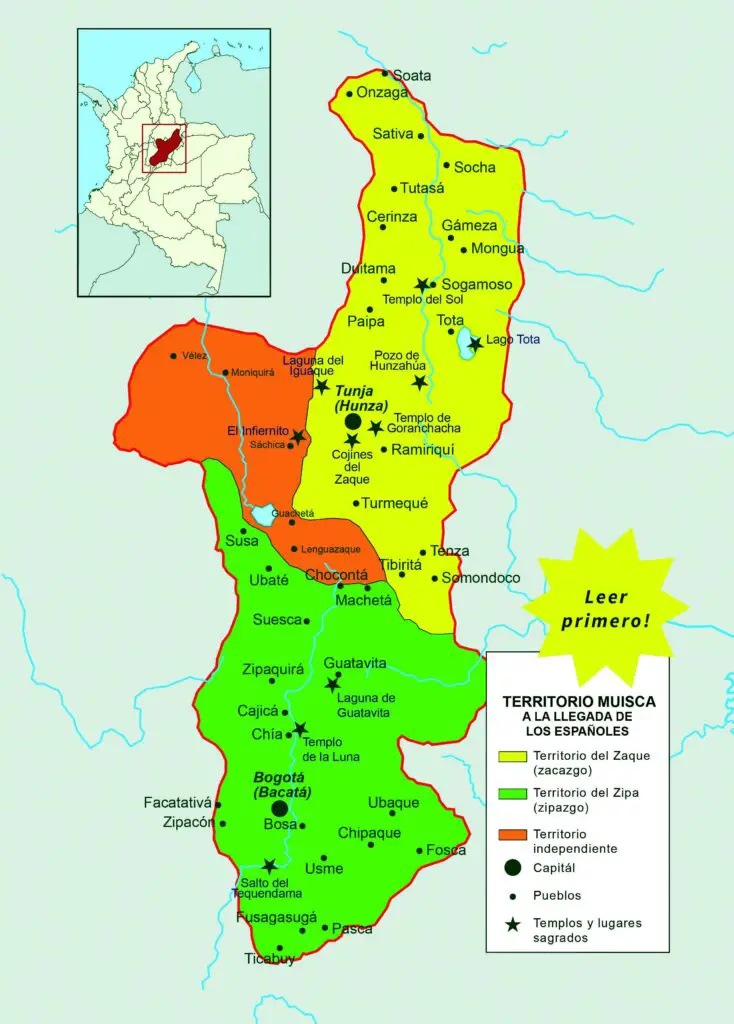
At the time of Spanish contact in the 1530s, the Muisca territory was largely divided into two major, often competing, confederations:
- The Southern Confederation: Led by the Zipa, with its capital at Bacatá (near modern-day Bogotá). This was the larger and more populous of the two.
- The Northern Confederation: Led by the Zaque, with its capital at Hunza (modern-day Tunja).
These two paramount rulers presided over a hierarchy of lesser chiefs. While sources can be contradictory, a general structure looked something like this:
- Sequa: A powerful regional ruler, like the Zipa or Zaque.
- Tiba: A prestigious title for a town or village ruler. The strongest were called seuin tibas.
- Sibin: A village chief who ruled over several smaller hamlets.
- Uta: A local chief in charge of a small village or a few family groups (gues).
Below the ruling class, society was stratified into:
- Xeques (or Cheques): Priests who held significant religious authority.
- Guechas: Elite warriors who defended the territories.
- Commoners: The majority of the population, including farmers, merchants, and skilled artisans (especially goldsmiths and potters).
- Slaves: Individuals at the bottom of the social ladder, though less is known about the prevalence of slavery.
A key feature of Muisca society was its matrilineal succession. A chief was typically succeeded not by his own son, but by the son of his eldest sister. This practice reinforced alliances between different ruling families and is a vital detail for understanding their social dynamics.
The map below provides a fantastic visual of this political division, clearly showing the territories of the Zipa and Zaque, as well as other important Muisca chiefdoms.
Test your understanding!
Imagine you are creating a character for a story set in Muisca territory. Your character is the nephew of the powerful ruler of Hunza. Based on what you've learned, what would be your character's likely future role and title?
Show answer
The ruler of Hunza was the Zaque. Because the Muisca practiced matrilineal succession, the Zaque's heir would be his sister's son. Therefore, your character would be the heir apparent, preparing to become the next Zaque. He would undergo a long period of ritual training and education under the guidance of priests (xeques).
Social Fabric: The Clan System
This complex political structure was built on a foundation of kinship. The fundamental social unit was the extended family clan. The concept of the clan remains important for Muisca descendants today, offering a real-world link to their historical social organization.
The following reading from the Cabildo Indígena Muisca de Bosa (a legally recognized organization of Muisca descendants in Bogotá) explains how this clan structure functions today, echoing its historical importance.
This webpage from the Cabildo Indígena Muisca de Bosa, titled 'What is CIMB?', offers a modern perspective on Muisca identity and social structure. We will focus on the section describing the family clans.
Please read the section titled 'The Clans' (near the end of the page). Focus on how kinship, elders, and the transmission of knowledge form the basis of their social organization, connecting the past to the present.
Conclusion
In this lesson, we have established the setting and the social framework of the Muisca world. You can now visualize their home and understand the roles people played within it.
Key Takeaways:
- The Muisca inhabited the Altiplano Cundiboyacense, a fertile, high-altitude plateau in the Colombian Andes that provided a unique and resource-rich environment.
- Their political system was a confederation of allied chiefdoms, not a centralized empire.
- The two most powerful leaders were the Zipa of Bacatá (south) and the Zaque of Hunza (north), who ruled over a hierarchy of lesser chiefs.
- Muisca society was stratified, with distinct roles for rulers, priests, warriors, commoners, and slaves.
- Matrilineal succession was a cornerstone of their political system, where power passed through the female line to a sister's son.
With this foundation, you are now prepared to explore the Muisca worldview more deeply. You have a "map" of their society; next, we will begin to populate it with their beliefs and values.
Preview of the Next Lesson:
In our next lesson, we will examine the crucial relationship between Muisca political leaders and religious authority. We will see how the power of the Zipa and Zaque was not just political but deeply rooted in their spiritual cosmology, a connection that is essential for understanding the myths we will later explore.
Can't find a good explanation? Sign up and we'll make it for you
Sign up