
Hello! Welcome to the third lesson in our foundational module on sleep science.
In our last lesson, we created a "map" of the brain, identifying the key regions that act as control centers for sleep and wakefulness. We briefly met the suprachiasmatic nucleus (SCN), which I referred to as the brain's "master clock."
Today, we will focus entirely on this master clock and the powerful rhythm it generates. This lesson moves from the where of sleep regulation to the when. We will explore the circadian rhythm, the internal 24-hour cycle that governs not just when you feel sleepy, but also your patterns of alertness, body temperature, hormone release, and much more. Understanding this fundamental biological rhythm is a critical step before we can later explore how practices like meditation might interact with it.
By the end of this lesson, you will be able to explain what the circadian rhythm is, how the brain generates it in response to light, and its central role in orchestrating your daily sleep-wake cycle.
What is the Circadian Rhythm?
Have you ever noticed that you naturally feel a dip in energy in the mid-afternoon, or that you start to feel tired around the same time each evening, even without looking at a clock? These are manifestations of your internal biological clock.
The term circadian rhythm comes from the Latin words circa ("about") and diem ("day"). It's an internal process that regulates a vast array of our bodily functions on a cycle that lasts approximately 24 hours. While we most commonly associate it with sleep, this rhythm is fundamental to almost all life on Earth, helping organisms anticipate and adapt to the daily cycle of light and darkness.
Let's start with a quick and engaging overview of what this rhythm is and why it's so important.
Circadian Rhythm and Your Brain's Clock
The video 'Circadian Rhythm and Your Brain's Clock' from the SciShow channel provides an excellent introduction to this topic. It explains the concept in a very accessible way and highlights its broad impact on our daily lives.
Please watch the segments from 0:15 to 1:13 and 1:53 to 2:43. The first part defines the circadian rhythm, and the second part discusses the typical peaks and lulls in alertness it creates throughout the day.
As the video mentions, this internal clock orchestrates many processes. To build on that, let's turn to a more detailed written resource.
The article 'What Is Circadian Rhythm?' from the Sleep Foundation provides a clear and comprehensive definition, listing the various bodily functions that are under circadian control.
Please read the first two sections, titled 'What Is Circadian Rhythm?' and 'Sleep and Circadian Rhythm.' Focus on understanding the core purpose of the rhythm and the specific ways it prepares your body for both sleep and wakefulness.
The Master Clock: How the Brain Keeps Time
So, how does the body generate this rhythm? As we learned in the last lesson, the control center is the suprachiasmatic nucleus (SCN), a tiny cluster of several thousand neurons located in the hypothalamus. The SCN is your master clock.
The most crucial factor for calibrating this clock is light. The SCN is positioned perfectly to receive information directly from the optic nerves in your eyes. This pathway from the retina to the hypothalamus is what allows your internal clock to synchronize with the external 24-hour day.
Here’s how the mechanism works:
- Light as a Signal: When light—especially sunlight—enters your eyes, specialized cells in your retina send a signal directly to the SCN.
- Daytime Signal: During the day, the light signal tells the SCN to be active. The SCN then sends out signals to the rest of the brain and body that promote wakefulness and alertness. Crucially, it sends an inhibitory signal to a small gland called the pineal gland, preventing it from producing the sleep-promoting hormone, melatonin.
- Nighttime Signal: As darkness falls, the light signal to the SCN fades. The SCN becomes less active and stops inhibiting the pineal gland.
- Melatonin Release: Freed from its inhibition, the pineal gland begins to produce and release melatonin into the bloodstream. Melatonin is often called the "hormone of darkness." Its rising levels signal to your entire body that it is nighttime, causing your body temperature to drop and feelings of sleepiness to increase.
The following video provides a fantastic step-by-step animation of this entire pathway.
Sleep Stages, Sleep Cycle, and the Biology of Sleep
In the video 'Sleep Stages, Sleep Cycle, and the Biology of Sleep' by Psych Explained, the presenter clearly illustrates the journey of the light signal from the eye to the SCN and finally to the pineal gland.
Please watch from 1:25 to 4:59. Pay close attention to the sequence: eye -> retina -> hypothalamus (SCN) -> pineal gland -> melatonin.
This biological pathway is the core mechanism of your sleep-wake cycle's timing. The diagram below provides a static summary of this process.

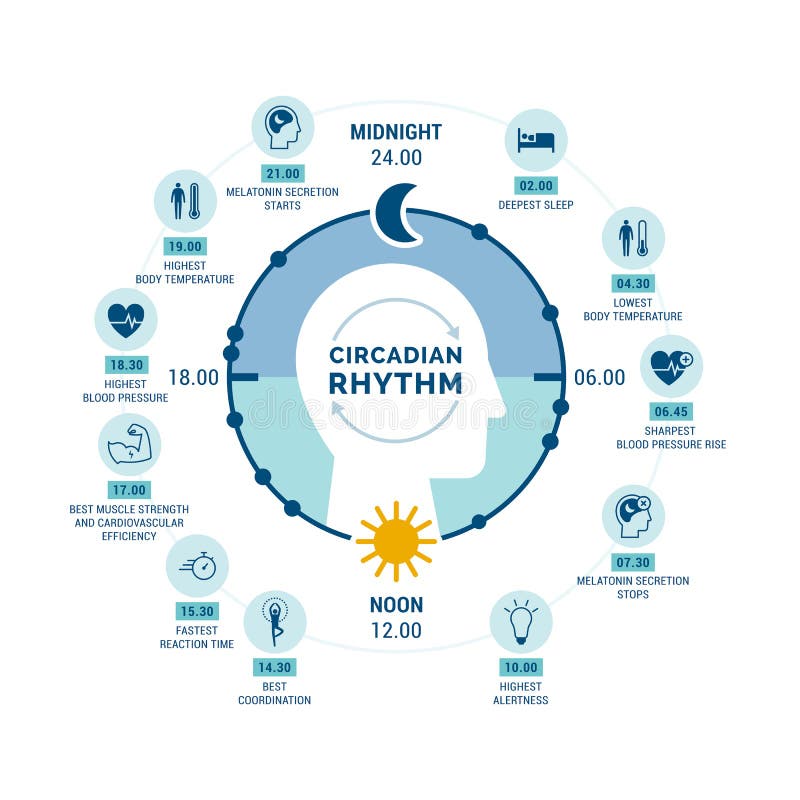
The result of this master clock's daily work is a predictable 24-hour pattern of physiological changes, as illustrated here:
Zeitgebers: The "Time-Givers" That Sync Your Clock
Your internal biological clock actually runs on a cycle slightly longer than 24 hours (on average, 24.2 hours). To prevent your sleep schedule from drifting later and later each day, your clock needs to be reset daily. The environmental cues that help reset and synchronize our internal clock are called Zeitgebers (a German word meaning "time-givers").
- The Primary Zeitgeber: By far, the most powerful Zeitgeber is the light-dark cycle. Morning light exposure is particularly effective at advancing the clock and reinforcing the start of the active day. This is why getting sunlight in the morning is a cornerstone of good sleep hygiene.
- Other Zeitgebers: While light is dominant, other cues can also influence the clock, including:
- Timing of meals: Eating at regular times can help anchor your rhythm.
- Exercise: Physical activity, especially in the morning or afternoon, can reinforce wakefulness.
- Social interaction: Regular social schedules also provide timing cues to the brain.
In our modern world, we are often surrounded by weak or conflicting Zeitgebers. We may lack bright light during the day (by staying indoors) and have too much bright, artificial light at night (from screens and lighting). This can confuse the SCN, leading to a misaligned or weakened circadian rhythm, which can cause difficulty sleeping, fatigue, and other health issues.
Test your understanding!
Imagine a person who travels from India to the United States, crossing multiple time zones. For the first few days, they feel sleepy during the American afternoon and wide awake late at night. From the perspective of circadian rhythms, what is happening, and what is the most effective Zeitgeber they could use to adjust their internal clock more quickly?
Show answer
What is happening is a classic case of jet lag. The person's internal clock (SCN) is still synchronized to the Indian light-dark cycle. It is telling their body to prepare for sleep when it's daytime in the U.S. and to be awake when it's nighttime.
The most effective Zeitgeber to speed up adjustment is light. By exposing themselves to bright, natural sunlight in the morning at their new location and avoiding bright light in the evening, they can help their SCN "reset" more quickly to the new 24-hour cycle.
Conclusion
In this lesson, we've put the brain's master clock, the SCN, under the microscope. We've seen how it uses the elegant and powerful signal of light to generate a 24-hour rhythm that governs our entire day.
Key Takeaways:
- The circadian rhythm is an approximately 24-hour internal biological clock that aligns our physiology with the day-night cycle.
- The suprachiasmatic nucleus (SCN) in the hypothalamus is the master clock that controls this rhythm.
- The primary environmental cue, or Zeitgeber, for the SCN is light, which it receives directly from the eyes.
- The SCN controls the sleep-wake cycle largely by regulating the release of melatonin (the "hormone of darkness") from the pineal gland.
- A strong, stable circadian rhythm, well-aligned with the external day, is essential for restorative sleep and overall health.
Preview of the Next Lesson:
The circadian rhythm explains the timing of sleep—it creates a daily window of opportunity for sleep. However, it doesn't explain why you feel sleepier after a long day than after a short one. This is controlled by the second major process regulating sleep: the homeostatic sleep drive, also known as "sleep pressure." In our next lesson, we will explore how this pressure builds up the longer you are awake, creating a powerful need for sleep that works in tandem with your circadian rhythm.