Hello! Welcome to your fourth lesson in the "Foundations of Sleep Science" module.
In our last lesson, we explored the circadian rhythm (often called Process C), the body's internal 24-hour clock that creates the daily timing for sleep. We saw how the suprachiasmatic nucleus (SCN) acts as a master clock, using light to signal to the body when it's time to be awake and when it's time to prepare for sleep.
However, the circadian rhythm is only half of the story. It explains why you generally get sleepy in the evening, but it doesn't explain why you feel an overwhelming need to sleep after staying awake for 36 hours, even if it's the middle of the day.
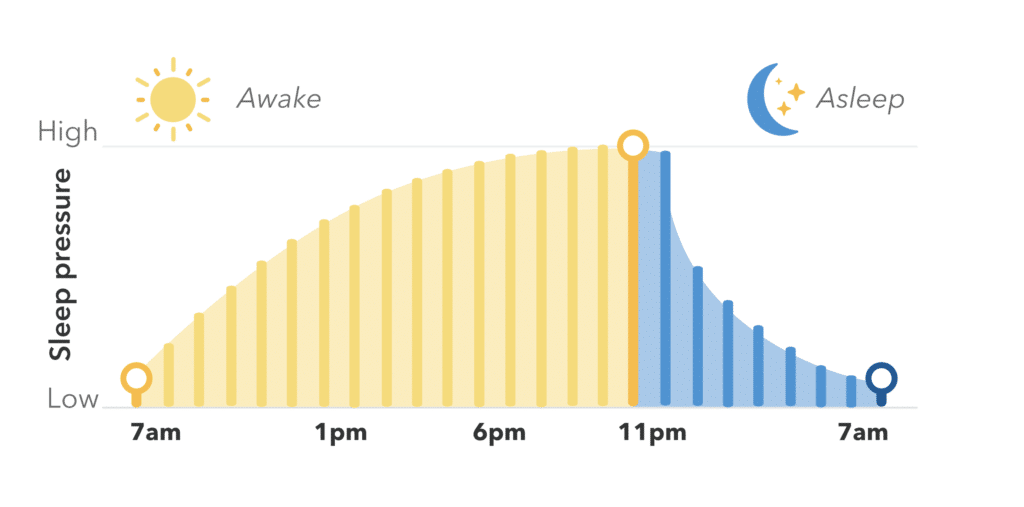
Today, we'll investigate the second major force in sleep regulation: the homeostatic sleep drive, or Process S. Think of this as the body's relentless accountant for sleep. It tracks how long you've been awake and generates a powerful "pressure" to sleep. This is a purely biological drive, an automatic process that ensures the brain gets the rest it needs. Understanding this powerful, unconscious mechanism is a crucial foundation for our later exploration of how Jain practices aim to introduce consciousness and intention into this normally automatic state.
By the end of this lesson, you will be able to describe the homeostatic sleep drive and explain how this "sleep pressure" builds in the brain.
Defining the Homeostatic Sleep Drive
The core idea of the homeostatic sleep drive is simple: the longer you stay awake, the stronger your desire and need for sleep become. It's a self-regulating (homeostatic) system, much like your body's regulation of temperature or blood sugar. When a crucial resource—in this case, the state of being rested—is depleted, the body generates a drive to restore it.
A common and helpful analogy is an hourglass. When you wake up, the hourglass is flipped, and "sleep pressure" begins to accumulate like sand in the bottom chamber. This pressure builds continuously throughout your waking hours. The only way to "flip the hourglass back" and relieve the pressure is to sleep.
To get a more formal definition, let's start with a resource from Harvard Medical School's sleep division.
Science of Sleep: How is Sleep Regulated?
This article, 'Science of Sleep: How is Sleep Regulated?', provides a clear and authoritative definition of the homeostatic sleep drive.
Please read the section titled 'Sleep Drive'. Focus on the concept of it being a 'homeostatic system' and the key idea that this drive constantly grows while you are awake.
The Mechanism of Sleep Pressure: Adenosine
You might be wondering: How does the brain actually "measure" how long you've been awake? What is the "sand" in the hourglass analogy?
Scientists believe a key chemical responsible for this is adenosine.
Your brain is incredibly active, and its cells (neurons) require a lot of energy to function. As your brain cells use energy, they produce adenosine as a byproduct. This adenosine slowly accumulates in the spaces between neurons throughout your waking hours.
Adenosine then binds to specific receptors on brain cells, and this binding has an inhibitory effect—it signals the cells to slow down their activity. The higher the concentration of adenosine, the more widespread this "slowing down" signal becomes, which you experience as a growing feeling of sleepiness or "sleep pressure."
Let's watch a brief animation that visualizes this concept.
This short clip from Alila Medical Media clearly introduces the homeostatic drive and its connection to adenosine.
Please watch from 02:42 to 03:22. The video defines the homeostatic drive and points to adenosine as the substance that drives this pressure to sleep.
During sleep, the brain's metabolic rate slows down, and it uses less energy. This allows the accumulated adenosine to be cleared away. After a full night of restorative sleep, adenosine levels are back at their lowest, the sleep pressure is gone, and you feel refreshed.
A Practical Example: Caffeine
The role of adenosine becomes even clearer when we consider the effects of caffeine. Caffeine is the world's most popular stimulant, and its primary mechanism of action is directly related to adenosine.
Caffeine molecules have a shape that is very similar to adenosine. This allows caffeine to fit into and block the adenosine receptors in your brain. When caffeine is blocking these receptors, the accumulating adenosine cannot bind to them and cannot deliver its sleepiness signal.
This is why coffee makes you feel alert. It doesn't get rid of the adenosine; it just puts a blindfold on your brain so it can't see it. The sleep pressure is still building up silently in the background. Once the caffeine is metabolized and its effects wear off, the receptors are unblocked, and the accumulated adenosine can rush in, often leading to a sudden and intense wave of sleepiness—the infamous "caffeine crash."
Let's go back to the Harvard article for a precise explanation of this process.
Science of Sleep: How is Sleep Regulated?
This section of the article 'Science of Sleep: How is Sleep Regulated?' explains the adenosine hypothesis in more detail and clarifies exactly how caffeine works as an adenosine antagonist.
Find the heading 'Medications and Other Substances' and read the three paragraphs under it, starting with 'The pressure to sleep...' and ending with '...we stay alert.' This will connect the concept of sleep drive directly to the action of caffeine.
Test your understanding!
A student pulls an "all-nighter" to study for an exam, drinking coffee throughout the night. They feel relatively alert for their 9 AM exam. However, by 2 PM, they feel an overwhelming and almost uncontrollable urge to sleep. Using the concepts of homeostatic sleep drive and adenosine, explain what is happening to the student at 2 PM.
Show answer
By staying awake all night, the student has allowed their homeostatic sleep drive to build for over 24 hours, leading to an extremely high level of accumulated adenosine in their brain. The coffee they drank masked this immense sleep pressure by blocking the adenosine receptors. By 2 PM, the effects of the morning's caffeine have likely worn off. The caffeine is no longer blocking the receptors, allowing the massive amount of accumulated adenosine to bind to them, creating a very strong and sudden "slow-down" signal throughout the brain. This results in the overwhelming urge to sleep.
Sleep Debt
The homeostatic system is a strict accountant. If you don't sleep enough on a given night, the adenosine is not fully cleared. You wake up with some residual sleep pressure, which then continues to build throughout the next day. This accumulated sleep deficit is known as sleep debt.
Like a financial debt, sleep debt must be paid back. One slightly shorter night might be corrected by sleeping a bit longer the next night. However, chronic sleep restriction or pulling an all-nighter creates a significant debt that can take several nights of extended sleep to fully repay.
The following video explains this concept of sleep debt very clearly.
The video 'The 2-Process Model of Sleep' from The BioClock Studio provides an excellent explanation of what happens when you skip sleep and accrue a sleep debt.
Please watch the segment from 3:52 to 4:39. Focus on how the sleep pressure continues to build when sleep is skipped and the idea that this creates a 'debt' that must be paid back over subsequent nights.
Conclusion
Today, we've unpacked the second fundamental process governing your sleep: the homeostatic sleep drive. We've seen that it functions like an hourglass, building a relentless pressure for sleep the longer you are awake.
Key Takeaways:
- The homeostatic sleep drive (Process S) is the body's internal system that increases the need for sleep as a function of time spent awake.
- This "sleep pressure" is primarily driven by the accumulation of the neurochemical adenosine in the brain, a byproduct of cellular energy use.
- The only way to relieve sleep pressure and clear adenosine is by sleeping.
- Caffeine promotes wakefulness by blocking adenosine receptors, effectively masking the true level of sleep pressure.
- When you don't get enough sleep, you accumulate a sleep debt, which must be "repaid" with additional sleep later.
Preview of the Next Lesson:
We have now explored the two core processes of sleep regulation in isolation: the circadian rhythm (the timing mechanism) and the homeostatic drive (the pressure mechanism). But how do they work together? In our next lesson, we will synthesize these two concepts into the Two-Process Model of Sleep Regulation. We will see how the constant interplay—the push and pull—between your internal clock and your sleep pressure dictates your daily patterns of alertness and sleepiness with remarkable precision. This will complete our foundational understanding of how sleep is regulated.