Hello! Welcome back to your radioelectronics course.
In our last lesson, we solidified our understanding of Ohm's Law and how it governs the relationship between voltage, current, and resistance for a single component. Now, we'll expand on that to analyze circuits containing multiple resistors.
Introduction
Today's Topic: Calculating Equivalent Resistance for Series and Parallel Combinations.
This lesson addresses the third learning outcome in the "DC Circuit Fundamentals" module. We will learn how to simplify networks of resistors into a single equivalent resistance (). This is a fundamental skill that allows us to apply Ohm's Law to complex circuits, treating them as if they contained only a single resistor. We will cover the rules for resistors in series, resistors in parallel, and the systematic process for simplifying circuits that have a combination of both.
Time to complete: Approximately 45 minutes.
Recap from Previous Lesson:
- Ohm's Law defines the relationship .
- Resistance (R) is the opposition to current flow.
- Current (I) is directly proportional to voltage (V) and inversely proportional to resistance (R).
1. Resistors in Series
When components are connected end-to-end, creating a single path for the current, they are said to be in series.
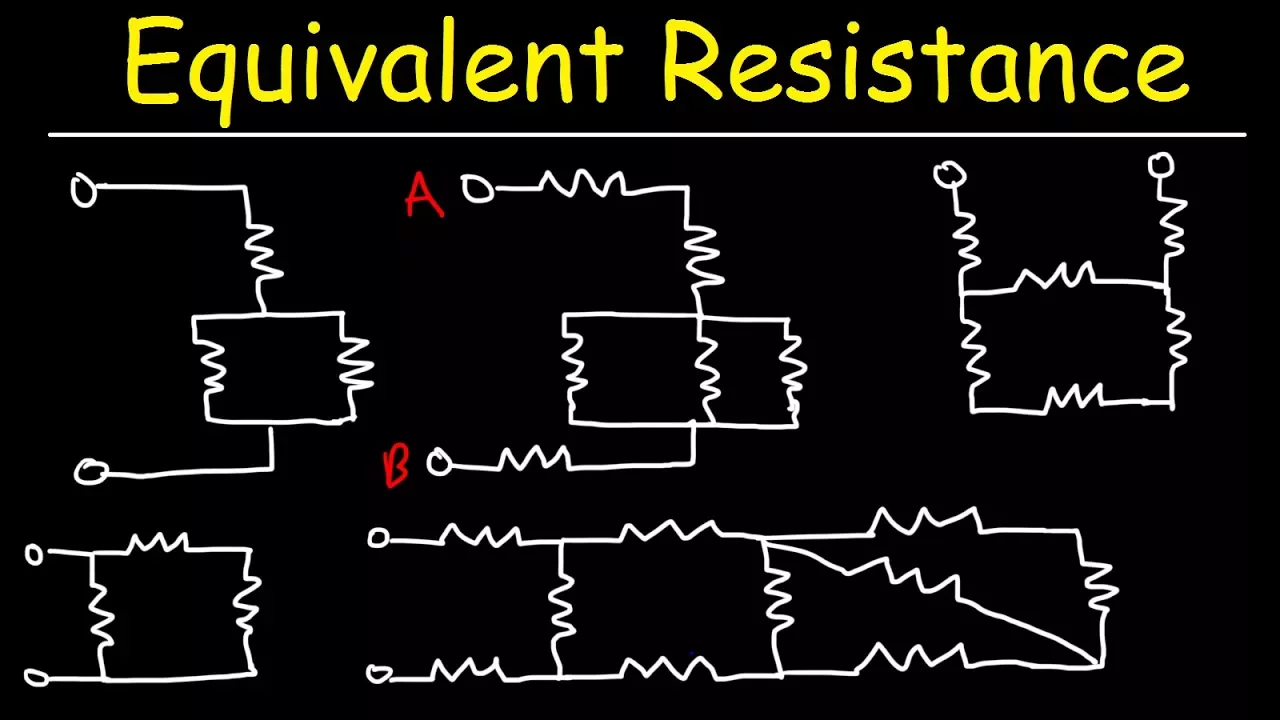
Watch the very beginning of this video, from 00:00 to 00:42, which provides a straightforward introduction to the concept.
As the video shows, calculating the equivalent resistance for a series circuit is simple: you just add the individual resistances.
The formula is:
Why does this work?
As an engineer, you'll appreciate the reasoning behind the formula. In a series circuit, the current () is the same through every resistor. The total voltage drop across the entire series combination is the sum of the individual voltage drops across each resistor. Using Ohm's Law:
- Total Voltage:
- Substitute :
- Factor out the common current :
- From Ohm's Law, we know that for the entire circuit, .
By comparing the last two equations, we see that the term in the parentheses must be the equivalent resistance. This gives us the simple additive rule for series resistors.
2. Resistors in Parallel
When components are connected across the same two points, providing multiple paths for the current, they are in parallel.
Continue watching the same video from 00:42 to 02:58. This segment covers the formula for parallel resistors and a common shortcut.
The key takeaway is that adding more resistors in parallel decreases the total equivalent resistance because you are providing more pathways for the current to flow.
The general formula is:
Or, written to solve for directly:
A Very Common Shortcut (for Two Resistors):
For the special case of exactly two resistors in parallel, the formula can be rearranged to the "product over sum" rule, which is often faster to use:
Why does this work?
In a parallel circuit, the voltage () is the same across every resistor. The total current leaving the source is the sum of the currents flowing through each parallel branch.
- Total Current:
- Substitute :
- Factor out the common voltage :
- For the entire circuit, .
By comparing the last two equations, we can derive the formula for parallel equivalent resistance.
3. Simplifying Combination Circuits
Most real-world circuits are not purely series or parallel but a combination of both. To find the total equivalent resistance of such a circuit, we use a step-by-step reduction process:
- Identify a group of resistors that are purely in series or purely in parallel. Often, it's easiest to start "farthest" from the power source or the terminals of interest.
- Calculate the equivalent resistance for that group.
- Redraw the circuit, replacing the group with its single equivalent resistor.
- Repeat the process until only one resistor remains.
The video you've been watching provides several excellent worked examples of this process. Please watch the rest of the video from 02:58 to the end. Pay close attention to how the circuit is simplified at each stage.
The final example (starting at 08:54) is particularly important as it demonstrates a critical technique: redrawing a confusing circuit diagram to make the series and parallel relationships clear. This skill of re-visualizing a schematic is invaluable.
4. A Systematic Method for Analysis
The process of simplifying circuits can be formalized into a repeatable method. Another great video introduces this as the "Break it down-Build it up" method. Today's lesson covers the "Break it down" phase.
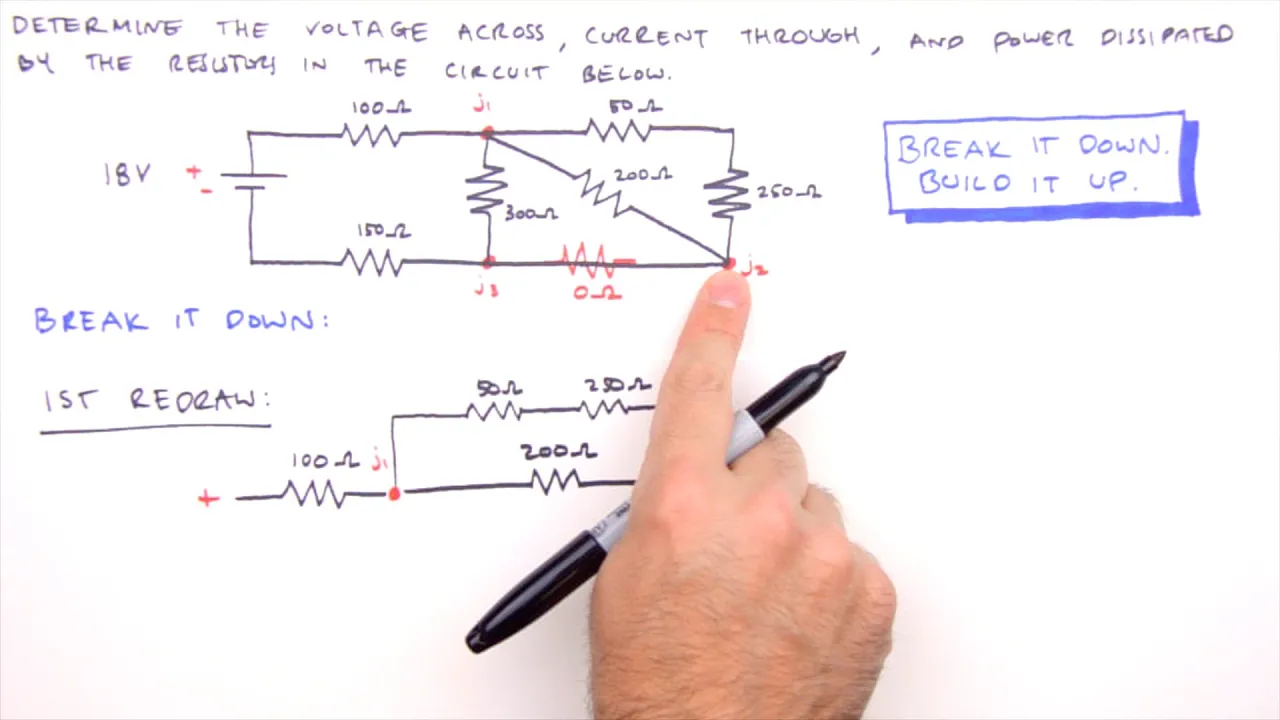
I recommend watching the first few minutes of this video, from 00:00 to 03:40. The instructor provides a different, very complex example and walks through the same systematic process of redrawing and simplifying. This will reinforce the technique you saw in the first video.
This methodical approach—breaking the circuit down to a single and then (in later analyses) building it back up to find individual currents and voltages—is a powerful problem-solving framework for a circuit analyst.
Conclusion
In this lesson, you've learned how to analyze and simplify networks of resistors. This is a crucial step before applying more advanced circuit analysis techniques.
Key Takeaways:
- Series Resistors: Current has one path. Equivalent resistance is the sum of individual resistances: .
- Parallel Resistors: Current has multiple paths. Equivalent resistance is the reciprocal of the sum of the reciprocals: .
- Combination Circuits: Solved by iteratively finding series or parallel groups, calculating their equivalent resistance, and redrawing the simplified circuit until a single resistor remains.
Preview of Next Lesson:
While simplifying series-parallel circuits is powerful, not all circuits can be reduced this way (e.g., bridge circuits). To handle any circuit configuration, we need more fundamental laws. In the next lesson, we will introduce Kirchhoff's Laws: Kirchhoff's Current Law (KCL) and Kirchhoff's Voltage Law (KVL). These two laws form the bedrock of all DC and AC circuit analysis.