Hello! Welcome back to your course on radioelectronics.
In our first lesson, we refreshed our understanding of the fundamental electrical quantities: charge, current, voltage, and power. Now, we will focus on the crucial law that connects three of them.
Introduction
Today's Topic: Ohm's Law: The Relationship Between Voltage, Current, and Resistance.
This lesson focuses on the second learning outcome of our "DC Circuit Fundamentals" module. You've likely encountered Ohm's Law many times in your studies and career, so our goal here is to solidify your intuitive and practical understanding of it. We will explore how voltage, current, and a new quantity, resistance, are intrinsically linked.
This is a cornerstone concept of electronics, and mastering it is essential for analyzing virtually any circuit you will encounter.
Time to complete: Approximately 35 minutes.
Recap from Previous Lesson:
- Voltage (V) is the electrical pressure or potential difference that drives charge.
- Current (I) is the rate of flow of charge.
- Power (P) is the rate at which energy is transferred, given by .
1. Defining Ohm's Law
Ohm's Law provides the mathematical relationship between voltage, current, and resistance. The first video we'll watch gives a concise and practical introduction to this law and a helpful mnemonic for remembering its formulas.
Please watch the first part of this video from The Engineering Mindset.
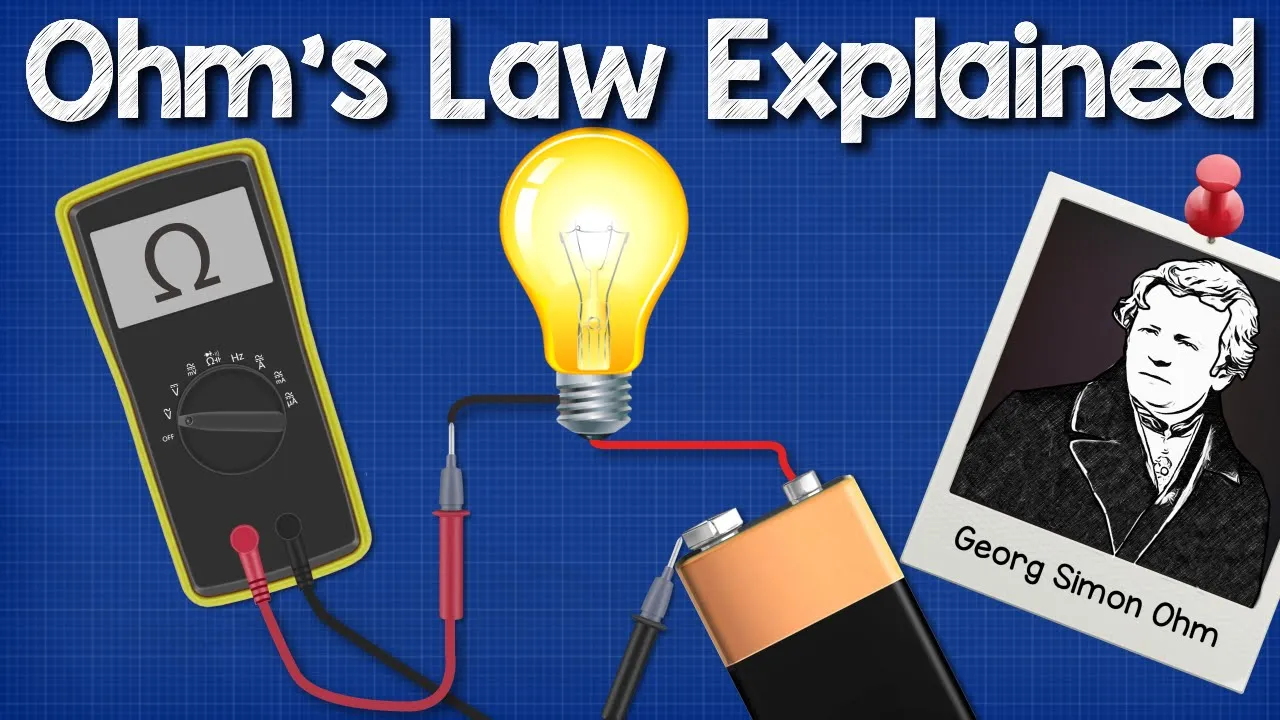
Watch from the beginning until 03:30. Focus on:
- The definition of Ohm's Law as the relationship between V, I, and R.
- The "Ohm's Triangle" mnemonic.
- The three algebraic variations of the law.
As the video explains, Ohm's Law can be expressed in three ways, all derived from the fundamental equation :
- Voltage: (Voltage equals Current multiplied by Resistance)
- Current: (Current equals Voltage divided by Resistance)
- Resistance: (Resistance equals Voltage divided by Current)
This simple algebraic relationship is one of the most powerful tools in circuit analysis.
2. The Physical Relationship and Proportionality
To build a deeper intuition, it's crucial to understand how these quantities influence one another physically. The next segments of the same video provide excellent visual examples.
Continue watching from 03:30 to 08:01.
As you watch, pay close attention to the conclusions drawn from the circuit examples:
- Current is directly proportional to voltage: If you keep the resistance constant and double the voltage (the "push"), the current (the "flow") also doubles. This is demonstrated from 03:30 to 05:22.
- Current is inversely proportional to resistance: If you keep the voltage constant and double the resistance (the "opposition"), the current is halved. This is shown from 05:22 to 08:01.
These proportionalities are the essence of Ohm's Law in a physical sense.
3. Resistance: Its Function in a Circuit
So far, we have treated resistance as a property. But what is its practical purpose? Resistors are fundamental components used to control the flow of current.
The next short segment in the video illustrates this perfectly.
Please watch from 07:46 to 09:06 in .
The key takeaway is that resistance is the opposition to the flow of current. In practice, we use components called resistors to intentionally introduce resistance into a circuit. A common application, as shown in the video, is to place a resistor in series with a component like an LED to limit the current to a safe level, preventing it from being damaged.
4. A Practical Note on Units
When applying Ohm's Law, it is critical to use consistent, base units to ensure your calculations are correct. Forgetting to convert from prefixes like milli- (m), micro- (μ), or kilo- (k) is a common source of error.
The next video explains this point clearly. Please watch this specific segment.
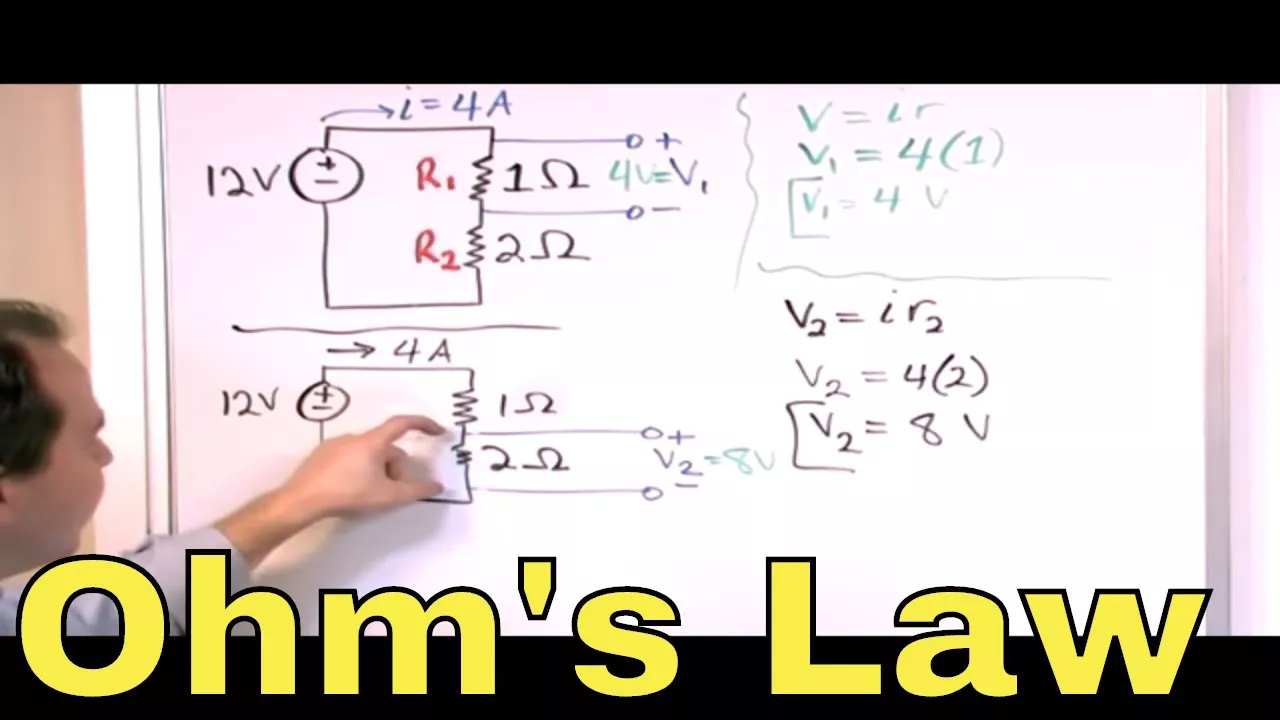
Watch the segment on handling units from 21:12 to 24:30.
The core principle is to always perform calculations using the base units:
- Voltage in Volts (V)
- Current in Amperes (A)
- Resistance in Ohms (Ω)
For example, if a circuit has a voltage of 50 millivolts (mV) and a current of 10 milliamps (mA), you must convert them before calculating resistance:
Then, you can apply Ohm's Law:
This habit will prevent many simple mistakes as circuits become more complex.
5. Test Your Knowledge
Now, let's apply what you've reviewed. The first video concludes with two practice problems. Try solving them on your own before checking the answers.
You can find the problems at 09:06 in .
Problem 1: A lamp has a resistance of 240 Ω. If you connect it to a 120 V outlet, what will the current be?
Problem 2: If you connect the same 240 Ω lamp to a different outlet and measure a current of 0.958 A, what is the voltage of the outlet?
Click to see the solutions
Solution 1:
We need to find the current (I).
Using Ohm's Law:
Solution 2:
We need to find the voltage (V).
Using Ohm's Law:
(This is the standard voltage in the UK, approximately 230 V).
Conclusion
In this lesson, we took a detailed look at Ohm's Law, a fundamental principle of radioelectronics. We covered:
- The mathematical relationship and its algebraic variations.
- The direct proportionality between voltage and current.
- The inverse proportionality between current and resistance.
- The practical function of resistance as an opposition to current flow, used to control and protect circuits.
- The critical importance of using consistent base units (Volts, Amps, Ohms) in calculations.
Preview of Next Lesson:
A single resistor is simple to analyze. But what happens when you have multiple resistors in a circuit? In our next lesson, we will explore series and parallel circuits and learn how to calculate the equivalent resistance for these common combinations.