Hello! Welcome to your first lesson in "Radioelectronics: fundamentals, then advanced math."
Given your background in Radiophysics and Electronics, this initial module is designed as a refresher to solidify the foundational concepts we'll be building upon throughout the course. We'll start at the very beginning to ensure we have a strong, shared understanding of the core principles.
Introduction
Today's Topic: Review of Electrical Quantities: Charge, Current, Voltage, and Power.
This lesson addresses the first learning outcome of our "DC Circuit Fundamentals" module. We will revisit the four fundamental quantities that form the language of electronics. We'll start with conceptual definitions to rebuild your intuition and then move into practical formulas and problem-solving.
Time to complete: Approximately 45 minutes.
1. Conceptual Foundations: What Are We Measuring?
Before we jump into equations, let's rebuild the physical intuition behind these concepts. Your engineering degree will have covered this, but a quick review of the "why" is always a great starting point. The following video provides excellent analogies to help visualize what's happening inside a circuit.
Please watch these segments from "Voltage, Current and Power explained" by ALL ABOUT ELECTRONICS.
Charge (Q)
First, let's revisit electric charge—the fundamental property of matter that causes it to experience a force when placed in an electromagnetic field.
Watch the first segment on charge (00:00:21 - 00:02:46). Focus on:
- The role of electrons as mobile charge carriers in a conductor.
- The unit of charge: the Coulomb (C).
In essence, charge is the "stuff" that moves. All the other quantities we'll discuss are related to how this "stuff" behaves.
Current (I)
Current is what we get when charge is in motion. It's not just about the amount of charge, but how fast it's moving past a point.
Continue with the same video, watching the segment on current (00:02:46 - 00:05:16). Pay attention to:
- The definition of current as the rate of flow of charge.
- The water-flow analogy, which is a classic for a reason!
- The unit of current: the Ampere (A), where .
Mathematically, this is expressed as the derivative of charge with respect to time:
This definition highlights that current is a dynamic quantity.
Voltage (V)
What makes charge move? A "push" is needed. This electrical pressure or potential difference is what we call voltage. It's a measure of the energy available to move charge from one point to another.
Now watch the segment on voltage (00:07:00 - 00:10:42). Focus on:
- The definition of voltage as energy per unit charge.
- The unit of voltage: the Volt (V), where .
The fundamental relationship here is:
where is the work done or energy transferred. This is a more fundamental definition than Ohm's Law, as it applies universally, not just to resistors.
Power (P)
Finally, power measures how quickly energy is being used or transferred. In an electrical context, it's the rate at which electrical energy is converted into another form (like heat or light).
Watch the final segment on power (00:10:42 - 00:14:44). Note how the video derives the main power formula:
- Power is the rate of energy transfer ().
- By combining our previous definitions, we arrive at the classic formula:
- The unit of power is the Watt (W), where .
2. Practical Application and Formulas
Now that we've refreshed the concepts, let's see how they are applied in practice with the common formulas used for DC circuit analysis. The following video is very direct and problem-oriented, making it an excellent practical review.
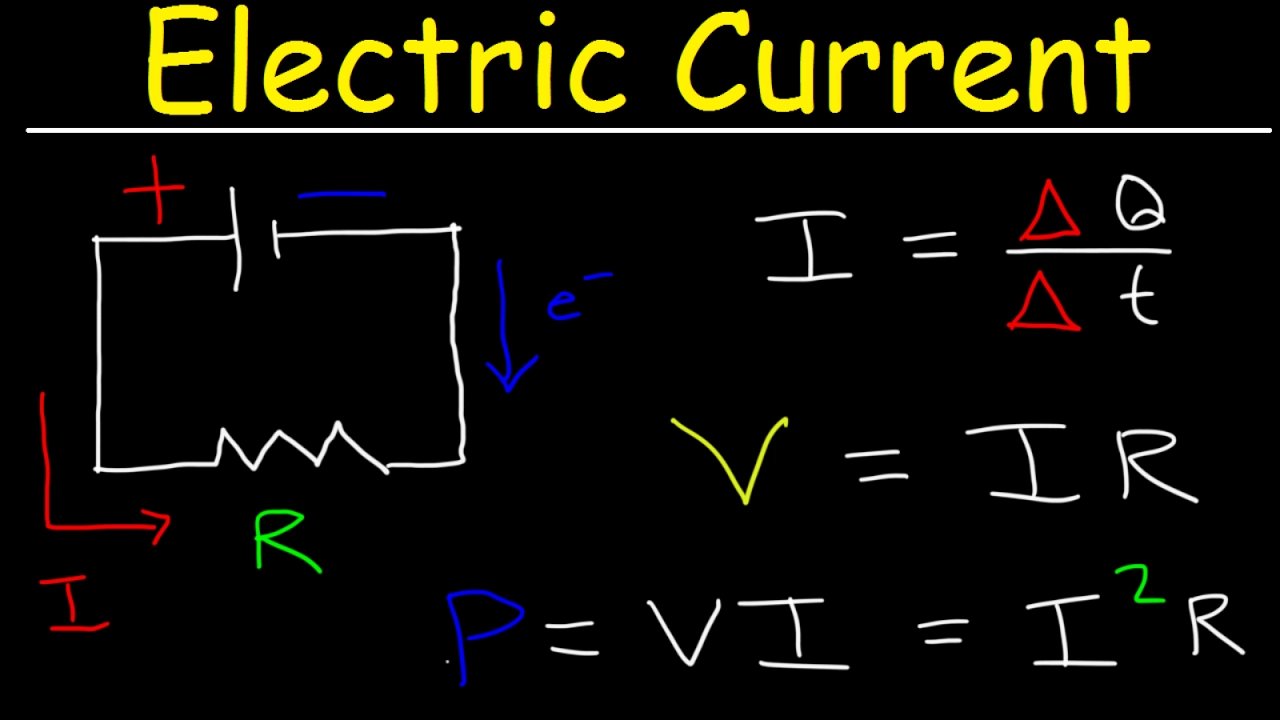
First, watch the introductory part of the video (00:00:41 - 00:03:55). This will give you a quick summary of the key formulas we'll use.
- Current:
- Ohm's Law: (We will explore this in depth in the next lesson)
- Power: , , and
Now, let's see these formulas in action. Follow along with the solved problems in the video to see how these fundamental relationships are used to analyze simple circuits.
- Charge Calculation: Watch from 00:03:55 to 00:06:11. This problem directly applies the definition of current to find the total charge.
- Current and Power: Watch from 00:06:11 to 00:09:10. Notice the use of Ohm's Law to find current and the demonstration that power delivered by the source equals the power dissipated by the resistor.
- Resistance and Power: Watch from 00:09:10 to 00:11:27. This is another good example reinforcing the relationship between P, V, and I.
- Putting It All Together: Finally, watch from 00:14:49 to 00:18:10. This problem starts with charge and time, calculates current, and then uses that to find power—a great summary of the flow of logic.
Summary Table
Here is a quick reference table summarizing the four fundamental quantities:
| Quantity | Symbol | Unit | Defining Relationship | Analogy (from videos) |
|---|---|---|---|---|
| Charge | Coulomb (C) | Fundamental property of matter | Water molecules | |
| Current | Ampere (A) | Rate of flow of charge: | Water flow rate | |
| Voltage | Volt (V) | Energy per unit charge: | Water pressure / pump | |
| Power | Watt (W) | Rate of energy transfer: | The work the water can do |
Conclusion
In this lesson, we refreshed our understanding of the four pillars of electronics:
- Charge (Q): The basic quantity of electricity.
- Current (I): The flow rate of charge.
- Voltage (V): The energy that drives the current.
- Power (P): The rate at which energy is delivered or consumed.
We started with conceptual definitions to build intuition and then moved to the mathematical formulas used in circuit analysis, applying them to solve practical problems.
Preview of Next Lesson:
In the videos, you saw the formula used frequently. This is Ohm's Law. In our next lesson, we will dedicate our time to this crucial law, exploring the concept of Resistance and how it acts as the link between voltage and current in many materials and components.