
Hello again. In the previous lesson, you learned to spot strategic interdependence: a situation in which your outcome depends on what other people choose, while their outcome depends in part on you. The practical question was: Must I think about someone else’s likely choice to judge my own?
Recognising a game is only the first step. This lesson gives you a compact way to make that interaction visible. By the end, you will be able to describe a familiar situation on one page: who is making choices, what they can do, what they care about, when choices occur, and what each person knows at the moment of decision.
A game map: making an interaction inspectable
Game theory does not require you to reduce people to cold, predictable machines. A game map is simply a deliberate simplification: it identifies the decisions that matter in one bounded interaction.
The familiar three building blocks are a useful starting point.
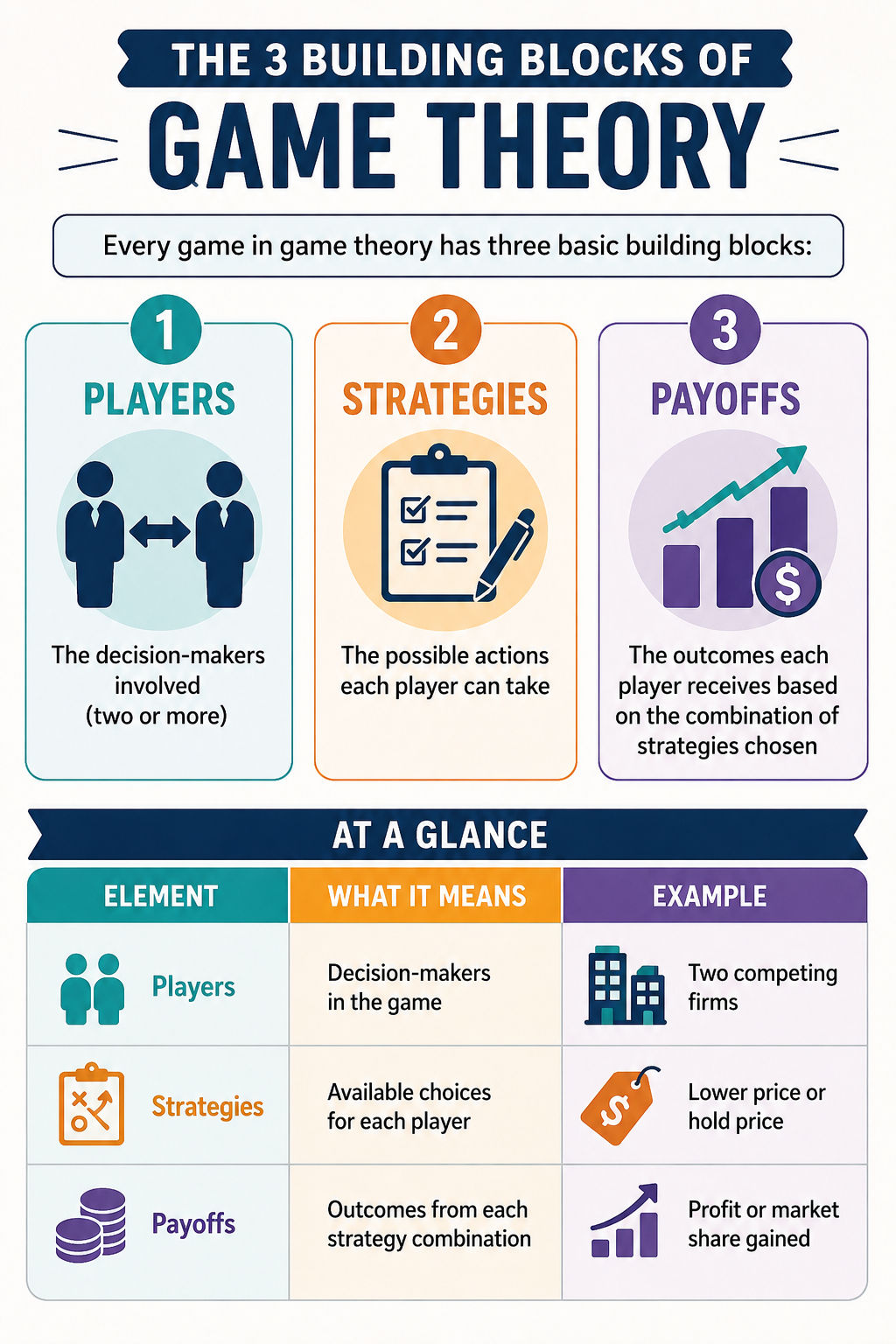
Watch What Actually Is Game Theory? from The Infographics Show for a quick visual refresher on players, strategies, payoffs, and mutual dependence.
Watch the core terms. Notice that strategies are the actions available to participants, while payoffs can be much broader than money. Also note the warning that participants may not have complete information; this will matter when you map real interactions.
For everyday strategic thinking, use this five-part model:
- Players — the people or groups making relevant choices.
- Choices — the feasible actions open to each player.
- Incentives and payoffs — what each player gains, loses, values, or tries to avoid as choices combine.
- Move order — who acts first, who can observe what, and when choices become fixed.
- Information — what is known, private, uncertain, or inferred at the time of choice.
4.2 Social interactions: Game theory - The Economy 2.0
Read CORE Economics’ concise definition of a game. It provides the formal backbone for the one-page map you will use throughout the course.
In the opening farmers example, begin with the setup. Then continue to the subsection titled “Game” and read its full five-item list. Focus especially on the distinction between feasible strategies, order of play, information, and pay-offs. These are assumptions about a particular interaction, not permanent facts about the people involved.
The crucial word is relevant. A customer, manager, algorithm, policy, or distant stakeholder may affect the stakes, but is not automatically a player in your map. They become a player only if they make a choice that can meaningfully respond to the focal interaction.
For example, if two colleagues decide whether to help one another with a deadline, their manager’s performance standards may shape the payoff. But if the manager will make no decision until next month, the manager is part of the background, not a player in this small game. If the colleagues can ask the manager for a deadline extension and the manager may approve or refuse, then the manager belongs in a wider version of the game.
The boundary you choose is not “the one true model.” It is a useful frame for the decision currently in front of you.
The difference between choices, incentives, and outcomes
These terms are easy to blur together, so it is worth separating them carefully.
A choice is an action a player can realistically take. “Send the draft today,” “ask for help,” “accept the offer,” “wait,” and “decline” are choices. A choice should be specific enough that an observer could usually tell which one was made.
An incentive is a reason an option may look attractive or unattractive. It may include time, money, convenience, reputation, fairness, autonomy, comfort, trust, status, or concern for another person. People often have several incentives at once, pointing in different directions.
A payoff is the overall result for a player once the participants’ choices meet. In a workplace interaction, a payoff might combine:
- whether the work is completed well;
- how much time or stress each person experienced;
- who receives credit or blame;
- whether the arrangement seems fair;
- what the interaction does to trust next time.
You do not need to assign numbers to these elements. Indeed, invented precision can hide uncertainty. At this stage, phrases such as “high effort but reliable outcome,” “short-term relief but damaged trust,” or “good result if both contribute” are often better than arbitrary scores.
One useful discipline is this:
Do not write “Alex wants respect” as a payoff. Write how a particular combination of choices may produce or threaten respect.
This keeps the map connected to observable decisions. It also prevents a common strategic error: treating a guess about someone’s personality as established fact.
A worked map: preparing a shared client briefing
Consider a realistic, bounded situation.
Aisha and Ben jointly own a client briefing due the next morning. Either person could prepare a usable first draft, although doing so takes several hours. On Monday afternoon, both must independently decide whether to prepare the draft now or postpone it. They have agreed not to check the shared workspace until after the decision deadline.
This is not a model of their entire working relationship. It is a map of one decision window: the independent preparation decision before the first draft is visible.
| Map field | Description |
|---|---|
| Players | Aisha and Ben. Each can decide whether to prepare the draft during the defined window. The client and manager affect the stakes but do not make a decision in this version. |
| Choices | Each person can prepare a usable draft or postpone preparation. These are deliberately broad choices; the map does not yet distinguish every writing style or level of effort. |
| Incentives | Both may care about a strong client outcome, avoiding embarrassment, protecting their evening, receiving credit, and being treated fairly. Their priorities may differ. |
| Joint outcomes | If both prepare, the briefing is likely strong, but effort may be duplicated. If one prepares and the other postpones, the team has a draft but the preparer bears most of the cost and may feel exploited. If both postpone, the briefing is likely rushed, incomplete, or stressful. |
| Move order | The choices are simultaneous in the game-theory sense: neither can observe the other’s decision before committing. This does not require identical clock times; it means neither gets to revise after seeing the other’s choice. The choices become visible after the cutoff. |
| Information | Both know the deadline, the client’s expectations, and that either person is capable of drafting. Aisha may not know Ben’s workload, energy, or actual intention. Ben may not know how strongly Aisha values fairness relative to the client outcome. |
This table reveals why the situation is strategic. “Prepare” has no single fixed value. It looks different depending on whether the other person also prepares.
Notice, too, what the map does not claim. It does not assert that Ben is lazy or that Aisha is altruistic. It records uncertainty more honestly:
- “Ben’s workload is privately known to Ben.”
- “Aisha’s willingness to cover the task is uncertain.”
- “Both can observe whether a draft exists after the cutoff.”
That is already enough structure to reason better.
Why move order can change the game
Now alter one feature. Suppose Ben messages Aisha before the deadline: “I have another urgent task. Can you take the briefing if I handle the client follow-up tomorrow?”
The interaction is no longer well described as two silent, simultaneous decisions. Communication has created a sequential interaction. Aisha receives information before deciding, and Ben’s message may make a response possible: accept the division, counter with another proposal, or refuse.
In a sequential interaction, a “strategy” can become a conditional plan, such as:
“If I receive a clear request paired with a concrete reciprocal contribution, I will prepare the draft; otherwise, I will ask for a narrower division of work.”
You do not need to decide whether that is the best rule yet. The important point is that an accurate map records the order in which information and choices appear. A simultaneous map and a sequential map can describe the same people facing the same broad issue while leading to very different expectations.
Information: known facts, private facts, and assumptions
Real life rarely supplies the clean certainty of a board game. A useful map separates three kinds of information.
Shared known facts
These are facts both participants know and can reasonably expect the other to know: a public deadline, a written policy, a price displayed in a store, or a meeting time in a shared calendar.
Sometimes you may hear the term common knowledge. For now, use it informally to mean not merely “we both know it,” but “we both know that the other knows it too.” A deadline in a shared project system is closer to common knowledge than a deadline mentioned casually in one private conversation.
Private information
A player may know something relevant that another player does not: their budget, workload, alternative offer, emotional capacity, or willingness to walk away. Private information does not imply dishonesty. It is simply information that has not been shared or verified.
Uncertain interpretations
You may observe an action but remain uncertain about its meaning. A delayed reply could reflect overload, disagreement, a technical problem, or avoidance. Your map should record the observable fact separately from your interpretation.
Compare:
- Observation: “They have not replied for two days.”
- Inference: “They may be avoiding the request.”
- Assumption presented as fact: “They do not care about the project.”
The first is evidence. The second is a useful hypothesis to test. The third is an unjustified conclusion unless you have strong supporting information.
This distinction is especially important for communication. Many avoidable conflicts begin when someone responds strategically to an assumed motive rather than to a known choice or constraint.
Your one-page mapping method
Choose a low-stakes interaction from the past week or one likely to occur soon. Suitable examples include organising a shared activity, deciding how to divide a household task, asking someone for input, setting a deadline with a colleague, or choosing whether to raise a concern in a group.
Keep the map narrow. Instead of “my relationship with my teammate,” write something like: “whether we each review the proposal before Wednesday’s meeting.”
Use the following template. Aim for one page, not a complete biography of everyone involved.
| Field | Write this |
|---|---|
| Frame | Name the specific decision and the time window. State what is inside and outside the map. |
| Players | List people or groups with a relevant choice. Move non-decision-making stakeholders to the background. |
| Choices | Give each player two to four realistic options. If someone acts after observing another, include their possible responses. |
| Incentives | State what each player plausibly values or wishes to avoid. Include non-financial concerns such as time, autonomy, fairness, reputation, or relationship quality. |
| Joint outcomes | Briefly describe what happens under the main combinations of choices. Do not assume that your preferred outcome is automatically theirs. |
| Move order | Record who acts first, what becomes observable, and when a choice becomes difficult to reverse. If choices are simultaneous, state what participants cannot see before committing. |
| Information | Divide relevant facts into shared knowledge, private information, and uncertainties. Label assumptions explicitly. |
| Assumptions | Write any simplifying decision you made: for example, “I treat the manager as background because they will not decide during this interaction.” |
When you finish, use this short quality check:
- Every named player has at least one meaningful choice.
- Every choice is feasible in the situation as you have framed it.
- Incentives describe what matters to each player, not merely what matters to you.
- The move order reflects what actually happens, rather than forcing the interaction into a neat grid.
- Unknowns remain unknown. You have not silently converted guesses into facts.
- The map is small enough that someone else could understand the decision situation in a minute or two.
A strong map is not the one with the most detail. It is the one that makes the relevant dependencies clear.
Key takeaways
A game map turns a vague social situation into a structured decision model. For any strategically interdependent interaction, identify:
- players with relevant agency;
- choices each player can actually make;
- incentives and payoffs created by combinations of choices;
- move order, including what can be observed before commitment;
- information that is shared, private, or uncertain.
The map is not a tool for reading minds. It is a way to make your assumptions visible, distinguish facts from inferences, and notice where communication could change the interaction.
Next, you will use these maps to diagnose the central challenge in a situation: are people mainly trying to coordinate, sustain cooperation, or manage conflict?
Can't find a good explanation? Sign up and we'll make it for you
Sign up