
Welcome back. You can now recognize a strategic interaction and map its players, choices, incentives, move order, and information. That map gives you the raw material for a more practical question:
What is the actual strategic difficulty here?
People often call any tense group situation a “conflict,” but that can lead to the wrong response. Sometimes people fundamentally want compatible outcomes but need to choose the same option. Sometimes everyone wants the shared result, yet each person is tempted to let others carry the cost. And sometimes the participants genuinely prefer incompatible outcomes.
By the end of this lesson, you will be able to diagnose whether an everyday interaction is mainly a problem of coordination, cooperation, or conflict—and state what evidence supports that diagnosis.
Three different obstacles to getting a good result
These labels describe the structure of incentives, not people’s personalities or moral character.
Coordination: “We need to line up our choices”
A coordination problem occurs when people broadly want a compatible result, but success depends on selecting compatible actions, standards, timing, or conventions.
Imagine two colleagues who both want a meeting, but one joins a video call while the other waits in a physical meeting room. Neither is trying to exploit the other. The failure is that their choices did not match.
Common coordination problems include:
- choosing a time and place to meet;
- agreeing which document version is authoritative;
- deciding who speaks first in a presentation;
- using the same standard, format, or tool;
- merging safely into traffic or taking turns at a narrow passage.
The key question is:
If we could reliably choose compatible actions, would that mostly solve the problem?
If yes, coordination is probably central.
A coordination problem can still contain small disagreements. Two friends may both want to meet but prefer different cafés. That does not erase the shared interest in meeting; it means they need a way to settle on one acceptable focal option.
Cooperation: “We all benefit, but will everyone contribute?”
A cooperation problem occurs when people would be better off if everyone contributed or restrained themselves, but each individual has a private incentive to avoid the cost while still benefiting from others’ effort.
Consider a shared team inbox. Everyone benefits when messages are answered promptly. Yet each person may prefer that someone else handles the unpleasant or time-consuming requests. If enough people make that individually understandable choice, the common benefit deteriorates.
The key question is:
Would everyone prefer mutual contribution to mutual non-contribution, while each person is tempted to hold back or free-ride?
If yes, the main challenge is cooperation.
This use of “cooperation” is structural, not moralistic. Someone may fail to contribute because of workload, unclear expectations, fear of being exploited, or a belief that their effort will not matter—not because they are selfish by nature.
Conflict: “Our preferred outcomes clash”
A conflict problem occurs when participants have genuinely incompatible preferences over the central outcome. One person’s preferred result makes the other worse off, at least on the issue currently being decided.
For instance, two teams may both need the same meeting room at the same time. If only one team can use it, their interests conflict over that scarce resource. Similarly, a buyer prefers a lower price while a seller prefers a higher price, all else equal.
The key question is:
Even if we understood each other perfectly and coordinated flawlessly, would one side still be dissatisfied with the central outcome?
If yes, conflict is central.
Conflict does not have to be a pure win-lose contest. A salary discussion, for example, can contain conflict over how a fixed budget is divided, while also containing shared interests in retaining a good employee and sustaining a working relationship. The useful diagnosis is not “there is no common ground”; it is “the current bottleneck is a disagreement over whose preferred outcome prevails, or how a limited resource is divided.”
6.3 Collective Dilemmas: Making Group Decisions - Introduction to Political Science | OpenStax
Read this short OpenStax discussion for a compact account of the three sources of group difficulty: opposing preferences, agreement on a goal but difficulty aligning details, and individual incentives that undermine a shared interest.
In the section “Causes of Collective Dilemmas,” read the three causes. Notice that the distinction rests on preferences and incentives, not on whether people happen to be arguing. Then read the section “Solutions to Collective Dilemmas When There Is General Agreement,” beginning with the definition of coordination problems. Focus on the idea that broad agreement does not automatically tell a group which specific option or procedure to choose.
Diagnose the structure, not the surface story
The same physical situation can have different strategic structures depending on the incentives. A narrow road, a shared calendar, or a group chat is not itself a coordination, cooperation, or conflict game. The relevant question is: what choices and payoffs does the situation create?
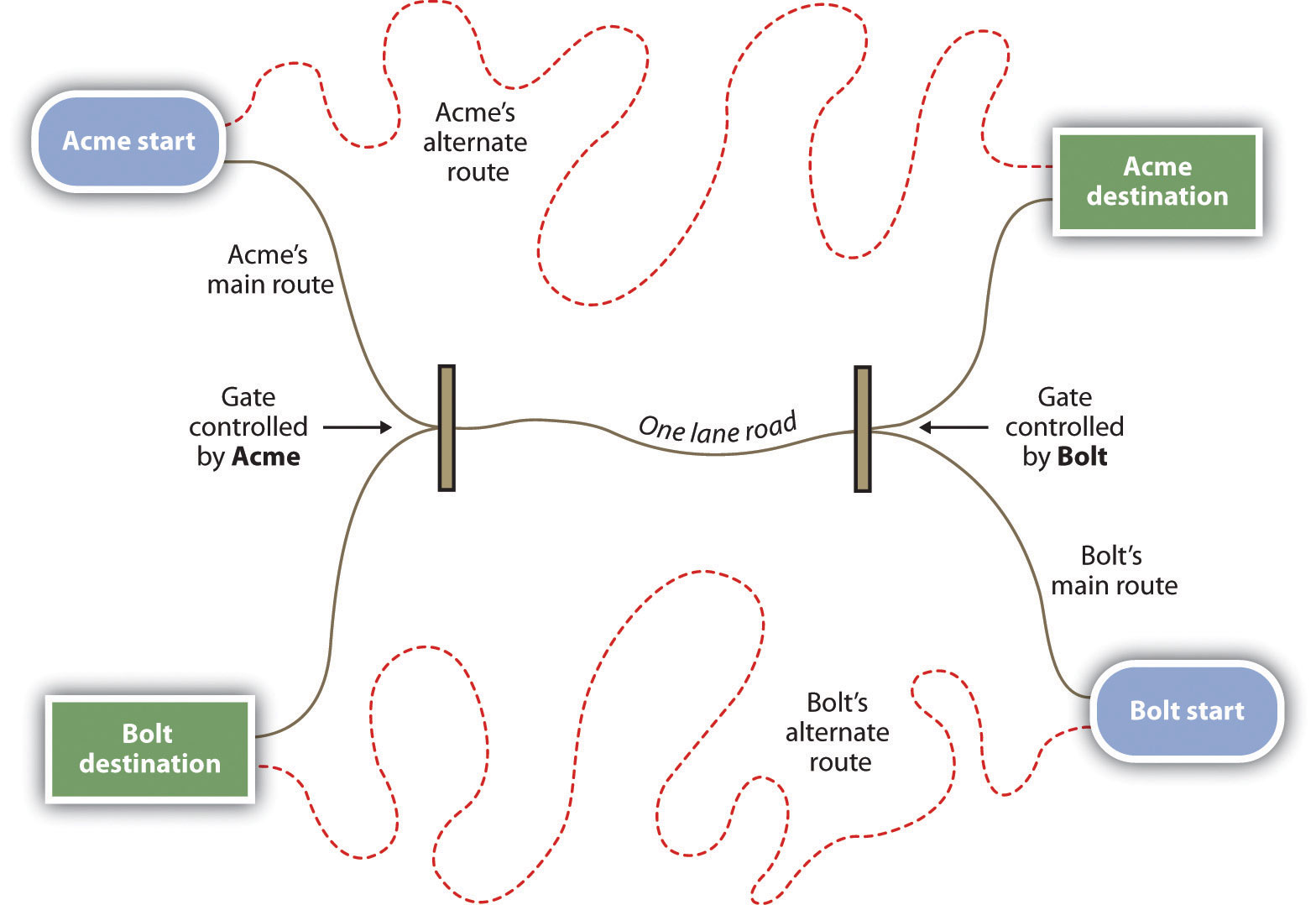
Take the Acme and Bolt road diagram. Suppose both parties mainly want safe, predictable passage through the one-lane segment. If they can agree on a schedule or a right-of-way rule, both benefit. The central issue is coordination.
Now change the incentives. Suppose each party gains a large advantage by claiming priority, while the other bears the delay. The road has become a conflict over priority.
Or suppose both parties would benefit if each waited when appropriate, but each can save time by rushing toward the gate and assuming the other will yield. The difficulty is now cooperation: mutual restraint would be better, but unilateral impatience is tempting.
A good diagnostic therefore begins with the mapped choices from the previous lesson, then tests the incentives behind them.
| If you observe this pattern… | The main challenge is likely… | Ask yourself… |
|---|---|---|
| Participants benefit when they choose compatible options; mismatches are costly or inconvenient. | Coordination | “Which shared convention, timing, or option must we align on?” |
| Everyone would prefer that all contribute, but each can save effort or gain advantage by not contributing. | Cooperation | “Can someone benefit from others’ contribution while withholding their own?” |
| Participants prefer different winners, allocations, priorities, or outcomes. | Conflict | “Whose preferred outcome is being sacrificed, and can the contested resource be divided or expanded?” |
A four-step diagnostic
Use this sequence with an everyday situation.
-
State the shared decision narrowly.
“Who will cover the support shift on Friday?” is more useful than “our team has communication problems.” -
Describe the outcome everyone would ideally accept.
Is there an outcome that is clearly good for all participants, or are their preferred results different from the outset? -
Check for a mismatch problem.
If the main risk is that people choose different times, standards, or sides, diagnose coordination. -
Check for a temptation problem.
If mutual effort is beneficial but each person can gain by letting others do the work, diagnose cooperation. If the desired outcomes themselves remain incompatible, diagnose conflict.
This is not a rigid sorting machine. Many real interactions contain all three elements. Your goal is to identify the primary bottleneck: the obstacle that must be addressed first for the situation to improve.
Three everyday cases
Case 1: Choosing a platform for a client workshop
A facilitator prefers Zoom because it is familiar. A client prefers Teams because it is already approved internally. Both want the workshop to happen smoothly and are willing to use either platform if the other does too.
The main issue is coordination. There is a minor preference difference, but neither person needs the other to lose. A simple decision rule, such as “use the client’s approved platform unless it lacks a required feature,” can resolve the interaction.
A poor diagnosis would call this “a conflict of personalities.” That framing invites defensiveness. The better framing is: “We need one compatible choice and a clear default.”
Case 2: Maintaining a shared knowledge base
Several teammates all benefit when documentation is accurate: fewer repeated questions, faster onboarding, and more reliable operations. Updating a page takes time, however, and someone who skips the task can still benefit from everyone else’s updates.
The main issue is cooperation. The group’s preferred collective outcome is broad contribution, but individual incentives may favor postponing or free-riding. Merely agreeing that documentation matters is not enough; agreement about the goal does not remove the personal cost of contributing.
This structure is often called a collective action problem. It appears in shared household tasks, open-source maintenance, neighborhood initiatives, and common resources.
Case 3: Allocating a limited professional-development budget
Two employees both want the same fixed training budget. Funding one person’s course may leave insufficient money for the other’s course. They may still cooperate in presenting information or proposing a fair process, but their preferences over the allocation are not identical.
The main issue is conflict. A fair process, a split allocation, different timing, or finding additional funds may reduce the tension—but those are responses to a real clash over a scarce resource, not merely a failure to coordinate.
The distinction matters: asking the employees simply to “be aligned” hides the trade-off. A more honest first move is to make the competing interests and decision criteria explicit.
Why the Prisoner’s Dilemma is a cooperation problem
The classic Prisoner’s Dilemma has an adversarial story, but the strategic relationship between the two prisoners is mainly a cooperation problem.
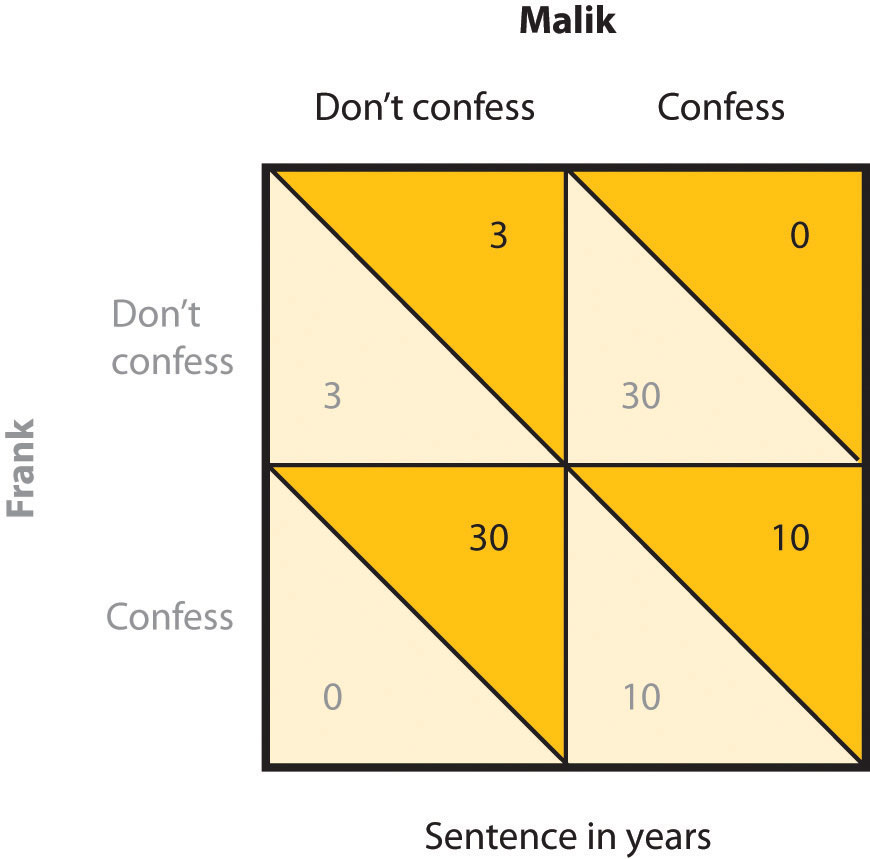
The crucial pattern is this:
- If both remain silent, both do relatively well.
- If one confesses while the other remains silent, the confessor does especially well and the silent person does especially badly.
- Because each fears being the only cooperative person, both may confess.
- Mutual confession is worse for both than mutual silence.
So the prisoners do not mainly need to settle on a convention, as in coordination. Nor do they simply disagree about who should receive a single prize, as in conflict. They face a shared interest in mutual restraint, alongside an individual temptation to abandon that restraint.
Prisoner’s Dilemma in Game Theory
Watch Ashley Hodgson’s “Prisoner’s Dilemma in Game Theory” for a visual walkthrough of this cooperation trap and two everyday-style extensions: shared resources and public goods.
Watch the core dilemma to see why mutual cooperation can be better for both participants while still being difficult to sustain. Then skip the technical discussion in the middle and watch everyday examples, which applies the same incentive structure to overfishing and a neighborhood-watch arrangement. As you watch, identify the private benefit of withholding effort and the collective cost when many people do so.
The Prisoner’s Dilemma will return in the next module. For now, retain only the diagnostic signature:
When the group would benefit from everyone contributing, but each person has a reason to protect themselves by withholding contribution, suspect a cooperation problem.
Choose language that fits the problem
Diagnosis improves communication because each structure calls for a different first conversation.
| Main challenge | Unhelpful opening | More useful opening |
|---|---|---|
| Coordination | “Why can nobody get organized?” | “Which option, rule, or timing do we need to align on?” |
| Cooperation | “People just do not care.” | “What contribution is expected, and what happens if some people carry the cost while others do not?” |
| Conflict | “We should all want the same thing.” | “Which interests are genuinely opposed, and what criteria or trade-offs could make the decision legitimate?” |
The revised language does not solve the situation automatically. It does something more basic and valuable: it makes the actual strategic problem discussable.
For a brief real-world field note, take a recent interaction and write three lines:
- Situation: What specific decision were people making?
- Primary structure: Coordination, cooperation, or conflict?
- Evidence: Which choice-and-incentive pattern led you to that classification?
Then add a second label only if it helps. For example: “Primarily cooperation, with a secondary coordination issue because responsibilities were never made visible.” This preserves nuance without losing the practical focus.
Key takeaways
Coordination, cooperation, and conflict are distinct strategic obstacles:
- Coordination means participants broadly benefit from compatible choices but need to align on an option, timing, rule, or standard.
- Cooperation means everyone benefits from mutual contribution or restraint, but each participant may be tempted to free-ride, defect, or protect themselves.
- Conflict means participants’ preferred outcomes are genuinely incompatible over the issue at hand, often because a resource, priority, or outcome must be divided.
Real situations can combine the three. Diagnose the primary bottleneck by examining choices and incentives rather than treating visible tension as proof of conflict.
Next, you will move from classification to prediction: you will practise switching perspectives, forecasting another participant’s likely move, and stating the assumptions behind that forecast.
Can't find a good explanation? Sign up and we'll make it for you
Sign up