
Hello, and welcome. This course treats game theory as a practical lens for everyday situations involving colleagues, friends, family, customers, and strangers—not as a branch of mathematics to master.
In this first module, Spot the Game Around You, you will learn to notice when an ordinary-looking decision is actually a strategic interaction. Today’s central idea is simple but consequential: a decision becomes strategic when what is best for you depends on what other people choose, and they are making similar calculations about you.
By the end, you should be able to distinguish a decision in a neutral environment from one that requires anticipating people’s incentives, likely responses, and expectations.
From “my decision” to “our interaction”
Many decisions are difficult without being strategic. Choosing whether to bring an umbrella depends on weather; deciding how long to study depends on your energy, deadline, and alternatives. The rain does not notice your plan and adapt to it. Your outcome may be uncertain, but it is not shaped by another decision-maker responding to you.
Now contrast that with deciding whether to raise a problem in a project meeting. Your outcome depends partly on whether a colleague supports, ignores, or challenges the concern. Their choice may depend on what they think you will do: Will you provide evidence? Escalate? Take responsibility for fixing it? Here, each person’s choice changes the environment faced by the other.
That is strategic interdependence.
A useful first definition is:
Your decision is strategically interdependent when the consequences of your choice depend on other people’s choices, and those people can in turn respond to, anticipate, or be affected by yours.
Game theory calls the people or groups making relevant choices players. “Player” does not imply manipulation, hostility, or literal play. It can mean two roommates managing chores, teams choosing whether to share information, neighbours deciding how much noise to tolerate, or organisations negotiating a contract.
The important distinction is not between friendly and unfriendly situations. It is between:
- a neutral environment, which does not form intentions or react to your choice; and
- an interactive environment, where other purposive decision-makers may react.
Econlib captures this contrast with a lumberjack and a general: wood does not resist the lumberjack’s plan, whereas an opponent will anticipate and resist a general’s plan. Everyday life includes many less dramatic versions of the second case.
Game Theory: A Simple Strategy That Will Change Your Life Forever
Watch Pursuit of Wonder’s “Game Theory: A Simple Strategy That Will Change Your Life Forever.” Its roommate scenario makes strategic interdependence concrete before introducing the formal idea.
Watch the roommate scenario. Notice that washing dishes is not merely a cleaning task: doing or not doing them can establish expectations and change the roommate’s future behaviour. Then watch the core definition, which connects such interactions to strategic planning. Do not worry yet about the video’s later advice; concentrate on identifying whose choices affect whose outcomes.
The dirty-dishes example contains a subtle point. If you wash everything yourself, the immediate kitchen outcome improves. But your action may also teach the roommate that leaving dishes has no cost. If you leave the dishes, you may suffer an unpleasant kitchen, but you may make the imbalance visible. The “best” move cannot be assessed solely from your own effort; it depends on how the roommate responds now and later.
That is the shift from individual optimization to strategic thinking.
Social effects are not always strategic games
It helps to separate two related ideas.
A social interaction exists when one person’s action affects another person’s outcome. For example, someone playing loud music late at night affects their neighbours’ sleep. Someone heating their home contributes, however slightly, to emissions that affect others.
A strategic interaction adds awareness: the participants understand, at least roughly, that their actions affect one another and make choices in light of that mutual dependence.
4.2 Social interactions: Game theory - The Economy 2.0
Read “Social and strategic interactions” from The Economy 2.0 by CORE Econ. It establishes the distinction between an action that affects others and a strategic interaction in which people recognize the mutual dependence.
In the section “Social and strategic interactions,” begin with the definition of social interactions. Continue through the definitions of “strategic interaction,” “strategy,” “game,” and “game theory,” ending after the four summary bullets. Focus particularly on why awareness of mutual effects matters: game theory is not a label for every situation involving more than one person.
Consider three versions of a noisy-neighbour situation:
-
Unnoticed spillover. A neighbour does not realise their speaker can be heard through the wall. Their music affects you, but they are not yet choosing with your outcome in mind. This is a social interaction, but only weakly strategic from their perspective.
-
Recognised conflict. You have complained, and the neighbour knows that continued noise may lead you to complain again, involve a landlord, or retaliate with noise of your own. Both people now have to consider the other’s likely response. The interaction is strategic.
-
Shared solution. You agree on quiet hours and a way to flag exceptions. The interaction remains strategic: each person still decides whether to keep the agreement. But communication has altered the available choices and expectations.
This distinction prevents a common mistake: treating “strategic” as synonymous with “selfish” or “competitive.” A strategic situation can involve conflict, cooperation, or both. A good team agreement, for instance, is strategic precisely because it accounts for what makes follow-through worthwhile for everyone.
The recognition test: should I think one move beyond myself?
When facing a decision, use this quick diagnostic. You do not need a payoff matrix, equations, or a formal model yet.
1. Is another person making a relevant choice?
The other person must have some meaningful discretion. A calendar system that automatically blocks an unavailable time is not a strategic player. A colleague deciding whether to accept, delay, or renegotiate a meeting is.
The relevant player may be an individual, a team, a customer, a manager, or a group. It need not be a named opponent.
2. Does their choice change what happens to you?
Ask: “Would my result differ if they chose differently?”
For example, whether you offer a discount to a prospective customer depends partly on whether the customer would otherwise leave, negotiate, buy immediately, or compare competitors. The same discount can be generous, unnecessary, or insufficient depending on that response.
3. Does your choice change what happens to them?
Strategic interdependence is usually mutual. Your response affects the other person’s incentives, options, reputation, workload, or beliefs about what will happen next.
In the customer example, a discount may affect not only whether they buy, but whether they expect discounts in future negotiations. In a workplace setting, taking over an overdue task may affect not only delivery but also who is expected to carry similar work next time.
4. Are people likely to anticipate or respond to one another?
This is the practical trigger. If the other participant can observe your action, infer something from it, or predict it based on a pattern, you have a strategic interaction.
Sometimes choices occur at the same time: two teams independently decide which proposal to prioritise. Sometimes they occur in sequence: one person makes an offer and another accepts, rejects, or counters. The order matters, but both forms are strategic because each person must take the other’s choices into account.
A compact version to remember is:
People + choices + mutual consequences + anticipation signal a strategic interaction.
Not every element must be perfectly visible. In real life, you often estimate another person’s priorities imperfectly. That uncertainty does not remove the game; it is often what makes the interaction challenging.
Reading a simple strategic situation
The following payoff matrix depicts a classic cooperation problem. Each person can cooperate or defect. The monetary values represent the outcome for “You” and the “Other Participant” under each combination of choices.
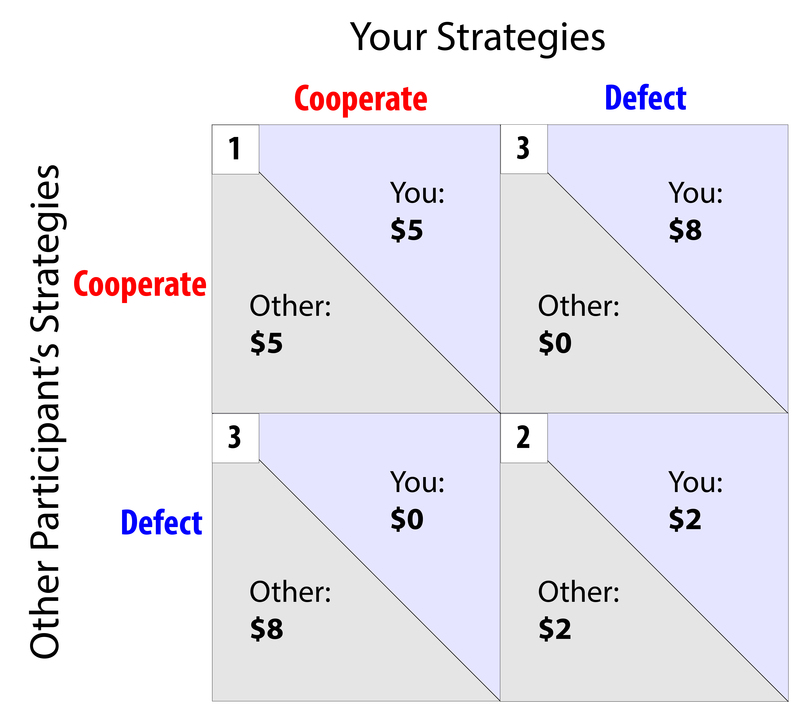
Do not try to solve this game yet. For today, use it to see the architecture of interdependence.
Suppose you choose cooperate. If the other person cooperates too, you receive $5. If they defect, you receive $0. The outcome of the same action by you changes because of their decision.
Now suppose you choose defect. If they cooperate, you receive $8; if they defect, you receive $2. Again, the other person’s choice changes the result of yours.
The same is true from the other participant’s perspective. Their outcome cannot be determined by their action alone. Each cell describes a joint outcome: what happens when both choices meet.
A payoff matrix is simply a disciplined way to make an everyday thought explicit:
- “If I act this way and they act that way, what happens?”
- “If I change my action while they do not, what changes?”
- “What will they expect me to do?”
In later lessons, you will use matrices to identify stable outcomes and explore why individually sensible choices can produce a result neither person particularly likes. For now, the key is recognising why this is a game at all: neither participant controls their outcome alone.
Everyday examples: game or not?
The strategic lens is useful only if applied selectively. Here are several common situations.
| Situation | Strategic? | Why |
|---|---|---|
| Choosing a personal workout based on the weather | Usually no | Weather affects the result but does not choose in response to you. |
| Selecting a route during rush hour | Often yes | Other drivers’ route choices shape congestion; your choice is part of that collective pattern. |
| Deciding whether to reply to a tense message immediately | Yes | Timing and tone influence the other person’s interpretation and likely reply. |
| Setting an alarm for an early flight | No | The alarm does not adapt its choice to yours. |
| Choosing whether to share useful information with another team | Yes | Their use, reciprocity, and future willingness to share affect whether your choice pays off. |
| Buying the only brand you genuinely prefer at a fixed price | Usually no | There may be a market in the background, but no relevant person is responding to this particular choice. |
| Negotiating a project deadline | Yes | Each side’s agreement, concessions, and alternatives affect the final outcome. |
Notice the word relevant. Nearly everything has distant social consequences, but not every decision deserves a game-theory analysis. If a participant’s response is too remote, fixed, or insignificant to change your decision, treat it as background rather than as an active player.
For example, online shopping occurs in a market involving firms, other buyers, and pricing algorithms. Yet a routine purchase may not require strategic thinking from the buyer. By contrast, bidding for a scarce item, negotiating with a seller, or deciding whether to wait for a discount clearly does.
The practical question is not “Are there other humans somewhere in the system?” It is:
“To make a good decision here, must I form a view about what someone else will choose?”
If yes, pause before treating the problem as purely technical, personal, or logistical.
A short real-world scan
Over the next day, notice three decisions you face. For each, write one sentence using this frame:
“This is / is not strategically interdependent because my outcome depends on whether [person or group] chooses [relevant action], and they may respond to [my action or expected action].”
Keep the analysis deliberately small. The aim is not to predict people perfectly. It is to train the habit of locating the point where another person’s agency enters your decision.
For instance:
“Whether I volunteer to repair a recurring reporting issue is strategically interdependent because the team may treat my intervention as a one-off contribution or as a signal that I will always take ownership.”
That sentence does not tell you what to do. It does reveal that “Should I fix it?” has a second layer: “What behaviour will this action invite or discourage?”
This is also why strategic thinking should remain ethical. Recognising incentives and responses is not a licence to exploit people. It can instead help you create clearer agreements, avoid accidental escalation, and choose actions that make constructive cooperation easier.
Key takeaways
A strategic interaction is present when people make relevant choices whose consequences are mutually dependent—and when participants can anticipate or respond to one another.
Remember these distinctions:
- Difficulty or uncertainty alone does not make a decision strategic.
- An action can affect others without yet being fully strategic; strategic reasoning becomes central when people recognise the mutual effects.
- Strategy is not only about winning conflicts. It also applies to coordination, trust, communication, and shared problem-solving.
- The most useful diagnostic question is: Must I consider what another person will choose in order to judge my own choice?
Next, you will take a situation you have recognised as strategic and map it clearly on one page: who is involved, what each person can do, what they care about, what they know, and who moves when.
Can't find a good explanation? Sign up and we'll make it for you
Sign up