
Welcome back. In the previous lesson, you mapped the B2B SaaS O2C lifecycle from customer and order setup through billing, AR, collections, cash application, revenue recognition, and close. The key insight was that these are connected operating streams: a commercial-data problem upstream can become an invoice dispute, delayed payment, or close issue downstream.
A process map tells people what happens and in what sequence. This lesson adds the governance layer: who owns the outcome, who performs the work, whose input is required, and who simply needs an update. You will build a practical RACI model for the cross-functional O2C process.
RACI: clarify ownership without pretending one team does everything
A RACI matrix assigns roles to process activities:
| Letter | Meaning | Practical O2C interpretation |
|---|---|---|
| R — Responsible | Performs the work | Creates the order, generates the invoice, applies the receipt, performs a reconciliation |
| A — Accountable | Owns the outcome and final decision | Accepts that an order is ready for billing, owns invoice accuracy, signs off a completed close activity |
| C — Consulted | Gives required input before completion | Legal comments on contract terms; Revenue Accounting assesses revenue implications |
| I — Informed | Receives an update after a decision or outcome | Customer Success is informed that a customer is on credit hold or that a subscription is activated |
The distinction between Responsible and Accountable is the one managers need to make most carefully:
- The Responsible role does the work.
- The Accountable role ensures the work is completed to the required standard, resolves escalation, and makes the final call where a decision is needed.
- One role can be both A and R, especially in a smaller company. For example, a Billing Operations Manager may both approve the release of an invoice batch and run the final validation.
- A process activity should normally have one Accountable role. Two accountable roles usually means that neither has clear authority when an exception occurs.
Importantly, assign RACI to roles, not named individuals. “Billing Operations Manager” remains meaningful even if the current manager changes. Later, an operating procedure can identify the named person currently filling that role.
RACI explained its simple yet powerful - The most watched RACI matrix video on YouTube
Watch RACI explained its simple yet powerful from the RACI channel. It gives a concise explanation of why role clarity matters and how to check a RACI for gaps and overlaps.
Start with roles versus people to distinguish a durable role from an individual employee. Then watch Responsible and Accountable and the RACI chart. Finish with the quality checks, focusing on the warning signs of multiple Accountable roles, too many Responsible roles, or excessive consultation.
A useful rule of thumb is this:
Assign accountability to the role with the authority to accept the output, resolve exceptions, and be measured on the result.
That is different from assigning accountability to the person who is merely most affected by the outcome. For example, Sales may be affected when an invoice is delayed, but Billing Operations should generally be accountable for issuing a correct invoice once the order is released.
Turn broad process stages into ownable activities
The previous process map included broad stages such as “contract and order setup” and “billing.” Those are useful for orientation, but too broad for a RACI row.
Consider a signed contract that lacks a required customer purchase-order number:
- Sales may need to obtain the PO from the customer.
- Deal Desk or RevOps may need to correct the structured order data.
- Billing Operations needs to decide whether the order meets its release requirements.
- Revenue Accounting may need to assess an unusual billing structure.
- Customer Success may need to know that activation is delayed.
If the RACI row were simply called “Order setup,” it could have several possible accountable owners. That is a warning that the activity needs to be divided into clearer actions:
- Create the structured order and billing schedule.
- Validate the order against the executed agreement.
- Accept and release the order for billing.
- Escalate or reject incomplete orders.
This decomposition does not create bureaucracy. It prevents the familiar situation in which Sales says “Finance owns it,” Finance says “Sales has not provided the data,” and the customer waits without an owner.
The following practitioner-oriented overview is useful because it names owners across the commercial and financial lifecycle. Treat its assignments as a starting point rather than a universal organization chart: the correct model depends on which team has decision rights in your company.
Quote to cash process: Step-by-step breakdown for SaaS
Read the relevant operational stages in Alguna’s Quote to cash process: Step-by-step breakdown for SaaS. It shows how ownership can shift from Sales and RevOps into Billing Operations, AR, and Revenue Accounting as a deal becomes a financial transaction.
In “Quote to cash process: Step-by-step overview,” begin with Step 5, “Sales to finance handoff.” Read the finance handoff and identify the data that must be owned before Billing can act. Then read Step 6, “Create the order and activate the subscription,” focusing on order creation. Continue through Steps 9 and 10, “Invoice generation” and “Collections and payments,” paying attention to their stated owners and outputs. Finally, in Step 11, “Revenue recognition and close,” read revenue ownership. Notice that the article separates operational execution from financial accountability.
A reference RACI for commercial setup through billing
The image below gives a high-level Quote-to-Cash view. It appropriately groups work under Sales, Legal, RevOps, Customer Success, and Finance. An O2C manager, however, needs a more detailed view inside “Finance”: Billing, AR, Cash Application, Revenue Accounting, and the Controller have related but different accountabilities.
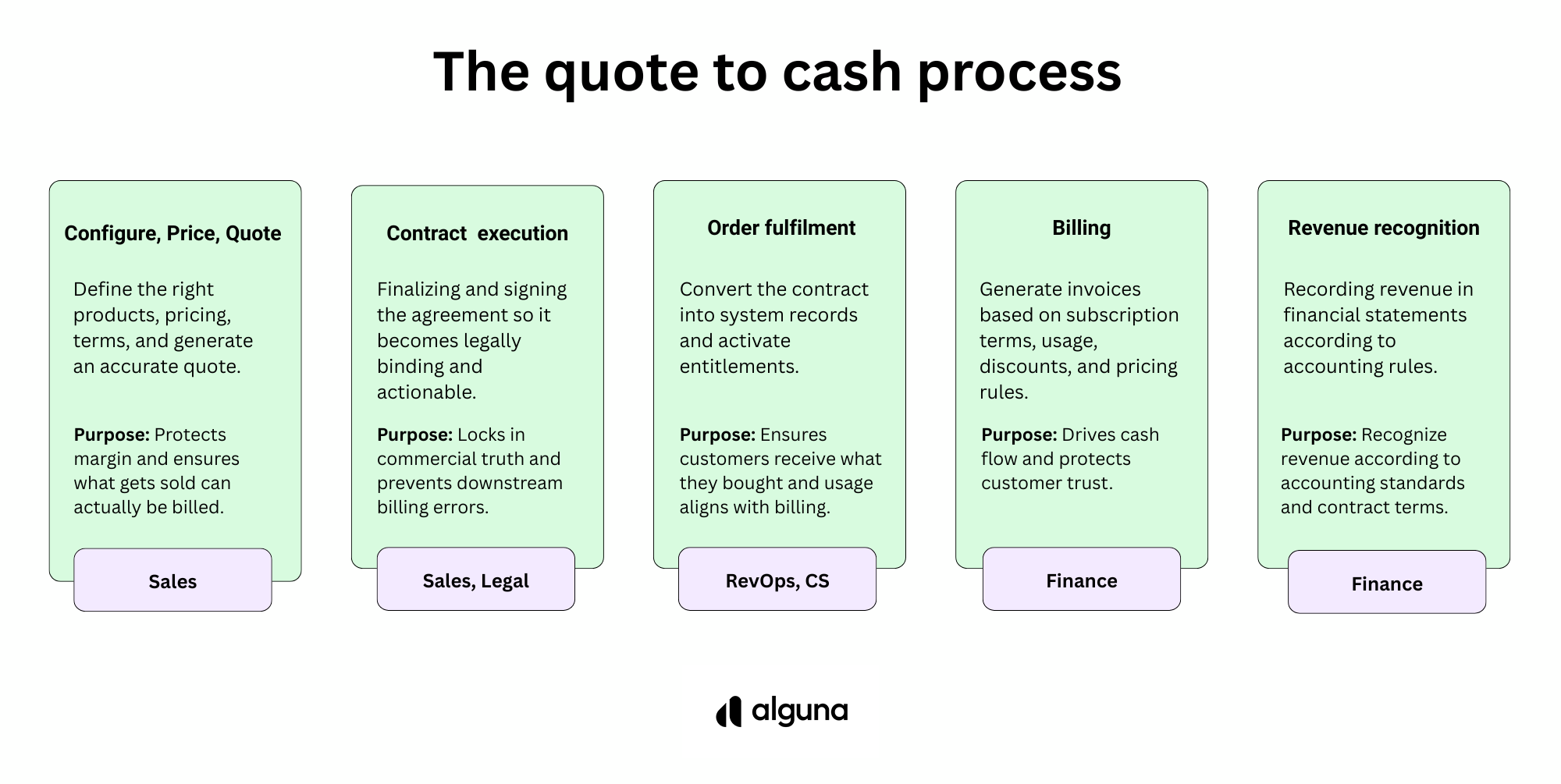
For the reference model below, use these role abbreviations:
- S: Sales / Account Executive
- D: Deal Desk / RevOps
- L: Legal
- B: Billing Operations / Order Management
- CS: Customer Success / Implementation
- RA: Revenue Accounting
A dash means the role has no routine participation in that activity. It does not mean the role can never become involved in an escalation.
| O2C activity | S | D | L | B | CS | RA |
|---|---|---|---|---|---|---|
| 1. Establish customer master and billing profile | R | A/R | I | C | I | C |
| 2. Approve standard commercial package and execute contract | R | A | R | C | C | C |
| 3. Create structured order and billing schedule from the executed agreement | I | A | I | R | C | C |
| 4. Validate and release the order for billing | I | C | I | A/R | C | C |
| 5. Confirm service activation or billable start date | I | I | I | C | A/R | C |
| 6. Generate, validate, and issue invoice or approved credit | I | I | I | A/R | C | C |
Why these assignments work
Customer master and billing profile. Sales is responsible for obtaining accurate legal-entity and contact information from the customer. RevOps is accountable because it normally governs CRM data quality and converts commercial information into structured operational data. Billing Operations and Revenue Accounting are consulted because payment terms, billing entity, tax information, currency, and contract structure must work downstream.
Commercial package and contract execution. Deal Desk or RevOps is accountable for the standard commercial package because it owns the rules around pricing, discount approvals, deal structure, and documented exceptions. Legal is responsible for its legal review and contract execution work. In a highly nonstandard legal negotiation, create a separate RACI row such as “Approve material legal deviation” with Legal as Accountable. Do not solve that situation by adding a second A to the standard deal-approval row.
Structured order and billing schedule. Billing Operations is responsible for creating the operational record, while RevOps remains accountable for the accuracy of the deal package being translated. This distinction is particularly useful when contract data is incomplete: Billing Operations can return the order for correction, but does not own the commercial decision embedded in the contract.
Order release. Billing Operations becomes accountable when the question is: Can this order safely enter billing? This is a different question from whether the commercial agreement was approved. Billing should be able to reject an order that is missing required data, even when Sales considers the deal closed.
Activation and billable start date. Customer Success or Implementation is accountable because it owns evidence that the customer can receive the service. Billing and Revenue Accounting are consulted because activation dates can determine invoice timing and revenue schedules.
Invoice or credit issuance. Billing Operations is accountable for the billing output. Customer Success may be consulted when the charge depends on implementation completion or customer access. Revenue Accounting is consulted on unusual credits, modifications, or contract terms that may affect the revenue assessment.
This division gives each team a meaningful boundary:
- Sales owns the accuracy of customer-facing commercial inputs.
- Deal Desk and RevOps own structured, approved deal data.
- Billing Operations owns whether operational data is fit to bill and whether billing output is accurate.
- Customer Success owns evidence of delivery or service availability.
- Revenue Accounting owns the accounting assessment, rather than the mechanics of invoice production.
A reference RACI from receivables to close
Once invoices are issued, the ownership model must become more specific. “Finance” is too broad to diagnose overdue receivables, unapplied cash, or a failed AR reconciliation.
Use these abbreviations for the downstream matrix:
- B: Billing Operations
- CS: Customer Success / Implementation
- AR: Accounts Receivable and Collections
- CA: Cash Application
- RA: Revenue Accounting
- C: Controller / General Ledger Accounting
| O2C activity | B | CS | AR | CA | RA | C |
|---|---|---|---|---|---|---|
| 7. Monitor open AR, manage collections, and triage disputes | C | C | A/R | I | I | I |
| 8. Identify receipts, apply cash, and control application exceptions | I | I | C | A/R | I | C |
| 9. Prepare and review revenue schedules and revenue entries | C | C | I | I | A/R | C |
| 10. Reconcile O2C subledgers and complete the O2C close | R | I | R | R | R | A |
Read the downstream ownership as a control design
AR and Collections. AR is accountable for the status of customer receivables: what is due, disputed, promised, overdue, or subject to escalation. Billing is consulted because many disputes require invoice correction. Customer Success is consulted when the dispute concerns service delivery, adoption, or a customer relationship issue.
Cash Application. Cash Application is accountable for timely, accurate receipt matching and controlled treatment of exceptions. AR is consulted because payment application changes the customer’s open balance and can affect collection actions. The Controller is consulted where bank reconciliation evidence, posting exceptions, or significant unidentified cash requires accounting attention.
Revenue Accounting. Revenue Accounting is accountable for revenue schedules and revenue entries because invoicing is not the same as revenue recognition. Billing provides contract, invoice, credit, and amendment data; Customer Success provides evidence related to service commencement or implementation milestones; the Controller reviews material accounting conclusions and close completeness.
O2C close. The Controller is accountable for the final financial-close outcome. That does not make the Controller responsible for doing every reconciliation. Billing, AR, Cash Application, and Revenue Accounting are each responsible for preparing and explaining their own subledger or schedule support. This is the difference between central financial accountability and distributed operational execution.
Use RACI to make handoffs enforceable
A RACI becomes useful only when it changes how handoffs work. For each activity, the Accountable role should be able to answer four operational questions:
-
What output am I accepting?
Examples include a complete billing profile, a released order, an issued invoice, an applied receipt, or a reconciled balance. -
What makes the output unacceptable?
Examples include missing legal entity, missing PO, unapproved discount, incorrect service date, unmatched receipt, or unsupported revenue adjustment. -
Who corrects the issue?
This is usually a Responsible role, not necessarily the Accountable role. -
Who must be consulted before the issue is resolved?
Consultation should be limited to people whose input can genuinely change the outcome.
A simple handoff principle helps avoid shared accountability:
The upstream owner is accountable for producing a complete output. The downstream owner is accountable for deciding whether that output meets the acceptance standard.
For example:
- Deal Desk or RevOps is accountable for providing a complete, approved commercial package.
- Billing Operations is accountable for accepting only orders that meet billing-release requirements.
- Customer Success is accountable for confirming service availability.
- Billing Operations is accountable for issuing the invoice based on approved data.
- AR is accountable for the receivable once it is open.
- Cash Application is accountable once the receipt arrives.
- Revenue Accounting is accountable for recognition over the service period.
- The Controller is accountable for the integrity of the closed financial results.
This does not mean that a downstream team can silently repair poor upstream data. If Billing manually changes a price to “fix” a Sales or RevOps error, it may remove the immediate problem but create an audit, revenue, and customer-trust risk. The correct design is to return the exception to its accountable source, document the correction, and then proceed through the approved workflow.
Quality-check a RACI before putting it into operation
Before presenting a RACI to leadership or using it in a process workshop, review it for these failure patterns.
| Failure pattern | What it sounds like | Better design |
|---|---|---|
| Multiple A roles | “Sales and Billing both own invoice accuracy.” | Billing owns invoice accuracy; Sales owns the accuracy of commercial terms supplied to Billing. |
| No A role | “The team will resolve incomplete orders.” | Name the manager or function that owns the order-release outcome. |
| Too many C roles | “Legal, Finance, Sales, RevOps, CS, and the Controller approve every order.” | Make consultation risk-based; involve specialists only for nonstandard terms or defined thresholds. |
| I used as hidden approval | “Copy the Controller, so they can object later.” | If approval is required, designate a true C or create a separate approval activity with an A. |
| AR owns an invoice-data correction | “AR will change the invoice because the customer complained.” | AR owns dispute triage; Billing or RevOps owns correction according to the root cause. |
| A role lacks authority | “A Billing Analyst is accountable for discount exceptions but cannot approve them.” | Assign A to the role with decision rights, such as the Billing Manager or Deal Desk Manager. |
In a real organization, validate the draft matrix with the people performing the work. The objective is not to defend a theoretical chart. It is to make the chart match actual systems, approval rights, SLAs, and escalation routes.
Key takeaways
- A process map explains the O2C lifecycle; a RACI matrix explains ownership within that lifecycle.
- Responsible performs the work; Accountable owns the outcome and final decision; Consulted provides necessary input; Informed receives relevant updates.
- Use one Accountable role per clearly defined activity. If two teams appear to need accountability, the activity is probably too broad and should be split.
- In a practical SaaS model, Deal Desk or RevOps governs commercial and order data, Billing Operations owns billable order release and invoice accuracy, AR owns receivables and collections, Cash Application owns receipt matching, Revenue Accounting owns revenue treatment, and the Controller owns close integrity.
- RACI should assign roles, not people, and should be paired with documented acceptance criteria and exception routes.
Next, you will define the entry and exit criteria for the major O2C handoffs, turning this ownership model into a more operational control framework.
Can't find a good explanation? Sign up and we'll make it for you
Sign up