Welcome to the first lesson of our new module on Security Token Design and Compliance. In the previous module, we successfully built, tested, and deployed a fiat-backed stablecoin. That token, which represents electronic money, falls into a specific regulatory category. Now, we are shifting our focus to another critical pillar of tokenized finance: security tokens. These digital assets represent traditional financial instruments like stocks or bonds and, as you might expect, operate under a much stricter set of rules.
Today's lesson addresses a foundational concept: explaining how tokenized securities differ from utility tokens, with a sharp focus on the regulatory requirements that drive these differences. For anyone working with investment management software, the distinction between a simple access voucher and a regulated financial instrument is fundamental. We will explore how this same distinction applies in the blockchain world, shaping not just the legal context but the very code that governs these tokens.
Utility vs. Security Tokens: The Fundamental Divide
At a high level, the difference between a utility token and a security token comes down to its primary purpose and the promises made to its holder. A utility token is designed to be used within a specific ecosystem, granting access to a product or service. A security token, in contrast, is designed as an investment, representing ownership or a claim on future profits.
The following short video provides a clear, concise explanation of this core difference.
STOs and Security Tokens Explained (simply)
This clip from 99Bitcoins explains the distinction by contrasting a utility token with a Starbucks gift card and a security token with a share in a company.
Please watch the segment from the beginning, which clearly defines both token types and their intended purposes.
To build on this, let's examine a more detailed comparison. The whitepaper for the ERC-3643 standard, a framework designed specifically for security tokens, provides an excellent breakdown.
[PDF] Whitepaper - ERC3643 - Tokeny Solutions
This document by Tokeny Solutions clearly articulates the need for "permissioned" tokens to comply with securities laws. The initial sections offer precise definitions and a direct comparison.
First, read the introduction to understand the context. Then, focus on the section "Constraints for tokenized securities". Pay close attention to the table comparing utility and security tokens across purpose, regulation, and lifecycle. This crystallizes the core differences.
As you can see, while a utility token's lifecycle is relatively simple post-issuance, a security token's issuer remains responsible for enforcing controls throughout the token's existence, from managing ownership to executing corporate actions. This ongoing liability is a direct result of regulation.
The Regulatory Driver: From the Howey Test to MiFID II
The key reason for the strict separation between these token types is that regulators in most jurisdictions treat them very differently. An instrument that represents an investment with an expectation of profit is typically classified as a "security" and falls under decades-old financial laws.
In the United States, the primary litmus test for this classification is the Howey Test. The video we watched earlier also provides a great explanation of this framework.
STOs and Security Tokens Explained (simply)
This segment walks through the four criteria of the Howey Test, explaining why most ICO tokens were ultimately classified as securities by the SEC.
Please watch the section from the explanation of the Howey Test. This will clarify the legal reasoning used by regulators to make the determination.
While the Howey Test is specific to the US, similar principles apply globally. In the European Union, the regulatory landscape is primarily defined by two major frameworks: MiCAR (Markets in Crypto-Assets Regulation) and MiFID II (Markets in Financial Instruments Directive).
The comprehensive report "Tokenization Standards" by Nethermind and PwC Germany offers a superb analysis of this EU regulatory landscape. It clarifies which assets fall under which rules, a distinction that is directly relevant to our work.
[PDF] Tokenization Standards: Taming the Regulatory Menagerie - GFTN
This report is an excellent guide to the intersection of token standards and regulation. It provides a clear distinction between the scope of MiCAR and MiFID II.
Please read the chapter "Mapping the Rules". This section is crucial as it explains that MiCAR governs assets like the stablecoin we built (an E-Money Token or EMT), but explicitly excludes financial instruments. Then, read the very short but important following chapter, "Breaking the Link". It reinforces a critical point: it is the underlying asset (what the token represents) that is regulated, not the token standard (the technology) itself.
This distinction is vital. Our USDStablecoin represents e-money and would be governed by MiCAR. A token representing a share in a company is a financial instrument and is governed by the much more stringent MiFID II, just like its non-tokenized counterpart. This regulatory reality is the single biggest factor differentiating security tokens from all other tokens.
Technical Consequences: Permissionless vs. Permissioned Tokens
This regulatory difference has profound technical implications. If a token is a regulated security, its ownership and transfer cannot be uncontrolled. The issuer must be able to enforce rules, such as ensuring that only eligible investors (e.g., those who have completed KYC/AML checks) can hold or receive the token.
This leads to the concept of permissioned tokens. Unlike the standard ERC-20 tokens we have used so far, which are permissionless (anyone can transfer them to anyone), a permissioned token has compliance logic built directly into its transfer functions.
The ERC-3643 whitepaper provides a clear illustration of this difference.
[PDF] Whitepaper - ERC3643 - Tokeny Solutions
This section contrasts the unrestricted flow of a standard ERC-20 token with the controlled flow of a T-REX (ERC-3643) permissioned token.
Read the section "Decentralized Validation System Overview". Study the diagrams and the step-by-step explanation. Notice how the transfer function is modified to call a "Validator" before the transaction can proceed.
This on-chain "Validator" is the technical solution to the regulatory problem. It checks the identity of the sender and receiver against a registry of approved participants and verifies the transfer against a set of compliance rules.
Standards like ERC-1400 and ERC-3643 were created specifically to provide a standardized way to build these permissioned features. The image below gives a high-level comparison of these standards against the basic ERC-20.
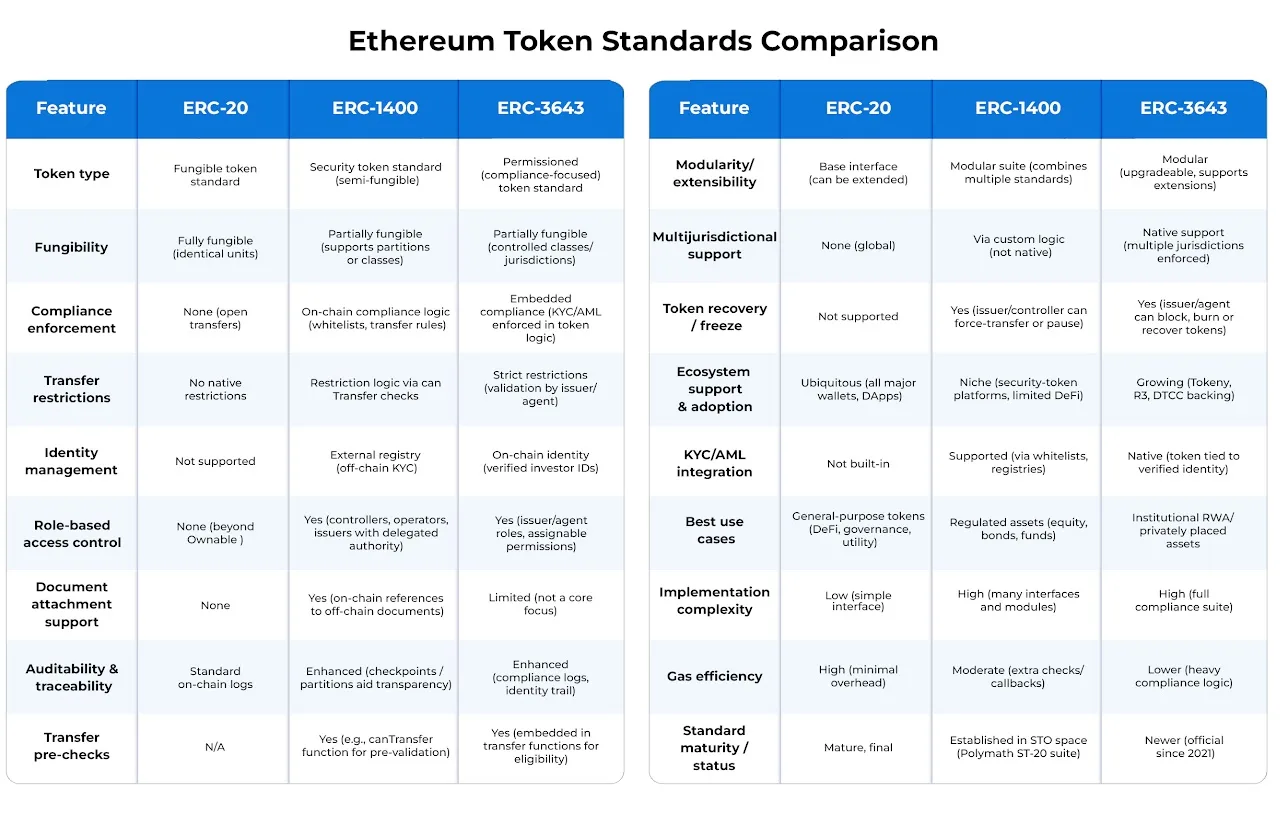
As you can see, these security token standards are engineered from the ground up to handle the demands of a regulated environment.
Conclusion
In this lesson, we established the crucial distinctions between utility and security tokens. You now understand that this is not merely a semantic difference but one with significant legal and technical consequences.
Key Takeaways:
- Utility tokens provide access to a product or service, while security tokens represent a financial investment with an expectation of profit.
- This distinction matters because security tokens are classified as financial instruments and are subject to stringent securities laws (like MiFID II in the EU), whereas other crypto-assets fall under different regulations (like MiCAR).
- The determination of whether a token is a security often hinges on tests like the US Howey Test, which assesses the nature of the investment.
- The regulatory requirements for securities mandate a permissioned token design. This means the token's core transfer logic must include checks to enforce compliance rules, such as verifying investor identity and eligibility.
We have laid the conceptual groundwork for this module. In our next lesson, we will dissect the architecture of the ERC-3643 (T-REX) standard to see precisely how its components for identity, a rule engine, and compliance management are constructed. This will prepare us to design our own simplified compliance system.