
Good to see you again. In the previous lesson, you defined a player fantasy: the role and emotional promise your battle royale should deliver consistently. That fantasy is the broad answer to “What should it feel like to play this game?”
This lesson turns that promise into three to four design pillars. Pillars are short principles that help you make later choices about the match loop, movement, weapons, maps, animation, and social systems without losing the game’s identity. By the end, you will have a compact set of pillars that are memorable, distinct, and useful for accepting, revising, or cutting ideas.
Plan on about 40 minutes: 8 minutes of reading, 5 minutes of video, and roughly 20 minutes drafting and refining your own pillars.
From player fantasy to practical design pillars
A player fantasy is the game’s central promise. For example:
Be a resourceful storm-runner leading a small crew through a shifting flooded frontier, reading terrain and making daring escapes under pressure.
A design pillar breaks that broad promise into a few commitments that can guide actual work. It answers: What must the game repeatedly prioritize for that fantasy to come true?
| Design layer | Example |
|---|---|
| Player fantasy | “Be a resourceful storm-runner.” |
| Design pillar | “The storm presents a readable, changing puzzle that rewards bold route judgment.” |
| Feature or system | Dynamic storm paths, visible wind cues, sheltered routes, and risky shortcuts. |
| Specific implementation | A damaged bridge becomes unsafe during a later storm phase, while a flooded tunnel offers slower but protected travel. |
The important distinction is that pillars sit above features. A feature is one possible solution; a pillar is the reason that solution belongs.
If you decide that the game must make players feel like clever route planners, you might eventually use storm paths, zip lines, vehicles, river currents, destructible bridges, map pings, or several other systems. You do not need to decide which one yet. The pillar tells you what any future solution must accomplish emotionally and strategically.
What makes a pillar useful?
Read the opening and decision-making advice in How pillars and triangles can focus your game design from Raspberry Pi. It gives a concise set of writing rules and explains how pillars keep a project focused when attractive new ideas appear.
How pillars and triangles can focus your game design - Raspberry Pi
Read this article from Raspberry Pi to see how short, player-focused pillars become practical rules for development rather than a decorative list.
In the section “The basics,” read the guidance on keeping statements short, phrasing them as rules, and using player emotion as the focus. Pay particular attention to active wording, then continue through the rest of that bullet list. Then go to “What to do with your pillars.” Read the section in full, especially its practical feature filter: the decision test. Notice that “cool” is not enough reason to include a feature if it does not support the intended game experience.
A strong pillar usually has five qualities:
-
Short
It fits in one sentence and can be remembered during a design discussion. -
Experience-led
It describes the player’s desired feeling or the experience they should have, not merely a genre feature. -
Active and positive
“We reward clever escapes” is stronger than “Players should not be trapped too often.” -
Distinct
Each pillar covers a different essential part of the game’s promise. Four synonyms for “exciting combat” are not four pillars. -
Decisive
It creates a trade-off. A pillar should help you choose between two reasonable ideas, not simply approve everything.
Consider the difference:
| Weak statement | Why it fails as a pillar | Stronger direction |
|---|---|---|
| “The game has guns.” | Nearly every battle royale has guns; it offers no direction for their design. | “Every fight gives bold squads a readable chance to outmaneuver stronger equipment.” |
| “There is exploration.” | A feature category, not an intended experience. | “Curiosity reveals useful routes, stories, and advantages beyond obvious paths.” |
| “Make it fun.” | Too vague to settle any disagreement. | “Small decisions create tense reversals and stories the squad wants to retell.” |
| “Realistic animation.” | “Realistic” is subjective and may conflict with readable competitive play. | “Animation makes movement, danger, and recovery instantly readable under pressure.” |
Notice that a pillar can influence animation without becoming an animation specification. The final example does not dictate a particular run cycle or reload length. It establishes a standard: animation must make important actions understandable quickly, especially in a competitive match.
Pillars are not a feature checklist
It is tempting to organize pillars by department:
- Combat pillar
- Exploration pillar
- Story pillar
- Art pillar
Sometimes that structure works, but it can become shallow. A battle royale does not need one pillar for every system. Instead, choose the few experiences that make this particular battle royale worth playing.
The God of War pillars slide below shows one production-facing way of communicating a game’s foundation. Its pillars are labelled Combat, Father/Son, and Exploration, with supporting goals under each. The labels are easy for a whole team to remember, while the details clarify what each area must deliver.
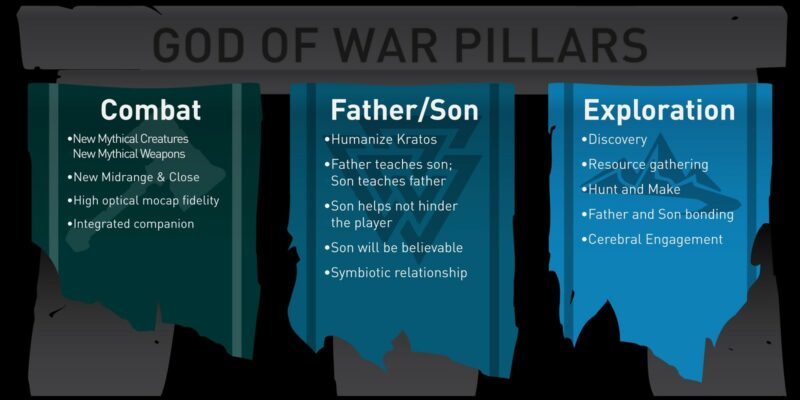
For your project, the pillar names can be evocative phrases, such as “Turn scraps into a plan”, as long as you also define what the phrase means. Without that definition, two people could interpret it differently: one might add hundreds of crafting recipes, while another might focus on quick squad decisions around limited equipment.
A useful pillar has two layers:
- a memorable title, used in conversation;
- a one-sentence operational meaning, used to judge decisions.
For example:
Turn scraps into a plan. Limited gear and incomplete information create complementary squad decisions, so improvisation feels capable and cooperative.
This is not a complete loot-system specification. It is a promise that later loot decisions must support.
A worked battle royale example
Using the storm-runner fantasy from the last lesson, here is a complete set of four pillars. Treat these as a model for structure, not a concept you must copy.
1. Outthink the storm
The storm presents a readable, changing puzzle that rewards preparation, observation, and bold route judgment.
This pillar supports the fantasy of being capable under pressure. It would shape zone presentation, map routes, environmental warnings, and the pacing of rotations. A zone that kills squads with no understandable warning would work against it.
2. Turn scraps into a plan
Limited gear and incomplete information create complementary squad decisions, so improvisation feels capable and cooperative.
This makes scarcity meaningful rather than merely frustrating. It can guide loot, inventory, pinging, revives, and team roles. The goal is not “make loot rare”; it is to make players tell stories about how a weak starting position became a smart plan.
3. Daring escapes earn stories
Fights create clear opportunities to disengage, regroup, and re-enter, making survival and recovery as expressive as elimination.
This does not mean players should always escape. It means retreating should sometimes be an intentional, skillful decision rather than a confused failure. Later, this pillar can affect terrain, movement, healing, damage feedback, and the clarity of animations.
4. Discover a frontier worth reading
Landmarks, environmental clues, and changing spaces reward attention, making the world feel dangerous but knowable.
This protects the exploration part of the game’s identity. A map should be more than a neutral arena filled with loot containers. Players should gain useful information and a sense of place by paying attention to it.
Together, these pillars cover the game’s pressure, teamwork, combat recovery, and world interaction. More importantly, they reinforce one another:
- A changing storm gives route knowledge value.
- Route knowledge makes exploration practical, not cosmetic.
- Imperfect resources make team planning valuable.
- Clear escape opportunities let players use that planning during a fight.
A proposed feature that strengthens two pillars is often especially promising. For instance, a visible storm-current system might strengthen both Outthink the storm and Discover a frontier worth reading.
Define the meaning, not just the slogan
Watch this short segment from Ryan Laley’s What are the Pillars of a Game’s Design?. It explains why a pillar needs a shared definition and why pillars are objectives rather than detailed instructions.
What are the Pillars of a Game's Design?
Ryan Laley uses the example of “Approachable” to show why a short pillar name must be accompanied by a clear interpretation.
Watch defining pillars. Focus on the distinction between an objective such as “approachable” and an implementation choice. Apply the same distinction to your own phrases: each should state what success feels like, while leaving room to discover the best mechanics through prototyping.
A pillar is successful when it can settle a specific design debate. Imagine the team suggests: “Let players find extremely rare weapons that instantly eliminate an enemy squad.”
Your pillars do not automatically tell you “yes” or “no.” They give you a better conversation:
| Pillar | Possible effect of the idea |
|---|---|
| Outthink the storm | It may distract attention from route and timing decisions. |
| Turn scraps into a plan | It could weaken improvisation if one lucky item becomes the only thing that matters. |
| Daring escapes earn stories | Instant elimination may remove the chance to recover or adapt. |
| Discover a frontier worth reading | If the weapon is tied to a dangerous, discoverable location, it could support this pillar. |
The likely conclusion is not necessarily to discard the idea. You might redesign it so its power is temporary, difficult to use, counterable, or earned through a risky exploration decision. That is the purpose of pillars: they turn vague preferences into design reasoning.
Draft your three to four pillars
Set aside about 15–20 minutes for this design pass. Keep your player-fantasy statement visible while you work.
First, generate more ideas than you need
Write six to eight short candidate phrases. Draw from the moments that should define a match:
- The type of pressure players overcome
- The way players express skill
- The relationship between teammates
- The kind of world they inhabit
- The emotional payoff of combat or survival
- The type of story a memorable match produces
At this stage, short fragments are enough:
- “Win through preparation”
- “Every rooftop is an opportunity”
- “Trust the crew under pressure”
- “Make escape look intentional”
- “A city that rewards local knowledge”
- “Risk creates spectacular reversals”
Do not lock yourself into four immediately. Generating several candidates makes duplication easier to spot.
Then, combine and sharpen
Merge overlapping ideas. “Win through preparation” and “A city that rewards local knowledge,” for example, might become one clearer pillar about reading the environment and choosing routes.
Turn the strongest candidates into positive, one-sentence commitments. These templates can help:
[Memorable phrase]. We create [player experience] so players feel [emotional payoff].
[Memorable phrase]. [Game condition] rewards [player behavior], making [desired feeling] central to every match.
[Memorable phrase]. Players can [meaningful action] under [pressure], creating [intended experience].
Avoid putting a complete solution inside the pillar. Compare:
| Overly prescriptive | Flexible but testable |
|---|---|
| “Players can use grappling hooks to reach every roof.” | “Vertical routes reward quick thinking and bold movement.” |
| “Every squad gets a healer character.” | “Teammates create opportunities to protect, recover, and rely on one another.” |
| “There are 100 weapons.” | “Different tools create meaningful tactical choices without making basic combat unreadable.” |
Add a guardrail to each pillar
Under each final pillar, write one short note beginning with either:
- This supports…
- This rules out…
- We will know this is working when…
For example:
Daring escapes earn stories. Fights create clear opportunities to disengage, regroup, and re-enter, making survival and recovery as expressive as elimination.
This rules out: unclear damage feedback or encounter spaces with no viable withdrawal route.
These guardrails are not pillars themselves. They simply preserve the intended meaning when you return to the document later.
Your completed design output should contain:
- Your player-fantasy statement from the previous lesson.
- Three or four pillars, each written as a memorable phrase plus one sentence.
- A one-line guardrail or success signal for each pillar.
Run a final coherence check
Before treating the pillars as final, check them as a group.
| Check | What you are looking for |
|---|---|
| Fantasy alignment | Each pillar strengthens the role and feelings promised by your player fantasy. |
| Distinct jobs | Every pillar protects something important that the others do not already cover. |
| Decision value | You can imagine a feature that the pillar would revise, redirect, or reject. |
| Whole-match relevance | The pillars matter beyond the opening minutes; they can influence looting, rotation, combat, and endgame. |
| Scope honesty | The pillar promises an experience, not an unrealistic quantity of content. |
| Memorability | You could explain all pillars to a collaborator without reading a page of notes. |
For a solo project or small prototype, pillars are particularly valuable because they give you permission to cut. A smaller game with a clear identity is more useful as a design project than a huge feature list with no consistent experience.
Key takeaways
Design pillars turn your player fantasy into a small set of durable development principles.
- Use three to four short, distinct, active, experience-led statements.
- A pillar explains the why; mechanics, maps, weapons, and animations are the possible how.
- Give each memorable phrase a clear one-sentence meaning and a brief guardrail.
- Use pillars to improve ideas, not only to reject them. A good idea that fits poorly can often be redesigned to serve the game better.
- Let the pillars protect your project’s focus when later design choices become more detailed.
Next, you will use your player fantasy and pillars to write a high-concept statement: a concise description of your battle royale’s premise, intended audience, and distinctive hook.
Can't find a good explanation? Sign up and we'll make it for you
Sign up