
Good to see you again. You now have the foundations of your battle royale’s identity: a target player, genre observations, a player fantasy, and three to four design pillars. This lesson compresses those decisions into the sentence—or at most two sentences—that someone should understand first.
A high-concept statement communicates your game’s premise and its distinctive hook quickly. It is not the full design document, a list of features, or a slogan. By the end of this lesson, you will have a polished statement that tells a reader what kind of battle royale this is, what players do, and why its matches should feel different.
Plan for about 40 minutes: roughly 12 minutes of viewing and reading, then 20–25 minutes drafting, testing, and revising.
A promise, not a catalogue
Your high concept is a compact expression of the game’s central playable promise. It should create a clear mental image while giving the listener a reason to want more detail.
For this course, a strong battle royale high concept usually contains four ingredients:
| Ingredient | Purpose | Example form |
|---|---|---|
| Genre frame | Establishes the familiar structure. | “A squad battle royale…” |
| Premise | Gives the world, situation, or role context. | “…set in a flooded frontier…” |
| Player action | States what players actively do. | “…where scavenger crews race, fight, and survive…” |
| Distinctive hook | Explains the meaningful difference. | “…as a visible living storm continually rewrites safe routes.” |
The first three ingredients help someone recognize the game. The hook makes them curious about this particular version of the genre.
Compare these descriptions:
| Version | Why it succeeds or fails |
|---|---|
| “A third-person battle royale with weapons, looting, a storm, traversal, and squads.” | It is accurate but generic. It lists conventions without giving the game an identity. |
| “A thrilling new survival experience where anything can happen.” | It promises excitement but gives no mental picture or playable difference. |
| “A squad battle royale in a flooded storm frontier, where scavenger crews race through collapsing settlements to outlast rival teams. A visible living storm reshapes safe routes each match, rewarding terrain knowledge, improvised plans, and daring escapes.” | It establishes a familiar genre, an evocative premise, active play, and a hook that changes decisions. |
Notice that the strong version does not explain player count, weapon categories, inventory slots, zone-damage numbers, or every movement ability. Those are important later, but they would blur the initial idea.
A useful rule is:
Describe the experience that makes the systems matter, not every system you hope to build.
Learn the shape of a high concept
Cornell’s Concept Document gives a concise, practical definition: use one or two player-focused sentences, separating the world or situation from what the player actively does.
Read “Concept Document” from Cornell University for a compact explanation of high-concept writing. Its example shows how setting and player action can work together without turning into a feature list.
In the “High Concept Statement” section, read the entire subsection. Begin with the player-focus guidance, then continue through the two-part example. Pay particular attention to the distinction between establishing a setting and describing what the player does within it.
The player-focus rule is especially valuable. A passive version says:
“After a catastrophic flood, survivors are trapped in a dangerous storm zone.”
That may be useful background lore, but it does not yet tell us what playing the game feels like.
A player-focused revision says:
“In a flooded storm frontier, scavenger crews race across unstable routes, outmaneuver rival squads, and turn salvaged tools into a path to survival.”
The world remains, but the active verbs—race, outmaneuver, turn—make the fantasy playable.
Make the hook change a decision
A battle royale already implies a competitive survival match, shrinking pressure, combat, scavenging, and a last team or player standing. Repeating those conventions is not a hook by itself. A hook is the twist that gives familiar conventions a different meaningful decision.
For example, “a battle royale set in a flooded city” is a premise. It becomes a stronger hook when flooding changes the match:
- Rising water reveals and removes routes.
- Currents create fast but exposed rotations.
- Squads can read visible weather signs before deciding where to travel.
- Some supplies become accessible only through temporary water routes.
You do not need to specify all of those systems in the high concept. You only need to state the core difference clearly enough that its gameplay consequences are imaginable.
Watch this segment from Design Land: High Concept by Extra Credits. It explains why a high concept should focus on one or a small number of defining elements, stay concise, and be tested with real listeners.
Design Land: High Concept - Extra Credits Video Games
Watch “Design Land: High Concept” by Extra Credits for a quick framework for choosing and communicating a central game idea. It is particularly helpful when several appealing features are competing for attention.
Watch the first guidepost on whether the defining idea is primarily mechanical or narrative. Then watch focus and compression for the case against cramming every good idea into the concept. Finish with the testing advice, noting that confusion is useful evidence for revision.
For a battle royale, the high concept will usually be mechanical-premise hybrid:
- The premise makes the match imaginable: a storm frontier, a vertical megacity, a shifting alien ruin, or another coherent situation.
- The mechanical hook changes the tactical choices players make within that situation.
The hook does not have to be unprecedented. It does have to be central enough that removing it would make your game feel substantially more conventional.
Use these four checks before naming something your hook:
- Repeated: Players encounter it throughout a match, not only in a cinematic introduction or rare event.
- Decisive: It changes movement, combat, survival, team coordination, or risk assessment.
- Legible: A new player can eventually understand how it works and why it matters.
- Pillar-aligned: It strengthens at least one of your existing pillars and does not undermine the others.
A striking visual theme without an altered decision can still be valuable art direction. It simply should not carry the entire high concept.
Write from three angles, then choose
It can be difficult to produce one excellent sentence from a blank page. Instead, draft three deliberately different versions. Keep your player fantasy and pillars visible while you do this.
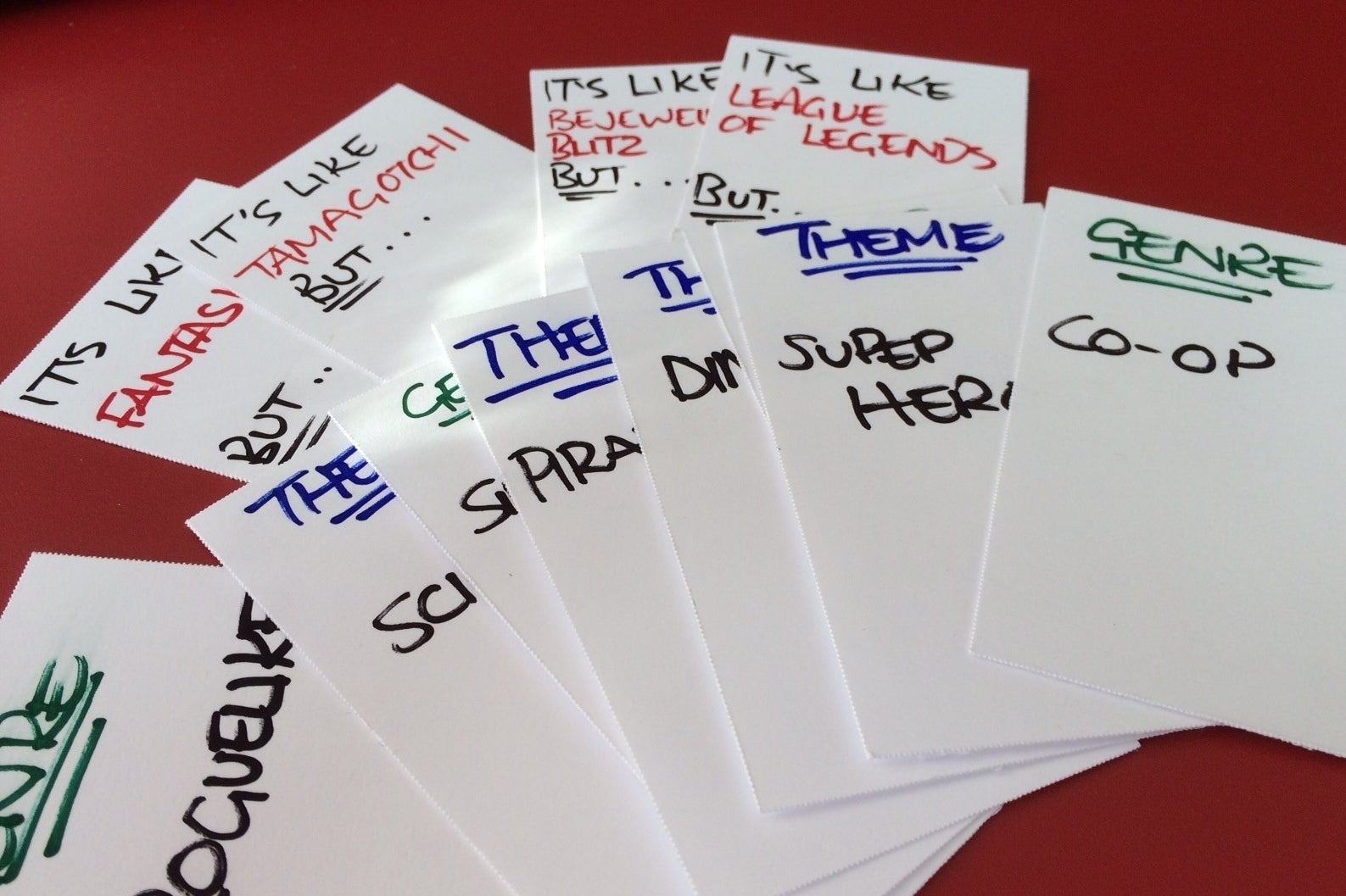
The brainstorming-card method in the image below is useful at this stage: separate familiar references, themes, genres, and “but” twists before attempting polished prose.
Start with four short notes:
| Note | What to write |
|---|---|
| Genre frame | “Squad battle royale,” “solo survival battle royale,” or another accurate frame. |
| Player fantasy | The role and emotional promise from your earlier lesson. |
| Premise | The place, situation, or conflict that gives the game a mental picture. |
| Hook | The one distinct condition that changes player decisions repeatedly. |
Then write three rough drafts using these approaches.
1. Action-first
Use this when the player fantasy is the clearest part of your concept.
A [genre] where [player role] [active verb] through [premise], while [hook] forces or rewards [meaningful decision].
Example:
A squad battle royale where storm-runners cross a flooded frontier to outlast rival crews, while a visible shifting tempest turns route knowledge and quick retreats into decisive advantages.
2. Premise-first
Use this when the setting immediately makes the game memorable.
In [distinct setting or situation], players [primary action] in a [genre]. [Hook] makes [desired player experience] central to every match.
Example:
In a frontier of drowned settlements and violent weather, scavenger crews fight for survival in a squad battle royale. The storm visibly transforms routes and shelter, making preparation and bold escapes as important as direct combat.
3. Hook-first
Use this when the mechanic itself is the clearest source of difference.
A [genre] where [hook] changes how players [core battle-royale action] in [premise].
Example:
A squad battle royale where a living storm continually redraws the safest paths through a flooded frontier, challenging crews to scout, improvise, and outmaneuver rivals before the world closes in.
These are drafts, not final answers. Their job is to reveal which part of your concept has the most energy and clarity.
Use comparisons for brainstorming, not as a substitute for identity
“It’s like [known game], but [difference]” can help you identify your ingredients privately. The comparison clarifies the baseline; the “but” clause identifies where your idea departs from it.
For example:
“It has the match tension of a squad battle royale, but the storm is not merely a closing boundary: it is a readable environmental system that changes how teams rotate and recover.”
That is useful design thinking. However, your final high-concept statement should usually stand on its own. If it only works because the reader knows three other games, it has not yet communicated your own premise and hook.
This short segment from Bacon and Games reinforces that an elevator pitch should be simple and intriguing rather than burdened with a developer’s full list of beloved details.
Don't Make These Mistakes When Pitching to Game Publishers
Watch “Don’t Make These Mistakes When Pitching to Game Publishers” by Bacon and Games for an example of how a short pitch can create a mental picture without explaining every mechanic.
Watch the elevator-pitch example. Focus on the contrast between detailed features the creator may care about and the few words a new listener needs in order to grasp the game’s appeal.
If you use a comparison in a conversation, follow it immediately with your independent statement. That keeps the comparison as a shortcut rather than allowing it to become the concept.
Refine the statement against your pillars
Now select the strongest of your three drafts and refine it into one or two sentences. Do not add details merely because they are important to the future design document. Instead, test every phrase against the work it performs.
| Revision issue | Revision move |
|---|---|
| The sentence could describe many battle royales. | Name the condition that makes your matches behave differently. |
| The setting is vivid, but player activity is unclear. | Add a player role and active verbs. |
| The hook sounds decorative. | State how it affects movement, combat, survival, or squad choices. |
| The sentence is overloaded. | Keep the genre, premise, player action, and one hook; cut secondary features. |
| The hook conflicts with a pillar. | Revise the hook or reconsider whether it truly belongs at the center of the game. |
| The intended audience is unclear. | Use genre and tone language that signals the right play experience, without adding demographic claims unnecessarily. |
For the storm-runner model, a finished statement could be:
Tempest Frontier is a squad battle royale set among flooded settlements where scavenger crews race to outlast rival teams. A visible living storm reshapes routes and shelter throughout the match, rewarding observation, improvised teamwork, and daring escapes.
It works because each clause has a purpose:
- “Squad battle royale” establishes the genre and social format.
- “Flooded settlements” creates a concrete premise.
- “Scavenger crews race to outlast rival teams” states the player role and central action.
- “Visible living storm reshapes routes and shelter” is the hook.
- “Observation, improvised teamwork, and daring escapes” connects the hook to the previous pillars.
It also leaves appropriate room for later lessons to define the precise match format, zone phases, weapons, loot, and map.
A quick listener test
Before treating your statement as finished, read it aloud to one person who has not followed your design process. Give them only the statement, not an explanation. Ask them to summarize it in their own words.
A successful version lets them accurately identify:
- the broad game type;
- the role or activity of the player;
- the game’s distinctive condition;
- one likely tactical consequence of that condition.
If they remember only the setting, strengthen the action. If they remember only that it is “a battle royale,” strengthen the hook. If they need several follow-up explanations to understand the sentence, remove details and rebuild around the clearest idea.
Your deliverable for this lesson is:
- One high-concept statement of one or two sentences.
- A short private note naming its premise, player action, and hook.
- One sentence explaining how the hook supports at least two design pillars.
Key takeaways
A high-concept statement is the shortest useful expression of your game’s identity.
- Lead with a recognizable genre frame, then make the player’s role and actions clear.
- Establish a premise, but keep the wording player-focused rather than lore-focused.
- Make the hook a recurring condition that changes meaningful match decisions.
- Avoid feature catalogues, vague excitement claims, and comparisons that replace your own concept.
- Draft several versions, choose the clearest one, and test it with someone unfamiliar with the project.
Next, you will begin turning this promise into playable structure by diagramming the core match loop, from entering a match through elimination or victory.
Can't find a good explanation? Sign up and we'll make it for you
Sign up