
Hello, and welcome to the first step in designing your battle royale: deciding who it is for. This module will turn an initial idea into a distinctive concept by defining a target player, studying the genre, clarifying the player fantasy, and establishing design pillars and a high concept.
A battle royale can contain shooting, survival, strategy, social teamwork, exploration, or spectacle—but trying to satisfy every possible player equally usually produces vague decisions. In this lesson, you will create a target-player profile: a realistic, fictional reference person whose motivations, play context, and frustrations will guide your later choices.
A target player is a design tool, not a stereotype
A target-player profile, often called a persona, is a concise model of the audience you most want to serve. It does not claim that every player is identical. Instead, it makes trade-offs visible.
For example, imagine two potential battle royale players:
- One wants fast, aggressive fights and is happy to restart immediately after elimination.
- Another enjoys coordinating with friends, planning rotations, and surviving long enough for that plan to matter.
Both may play battle royales, but they will evaluate the same design differently. A very small map with constant combat may delight the first player and frustrate the second. A long, slow match with deep tactical choices may do the reverse.
The profile helps you answer a practical question throughout development:
“Would this decision make the intended player more likely to start another match?”
That is more useful than asking whether a feature is “good” in the abstract.
How To Design Games For Your Target Market
Watch “How To Design Games For Your Target Market” by Tim Ruswick for a short argument against designing for “everyone.” The examples are opinionated, but the central design lesson is valuable: specificity gives a game a clearer identity.
Watch the target market argument. Focus on the distinction between broad appeal and a game that strongly serves a particular kind of player. You are not trying to exclude all other players; you are deciding whose needs settle disagreements when features compete.
A good persona is specific about relevant behavior, not needlessly detailed about personal facts. A name, age range, work or study situation, and preferred platform can make the player memorable. But details matter only when they affect design decisions.
For a battle royale, useful questions include:
- How much uninterrupted time does this player usually have?
- Do they play alone, with friends, or with strangers?
- Do they seek relaxed play, serious competition, skill mastery, social connection, or an imaginative world?
- What makes them quit a match or abandon a game entirely?
- What kinds of decisions do they want to make during play?
Start with motivation, not features
A common early-design mistake is beginning with a feature list: “It needs guns, vehicles, crafting, ranked mode, pets, and skins.” Features are possible answers. Motivation explains the underlying need those answers should serve.
The Quantic Foundry Gamer Motivation Model is a helpful vocabulary for thinking about why people play. It identifies twelve motivations in six paired groups.

The model is particularly useful because motivations are not simply “more is better.” They represent preferences and trade-offs. Someone with low interest in Completion, for instance, is not an inferior player; they may prefer self-directed goals rather than a checklist of missions.
1.5 Target Player Persona | Project: Video Game
Read “Target Player Persona” from Project: Video Game. It lays out the sequence you will use: choose motivations, translate them into player-experience goals, then create a realistic fictional persona.
On the page “1.5 Target Player Persona,” read the opening explanation, beginning with why games combine motivations, through the paragraph introducing player-experience goals. Then read the persona explanation beginning the definition of a persona, immediately before the “Assignment” section. Notice that motivations come before features, and that a persona should be based on motivations, goals, needs, and expectations.
The twelve motivations, translated for battle royale design
You do not need to target all twelve. In fact, selecting two to four primary motivations is usually enough to give an early concept focus.
| Group | Motivation | What the player is seeking | Possible battle royale implication |
|---|---|---|---|
| Action | Excitement | Fast pace, surprise, tension, thrills | Frequent meaningful encounters and dramatic reversals |
| Action | Destruction | Chaos, powerful weapons, mayhem | Destructible spaces, explosive tools, satisfying impact |
| Social | Competition | Beating other people, ranks, direct contest | Fair PvP, legible rules, meaningful victory |
| Social | Community | Cooperation, shared moments, belonging | Squad coordination and positive group interaction |
| Mastery | Challenge | Skill improvement through demanding play | Learnable skill ceiling and understandable failure |
| Mastery | Strategy | Planning, trade-offs, anticipating outcomes | Rotation choices, resource decisions, positional play |
| Achievement | Completion | Clear tasks, collection, measurable progress | Missions, goals, visible milestones outside matches |
| Achievement | Power | Feeling stronger through growth and upgrades | Temporary match power growth or long-term collection |
| Immersion | Fantasy | Becoming someone else in a compelling world | A setting and role that feel worth inhabiting |
| Immersion | Story | Characters, drama, and narrative meaning | Narrative framing, memorable factions, seasonal stories |
| Creativity | Discovery | Exploring, experimenting, testing boundaries | Secrets, emergent interactions, changing environments |
| Creativity | Design | Self-expression and customization | Character identity, visual customization, player-made style |
A battle royale is inherently competitive because players or squads are trying to outlast opponents. That does not mean Competition must be the only motivation. A tactical squad battle royale might combine:
- Competition: “I want a fair contest against other squads.”
- Strategy: “I want positioning and planning to matter.”
- Community: “I want coordination with friends to create memorable wins.”
- Excitement: “I want tense moments where decisive action matters.”
That combination would lead to a different game than one focused on Destruction, Excitement, and Power.
The important part is not choosing labels that sound appealing. It is choosing motivations that make future design decisions easier.
Turn motivations into experience goals
A player-experience goal describes what players should do, think, or feel. It is not a feature specification.
Compare these statements:
| Too feature-focused | Motivation-based experience goal |
|---|---|
| “Add a shrinking storm.” | “Players should feel mounting pressure to choose between a safe route and a high-value opportunity.” |
| “Include squads.” | “Friends should be able to coordinate a plan quickly enough that teamwork feels useful, not bureaucratic.” |
| “Add rare weapons.” | “Players should experience excitement when a risky choice creates a believable chance to turn around a losing match.” |
| “Include ranked mode.” | “Players who improve their skill should trust that wins and losses reflect understandable decisions and execution.” |
The second column does not dictate one solution. A later lesson can explore several mechanics that might fulfill the same goal. That flexibility is valuable early in design.
For your first concept, write one to three experience goals. Each should connect to at least one chosen motivation and should be observable in play.
A useful sentence pattern is:
“During a match, players will [do, think, or feel something] when [a recurring situation occurs].”
For example:
“During the middle of a match, squad players will debate whether to take a dangerous route through a high-value location or rotate early to secure a stronger final position.”
This goal supports Strategy, Community, and Competition. It says nothing yet about map size, exact zone timing, weapon balance, or player count. Those come later.
Describe the play context
Motivation tells you why a player wants an experience. Play context tells you what circumstances shape whether the experience is practical and enjoyable.
Context is essential for multiplayer games because a battle royale asks for time, attention, reliable communication, and tolerance for failure. A player with 20-minute solo sessions has different needs from a group of friends who reserve two hours on weekends.
Consider these dimensions:
| Context dimension | Design-relevant questions |
|---|---|
| Time | Does the player have 15 minutes or an entire evening? Can they commit to a full match? |
| Platform and input | PC, console, mobile, controller, mouse and keyboard, cross-platform play? |
| Social setting | Solo, duo, regular squad, or random teammates? Voice chat available or avoided? |
| Skill and genre familiarity | New to shooters, familiar with battle royales, or seeking a high skill ceiling? |
| Emotional stakes | Is this a casual social activity, a serious competitive hobby, or both at different times? |
| Reasons for leaving | Long downtime, unfair deaths, confusing systems, toxic communication, repetitive matches? |
Avoid treating demographics as destiny. “A 24-year-old” is not a motivation; nor is any gender, nationality, or job title. Include those details only when they help you imagine a plausible routine or reach an audience responsibly. The behavior is what should guide the design.
For example, “plays two evenings a week with three friends and dislikes leaving eliminated teammates waiting” immediately raises useful future questions about match duration, spectating, revival, and team communication. Those are better design signals than a long biography.
Build a provisional target-player profile
At this stage, your profile is a hypothesis, not research proof. Later playtesting may show that your assumptions were wrong or incomplete. That is normal. The purpose is to state your current design intent clearly enough that it can be tested.
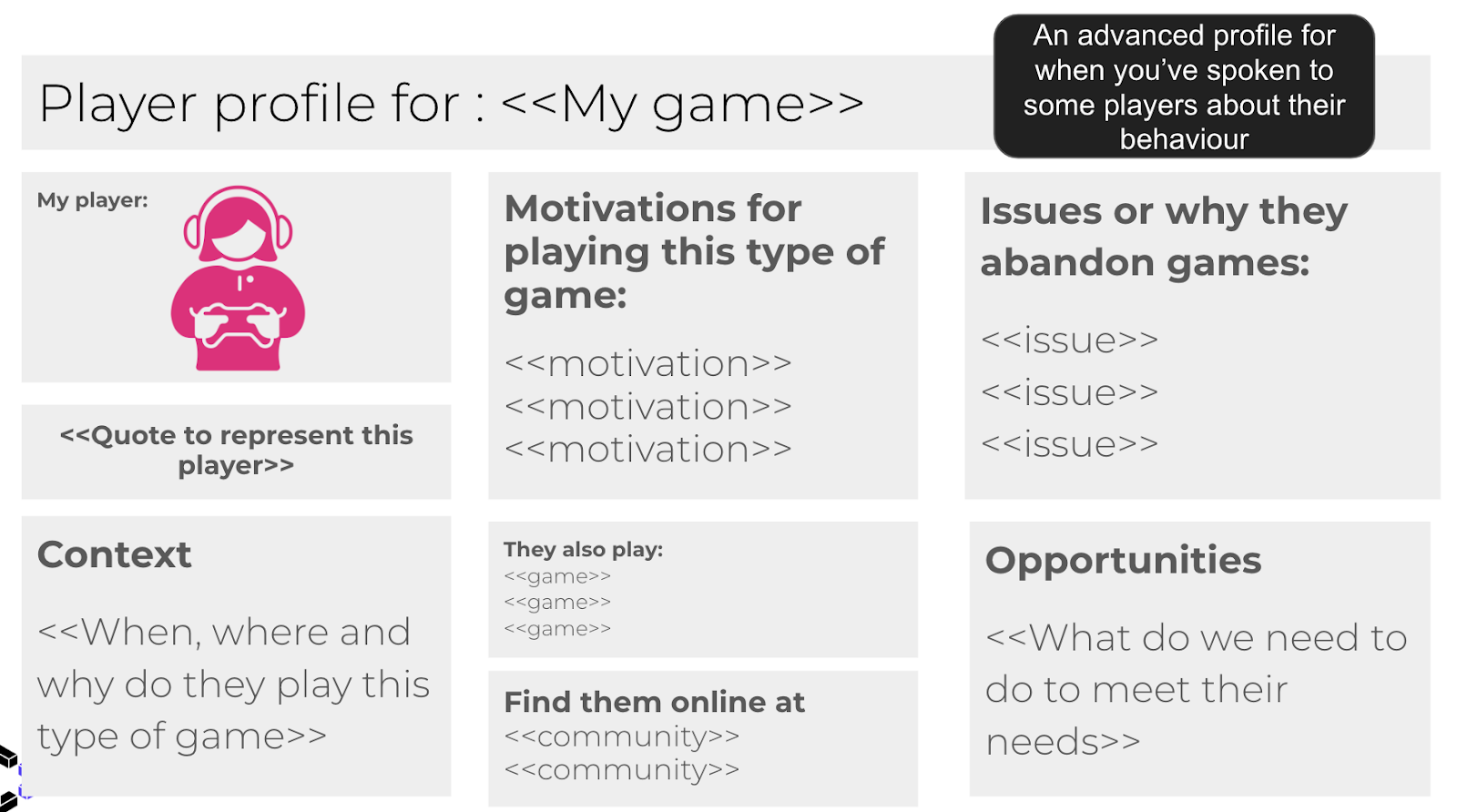
Here is an example for a hypothetical battle royale. It is deliberately provisional; do not copy it unchanged.
Example: Nia, the tactical squad regular
Audience snapshot
Nia is 24 and plays multiplayer games two or three evenings each week. She usually joins the same three friends on console with voice chat. They can commit to roughly an hour, but prefer individual matches that feel meaningful rather than exhausting.
What brings her to this type of game
Nia enjoys the uncertainty of a battle royale, but she wants more than aim duels. She likes spotting an opponent’s plan, deciding when to move, sharing information with teammates, and earning a win through coordination.
Primary motivations
- Strategy — meaningful choices about routes, timing, information, and risk.
- Community — cooperation, callouts, rescues, and shared stories.
- Competition — a fair contest in which good decisions and execution can win.
- Excitement — occasional high-pressure moments that make the match memorable.
Player-experience goals
- Players will feel that early information and smart movement can create an advantage without making combat irrelevant.
- Squad members will quickly form and revise plans together as the match changes.
- Players will be able to explain why they lost and identify one decision they could improve next time.
Play context
- Plays mostly in a regular squad, with occasional random teammates.
- Wants each match to have tension and variety, but not long stretches of aimless waiting.
- Values clear visual and audio information because voice chat can become chaotic during combat.
- Will try a difficult system if its benefits and risks are readable.
Frustrations and abandonment triggers
- Being eliminated without understanding what happened.
- Long inactive time after an early death.
- Coordination tools that require too many menus or complex commands.
- Teammates using communication to harass rather than cooperate.
- Randomness that makes planning feel pointless.
Design opportunities
- Make movement and map information readable enough to support tactical calls.
- Give squad coordination a meaningful role without requiring perfect voice communication.
- Make risk and reward visible so players can learn from success and failure.
- Preserve surprise and combat intensity without letting luck overwhelm decision-making.
What the game does not need to prioritize
- A huge volume of compulsory collectibles.
- Constant explosive chaos in every encounter.
- Extremely deep, permanent power progression that gives experienced players a match advantage.
Notice how the final section is useful. A persona should clarify not only what deserves attention, but also what should not consume early development effort.
Your one-page profile
Create a one-page target-player profile for the battle royale you want to design. You may use the player-profile image as a visual guide, but the written content matters more than the layout.
Use the following structure.
1. Working audience statement
Write one or two sentences:
“This battle royale is primarily for [a behaviorally defined audience] who want [the most important experience] during [their typical play context].”
Example:
“This battle royale is primarily for players who enjoy coordinated squad competition and tactical decisions, but who have limited evening playtime and want each match to produce a clear, memorable story.”
2. Persona snapshot
Give the player a name and include only the details that affect play.
- Name and approximate age range
- Usual platform or input preference
- Typical session length and schedule
- Solo, friends, or random teammates
- Familiarity with shooters and battle royales
- Two or three games they enjoy, if useful for identifying taste
3. Motivation priorities
Choose two to four motivations from the model. Rank them.
For each, finish this sentence:
“This matters because the player wants to…”
Keep the explanation behavioral. For Strategy, write “weigh routes and likely consequences,” not merely “likes strategic games.”
4. One to three player-experience goals
Write goals in terms of actions, thoughts, and feelings:
- “Players will…”
- “Players will feel…”
- “Players will have to decide…”
Do not write systems such as “add vehicles” or “add daily quests” yet.
5. Play context and friction
List:
- When, where, and with whom they play
- What makes a match worth finishing
- What causes frustration, quitting, or reluctance to return
- Any safety, accessibility, or communication needs relevant to online play
6. Design opportunities
Write three to five implications beginning with verbs:
- “Support…”
- “Make…”
- “Avoid…”
- “Ensure…”
- “Allow…”
These should connect directly to the profile. If an opportunity cannot be traced to a motivation, context detail, or friction, remove it.
Before considering the profile complete, use this quick quality check:
| Check | A strong profile does this |
|---|---|
| Focus | Chooses a primary audience rather than “everyone.” |
| Motivation | Names two to four motivations and explains each in behavioral terms. |
| Context | States when and how the player actually plays. |
| Tension | Identifies at least three frustrations or abandonment triggers. |
| Consequences | Produces concrete design opportunities, not vague claims. |
| Respect | Avoids stereotypes and treats the persona as a plausible person. |
Use the profile in later decisions
Your profile will not dictate every decision. It gives you a tie-breaker when options compete.
Suppose a later feature discussion asks whether a match should favor constant close-range action or leave room for planned rotations. For Nia’s profile, the question is not “Which option is objectively better?” It is:
- Does the option reinforce Strategy, Community, Competition, and Excitement together?
- Does it fit a squad player’s available time and tolerance for downtime?
- Does it reduce or intensify the frustrations the profile identifies?
If the answer is unclear, the profile needs revision—or you need evidence from players like the persona. A fictional profile is useful precisely because it makes your assumptions visible enough to test.
You have now established the human center of the design: a specific player, the experiences they seek, the context in which they play, and the problems the game should solve for them. The most important distinction to retain is this: motivations explain why a player plays; play context explains what the game must accommodate.
In the next lesson, you will examine existing battle royale games. You will identify their genre conventions, strengths, and opportunities to differentiate your concept for the target player you have just defined.
Can't find a good explanation? Sign up and we'll make it for you
Sign up