Welcome to the first lesson of our module, "AI for Fund Operations and Portfolio Support."
In our last lesson, we focused on the critical task of facilitating strategic introductions for your portfolio companies. A key theme was the necessity of building systems to manage your network and make that process scalable, especially for a solo General Partner like yourself.
Today, we'll apply that same principle of systemization and efficiency to the very top of your operational funnel: deal flow. Your success will depend on your ability to attract and identify the most promising startups from a large pool of applicants. Doing this manually is a significant bottleneck.
This lesson directly addresses the learning outcome: to use AI tools to automate the analysis of inbound pitch decks and applications. We'll explore practical ways you can leverage AI to screen applications faster, make more data-driven initial decisions, and free up your time to focus on the best opportunities. This is a foundational skill for building the AI-differentiated accelerator you envision.
1. The Challenge: Managing the Deal Flow Deluge
As an accelerator, you will receive hundreds, if not thousands, of applications. As someone who has prepared pitch decks, you're familiar with the effort that goes into each one. Now, imagine being on the receiving end, tasked with reviewing them all. For a solo GP, this is an overwhelming task that can consume hundreds of hours.
The venture capital landscape itself is becoming faster and more data-intensive, making manual processes a competitive disadvantage.
VC 3.0: How AI is Reshaping Venture Capital (What Founders Must Know)
To understand this shift, let's watch a brief segment from the NFX channel titled 'VC 3.0: How AI is Reshaping Venture Capital'. It explains how AI is becoming essential for handling the speed and volume of modern venture investing.
Please watch from 00:11:07 to 00:12:02. Pay attention to how AI is changing the first two phases of venture capital: sourcing and analyzing deals.
As the video highlights, AI helps VCs "analyze more companies in more depth." Your goal is not to replace your judgment but to build a system that surfaces the most promising applicants for your detailed review, saving you from spending time on the 80-90% that are a poor fit.
2. Core Concepts: How AI Analyzes Applications
At its core, AI-driven application analysis involves two main functions:
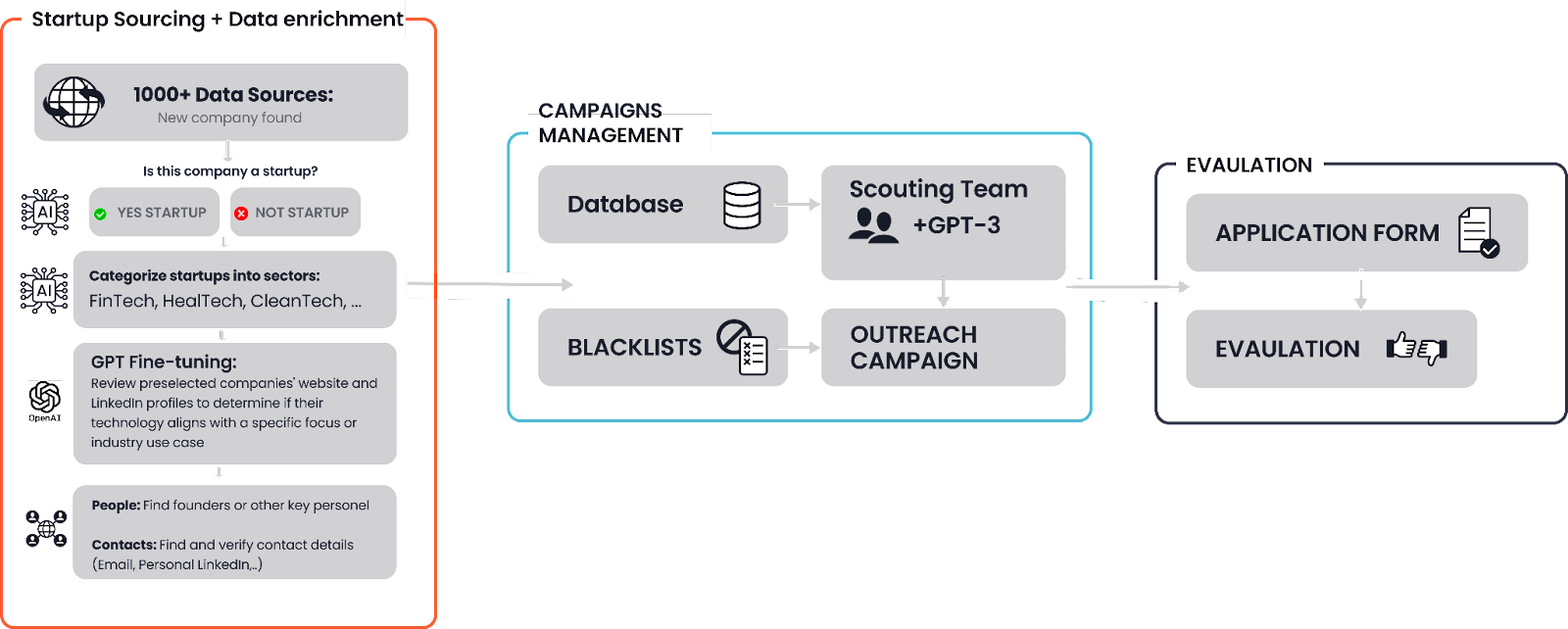
- Extraction and Summarization: Using Natural Language Processing (NLP), AI tools read unstructured documents like pitch decks (PDFs) and application essays (text). They extract key information—such as the problem, solution, team background, and traction metrics—and present it in a structured format.
- Scoring and Ranking: Machine learning models then evaluate this extracted information against your predefined investment criteria or rubric. This allows the system to score each application on dimensions like team strength, market size, and product defensibility, and then rank them for your review.
How VCs Use Predictive Analytics for Deal Flow
The article 'How VCs Use Predictive Analytics for Deal Flow' from StratEngineAI provides a good overview of this process. It explains how machine learning and NLP are used to screen startups.
Please read the section 'Automating Startup Screening' and the first FAQ, 'How can predictive analytics help venture capitalists discover high-potential startups faster?'. Focus on understanding the role of NLP and how automated screening helps filter opportunities based on an investor's thesis.
The key takeaway is that these tools transform a pile of disparate documents into a structured, comparable, and ranked database of opportunities. This enables you to work smarter, not just harder.
3. Practical Approaches to Automation
There are two primary ways you can implement this automation: using specialized, off-the-shelf software or building a more customized "DIY" workflow using no-code tools.
Approach 1: Specialized Accelerator Software
Several software platforms are designed specifically for accelerators and VCs. These tools provide an end-to-end solution for managing the entire application and review lifecycle.
How Automated Accelerator Software Are Speeding Up ...
To see how these platforms work, let's examine 'How Automated Accelerator Software Are Speeding Up Selections' from Sopact. This article details a system built for this exact purpose.
Please read the sections 'Accelerator Intelligence Lifecycle', 'The Intelligent Suite', and pay close attention to the details under 'Intelligent Cell: Score Every Application Against Your Rubric Automatically'. This section directly demonstrates: How AI scores application essays and decks against your rubric. How it provides evidence-linked scores and flags red flags. How it can even classify pitch decks automatically.
As described, tools like Sopact's "Intelligent Cell" can automatically:
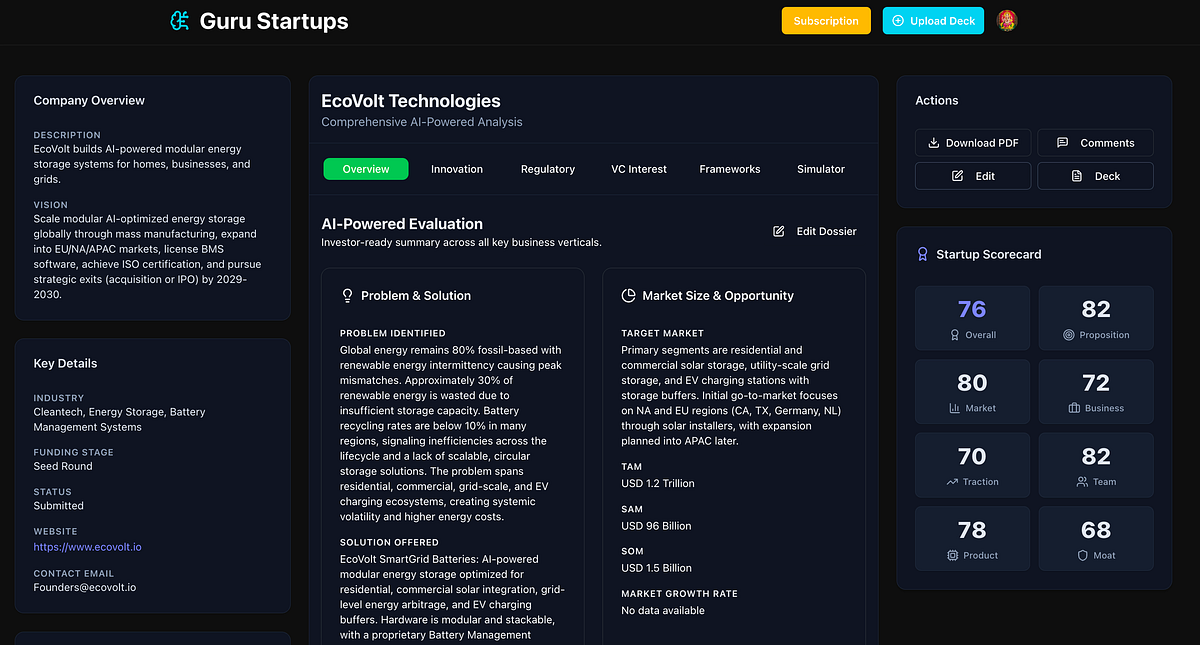
- Score essays against criteria like "Team Quality" and "Traction," citing the exact sentences that support the score.
- Detect red flags, such as buzzword overload or unrealistic projections.
- Analyze uploaded pitch decks to score their completeness and clarity.
The output is often a dashboard that gives you an at-a-glance view of each applicant, complete with AI-generated summaries and scores.
Approach 2: DIY Automation with No-Code Tools
Given your computer science background and the lean nature of a solo-led firm, a more flexible and cost-effective approach might be to build your own automation workflow using no-code tools like Zapier. This gives you full control over the process.
Here's a blueprint for a workflow you could build:
-
Trigger: New Application Submitted. This could be a startup filling out a Google Form, Typeform, or a form on your website. The form would include fields for text responses and a file upload for their pitch deck.
-
Action: Extract Text from Pitch Deck. An integration (e.g., PDF.co, CloudMersive) can parse the uploaded PDF pitch deck and extract its text content.
-
Action: Analyze with AI. The application answers and the extracted deck text are sent to a large language model (LLM) like OpenAI's GPT via a Zapier integration. The magic happens in the prompt you design. You would instruct the AI to act as a VC analyst:
"You are a pre-seed venture capital analyst. Analyze the following application and pitch deck text. Provide a summary of the Problem, Solution, Team, and Traction. Then, score the company from 1-10 on the following criteria: [Your Criteria 1], [Your Criteria 2], etc. Finally, list any potential red flags or missing information."
-
Action: Record the Output. The AI-generated summary, scores, and red flags are then automatically sent to a centralized database like Airtable or Google Sheets.
This creates your own custom, automated screening dashboard, tailored precisely to your investment thesis.
Zapier AI Tutorial for Beginners: Automation Made Simple 🟧
To understand the mechanics of building such a workflow, let's watch 'Zapier AI Tutorial for Beginners'. While the example is simple (responding to feedback), it perfectly demonstrates how to connect a trigger, add an AI analysis step, and use dynamic data.
Watch from 14:48 to 18:13. Focus on how a new 'AI by Zapier' step is added to the workflow. Observe how they craft a prompt and use dynamic values from a previous step (the form submission) as inputs for the AI to analyze. You would simply replace 'customer feedback' with 'application text' and 'pitch deck text' in your own workflow.
Test your understanding!
You want to build a DIY automation to screen startups for your accelerator, which focuses on B2B SaaS with a strong technical moat. One of your key evaluation criteria is "Founder-Market Fit."
How would you design the prompt for the AI step in your Zapier workflow to specifically evaluate this criterion?
Show answer
Your prompt for the AI model could include an instruction like this:
"Evaluate Founder-Market Fit (Score 1-10): Based on the 'Team' section of the pitch deck and application, assess the founders' experience. Do they have deep domain expertise in the industry they are targeting? Does their prior work experience (e.g., engineering, sales, product at relevant companies) give them a unique advantage in solving this problem? A high score requires direct, relevant industry or functional experience. A low score would reflect a team with no apparent connection to the market they are entering."
This specific instruction guides the AI to look for the evidence you care about, making its score much more meaningful for your decision-making.
4. The Human in the Loop: Triage, Don't Abdicate
It is crucial to remember that AI is a tool for triage and augmentation, not a replacement for your own investment judgment. The goal is to filter out the 80% of applications that are clearly not a fit, so you can spend your valuable time conducting deep diligence on the top 20%.
How VCs Use Predictive Analytics for Deal Flow
Let's revisit the StratEngineAI article to see how this human-AI partnership works in practice.
Please read the sections 'Scoring Pitch Decks Automatically', 'Benefits of Workflow Automation', and the 'Manual vs. Predictive Approaches' table. Notice the emphasis on filtering unsuitable deals, reducing bias, and freeing up human partners to focus on high-potential opportunities.
Benefits of this approach include:
- Efficiency: Automatically filters a high volume of deals.
- Consistency: Applies the same rubric to every application, reducing the risk of personal bias (e.g., affinity bias).
- Data-Driven Decisions: Creates a "blind" first pass where companies are judged on their merits before personal meetings, forcing a more objective initial screen.
Ultimately, the AI provides a recommendation and a structured investment memo, but the final decision to interview a team remains yours.
Conclusion
Automating the analysis of inbound applications and pitch decks is no longer a luxury; it's a core operational competency for a modern, efficient investment firm. For a solo GP, it is a mission-critical force multiplier.
Key Takeaways:
- Deal flow is a numbers game: You need an efficient system to manage high volumes of applications.
- AI automates analysis: It uses NLP and machine learning to extract, summarize, and score applications against your investment thesis.
- You have two main options: Use specialized off-the-shelf software for a turnkey solution, or build a flexible, custom workflow with no-code tools like Zapier.
- AI is for triage, not final decisions: The goal is to augment your expertise by filtering noise and surfacing the highest-potential deals for your review, ensuring your time is spent where it matters most.
Preview of the Next Lesson
We've now seen how AI can revolutionize the top of your funnel—managing applications. In the next lesson, we will jump to the other end of the investment lifecycle. We will explore how to evaluate and configure AI-powered dashboards for real-time portfolio performance tracking. This will show you how to use AI not just to find great companies, but to monitor and support them effectively after you've invested.