
Welcome back. In the last lesson, you expanded products such as
to get
This lesson reverses that process. Given a monic quadratic trinomial—a quadratic whose coefficient is —you will rewrite it as a product of two binomials. This is called factoring. It is a central algebra skill for graphing because the factors will soon reveal where a parabola crosses the -axis.
By the end, you should be able to factor expressions of the form
whenever integer factors exist.
Factoring is undoing expansion
Last lesson established the pattern
The two numbers inside the parentheses, and , play two roles:
- Their sum becomes the coefficient of .
- Their product becomes the constant term.
Factoring asks you to work backward. For
find integers and such that
and
Then the factored expression is
This shortcut works specifically because the leading term is , with coefficient . That is what monic means in this setting.
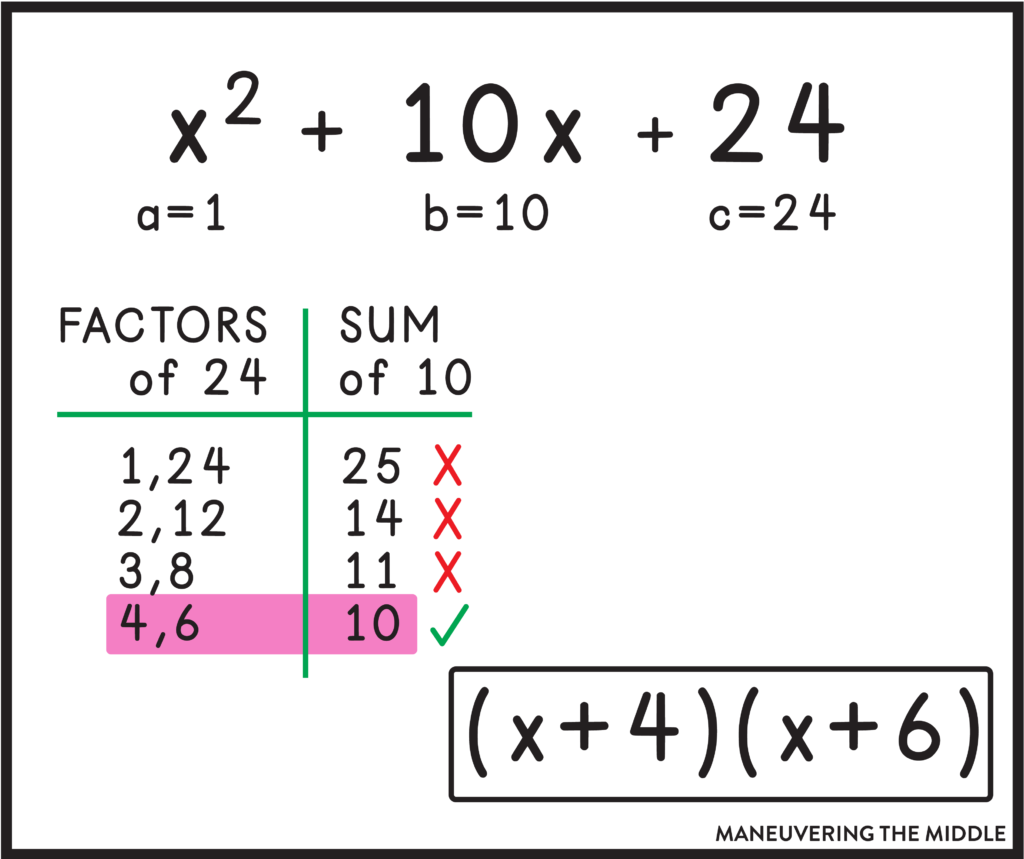
For that example:
we need two numbers whose product is and whose sum is .
| Factor pair of | Sum |
|---|---|
So,
The order does not matter:
To see why the method is reliable, expand your answer:
The expansion returns the original trinomial, so the factorization is correct.
Factoring Trinomials of the Form x2+bx+c
Watch “Factoring Trinomials of the Form x2+bx+c” from Mometrix Academy for a concise visual introduction to factoring as the reverse of FOIL. It includes examples with all the main sign patterns.
Watch the setup for the meaning of factoring and its connection to expansion. Then watch a positive example, where the two numbers are both positive. Continue with mixed signs, then two negatives. In every example, identify the required sum before the required product.
The sum-and-product routine
When you see
use this routine.
- Read the middle coefficient . This is the target sum.
- Read the constant . This is the target product.
- List factor pairs of , including appropriate negative signs.
- Select the pair whose sum is .
- Put that pair into two binomials:
Worked example: both factors positive
Factor
The needed pair must:
- multiply to ,
- add to .
The positive factor pairs of are:
Their sums are , , and . The correct pair is and .
A quick expansion check confirms it:
Notice that a positive constant and a positive middle coefficient led to two positive numbers. That makes sense: positive times positive is positive, and positive plus positive is positive.
7.2: Factoring trinomials of the form x² + bx + c - Mathematics LibreTexts
Read the opening of this LibreTexts lesson to reinforce the sum-and-product logic and see both the full grouping derivation and the faster monic-quadratic shortcut.
In the section “Factoring Trinomials of the Form x^2+bx+c,” read the core pattern. Then read the listed “Steps for factoring trinomials of the form x^2+bx+c” and follow Example 7.2.1 through its verification. Next, under the “Note” after Example 7.2.4, read the shortcut explanation and Example 7.2.5. Focus on why the two selected integers become the constants in the binomials.
Signs: use the constant first, then the middle term
The sign of , the constant term, tells you whether the two numbers have matching or opposite signs.
| Signs in the trinomial | What the two numbers must look like |
|---|---|
| Same sign: both positive or both negative | |
| Opposite signs: one positive and one negative | |
| Both positive | |
| Both negative | |
| Opposite signs, with the positive number having greater magnitude | |
| Opposite signs, with the negative number having greater magnitude |
These are not separate rules to memorize blindly. They follow from integer multiplication and addition.
Worked example: both factors negative
Factor
We need two numbers whose product is and whose sum is .
The factor magnitudes and multiply to . Because the product is positive, the signs must match. Because the sum must be negative, both numbers must be negative:
and
Therefore,
Check:
Worked example: opposite signs
Factor
This time, the product must be . Therefore the two numbers need opposite signs.
The factor pair and has a difference of . To obtain a sum of positive , the larger magnitude must be positive:
and
So,
A useful sign check comes directly from the factorization:
has a negative constant because is negative. Its middle term is positive because .
Factor pairs systematically
For small constants, you may recognize the pair quickly. For larger ones, a short, organized list is safer than guessing.
Factor
We need a product of and a sum of . Since the product is negative, try pairs with opposite signs:
| Pair | Product | Sum |
|---|---|---|
The pair is and . Thus,
It is tempting to put and into the factors because they also multiply to . But their sum is , not :
Their factorization would produce the wrong middle term:
The sum condition and product condition must both be satisfied.
Why the answer has two binomials beginning with
Suppose we factor a monic trinomial:
The first term of each factor must be , because
So the overall shape is already determined:
Factoring consists of filling the two blanks with the right signed integers. The constants you insert must create:
- the correct constant term through multiplication;
- the correct middle term through addition.
For example, for
we need product and sum . The numbers and work:
and
Therefore,
This also has a geometric interpretation. If
represented a rectangle’s area, then the factors
and
could represent its algebraic side lengths.
Checking and common mistakes
Expanding the two factors is the most dependable check, and you already know how to do it.
Suppose you factor
as
Verify:
The check works.
Choosing a pair that only has the right product
For
both and , and and , multiply to . But only one pair has the target sum:
while
Therefore,
not .
Losing signs
For
the constant is positive and the middle coefficient is negative. The numbers must therefore both be negative:
So,
Writing would produce , not .
Factoring when no integer pair exists
Not every monic quadratic can be factored using integers. For example,
would require two integers with product and sum . The factor pairs of have sums and , or their negative versions and . None has sum .
So this expression does not factor into binomials with integer constants. For this lesson, focus on recognizing and factoring the cases where the required integer pair does exist. Later algebra provides methods for quadratics that do not factor neatly this way.
A compact factoring checklist
Before treating a factorization as finished, check these points:
- The expression has the form
- The two selected integers multiply to .
- The same two integers add to .
- They are placed into the factors as
- If needed, expand to verify.
For example:
The pair must multiply to and add to . The correct pair is and :
Thus,
Key takeaways
Factoring a monic quadratic trinomial reverses the expansion pattern from the previous lesson:
To factor
find integers that add to and multiply to , then place them in
Use the sign of to determine whether the pair has matching or opposite signs, and use the sign of to decide which signs give the required sum. Finally, expand the factors if you want a reliable verification.
Next, you will use factored expressions to solve quadratic equations. A factorization such as
will let you identify the two input values that make the quadratic equal zero—exactly the -intercepts that matter for graphing parabolas.
Can't find a good explanation? Sign up and we'll make it for you
Sign up