
Welcome back. In the previous lesson, you learned to factor monic quadratic expressions by finding two integers with the required sum and product. For example,
Factoring turns one quadratic expression into a multiplication of simpler linear factors. This lesson takes the crucial next step: when that product equals zero, you can solve for the input values that make the equation true.
By the end, you will be able to solve equations such as
by using the zero-product property. This is an algebraic method that will later help identify the zeros, or -intercepts, of parabolas.
Why a product equal to zero is special
The zero-product property states:
In words: if two factors multiply to make zero, at least one of the factors must itself be zero.
For ordinary numbers, this is familiar:
But two nonzero real numbers cannot multiply to zero. For example,
The same principle applies when the factors contain . If
then either must be zero, or must be zero. Those are the only ways the entire product can be zero.
Solving equations with zero product property
Watch Khan Academy's “Solving equations with zero product property.” It gives a clear visual explanation of why a product can equal zero only when at least one factor equals zero, then applies the idea to a factored quadratic.
Watch the core idea, focusing on why two nonzero factors cannot produce zero. Then watch the worked solution, where the equation is split into two linear equations and both answers are verified by substitution.
A condition matters here: the right side must be zero. You may use the zero-product property for
but not directly for
When the product is , neither factor is required to be zero. The method only becomes available after the equation has been arranged with zero on one side.
The solving routine
When an equation is already in factored form and equal to zero, follow this routine:
- Identify the separate factors.
- Set each factor equal to zero.
- Solve each resulting linear equation.
- State both solutions, unless the factors produce the same value.
- Check by substituting if you want to confirm your result.
Consider:
The factors are and . Apply the zero-product property:
or
Now solve each linear equation:
or
Therefore,
are the two solutions.
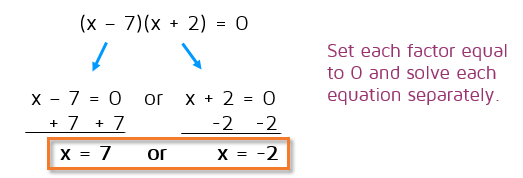
Notice the sign reversal that happens while solving:
- gives .
- gives .
The number written inside a factor is not automatically the solution. Always solve the individual linear equation.
Solving quadratic equations by factoring (article) | Khan Academy
Read Khan Academy’s explanation of factored quadratic equations. It reinforces both the procedure and the reason the property finds all possible solutions.
In the section “Solving factored quadratic equations,” read from the opening example through the first solution. Follow why each factor becomes its own equation. Then continue to the reflection discussion, especially why zero matters. Next, read the section “A note about the zero-product property,” from its opening question through the justification. Focus on the claim that the two cases from the factors are not guesses: they exhaust every possible solution.
Factors with coefficients
The method does not change when the factors are more complicated. Each factor is still set to zero, and then you solve the resulting linear equations using ordinary inverse operations.
Solve:
Set the first factor equal to zero:
Add to both sides:
Divide by :
Now set the other factor equal to zero:
Subtract :
So the solutions are
A quick check shows why both work. If , the first factor becomes zero:
If , the second factor becomes zero:
In either case, one factor is zero, so the product is zero.
A common mistake: canceling a factor
Do not divide both sides of a factored equation by one of its variable factors. For example, starting with
dividing by would appear to leave
That finds , but it wrongly loses the other solution . At , the factor you divided by would equal zero, so that division was not valid. Setting each factor to zero protects both solutions.
One solution versus two solutions
Many factored quadratic equations have two distinct solutions, because their two factors become zero at different inputs. Sometimes, however, the factors are identical.
Consider:
This means
Both factors lead to the same equation:
Thus,
There is only one distinct solution, even though the factor is written twice. You may hear this called a repeated solution or a double root later; for now, the important point is simply not to list the same value twice.
The pattern is:
| Factored equation | Distinct solutions |
|---|---|
The last row is worth noting: itself is a factor. Setting it equal to zero immediately gives .
From factoring to solving
You can now combine the previous lesson’s factoring skill with this one. Suppose you begin with a quadratic in standard form:
From the previous lesson, factor the left side. The two needed numbers multiply to and add to , so they are and :
The equation becomes
Now apply the zero-product property:
or
Therefore,
The roles of the two skills are different:
- Factoring rewrites a quadratic as a product.
- The zero-product property turns that product equation into separate linear equations.
- Solving the linear equations gives the values of .
For now, focus on recognizing when the quadratic has already been factored. In future work, you will routinely move from standard form to factored form and then use this exact method.
Key takeaways
The zero-product property is the central idea:
means
To solve a factored quadratic equation:
- Make sure one side of the equation is zero.
- Set each factor equal to zero.
- Solve both linear equations.
- Keep every distinct solution.
For example,
has solutions
and
These solutions are the inputs that make the quadratic equal zero. Later in the course, that same idea will let you recognize where a parabola meets the -axis.
Next, the course begins building the visual foundation for parabolas by creating a table of values and graphing the parent function
Can't find a good explanation? Sign up and we'll make it for you
Sign up