
Hello! Welcome to the final lesson of our module on cognitive biases.
Introduction
Throughout this module, we've explored powerful psychological principles that drive user behavior, from loss aversion in subscription models to choice overload in complex interfaces. We've seen how understanding these biases can lead to more effective product design.
However, with great power comes great responsibility. This lesson addresses the critical and often subtle distinction between ethical persuasion and unethical manipulation. As a Product Design Lead, navigating this line is not just a theoretical exercise but a daily professional and ethical obligation.
Your learning outcome for today is to discuss the ethical line between persuasive design and manipulation when leveraging cognitive biases.
To achieve this, we will:
- Define the spectrum from persuasion to manipulation, introducing the concept of "dark patterns."
- Establish a framework for ethical evaluation based on goal alignment and transparency.
- Review actionable guidelines for practicing ethical design.
- Reflect on how these principles apply to real-world design scenarios.
This lesson will equip you with the language and frameworks to champion ethical design within your teams and organization.
1. Defining the Spectrum: Persuasion vs. Manipulation
At its core, the difference between persuasion and manipulation lies in intent and outcome. Ethical persuasion guides users toward actions that are mutually beneficial, helping them achieve their own goals while also meeting business objectives. Manipulation, on the other hand, deceives or coerces users into actions that primarily benefit the business, often at the user's expense.
This distinction is crucial. Let's start by reading a short article that draws a clear line between the two.
The Ethics of Dark Patterns: When Persuasive Design Crosses a Line
This article, 'The Ethics of Dark Patterns,' provides a sharp definition of the difference between persuasion and manipulation, framing it as a matter of user choice and control.
Please read the section titled 'When “Persuasion” Becomes Manipulation.' Pay close attention to the table comparing examples of each. The key takeaway is the role of user choice and control.
The article highlights that the critical difference is choice and control. Persuasion respects a user's autonomy, while manipulation seeks to subvert it.

The practical application of manipulation in UX design is often referred to as dark patterns. These are interfaces intentionally crafted to trick users. Let's watch a quick video that introduces this concept with some common examples.
Dark Patterns in UX | Understanding with Unbabel
This video from Unbabel offers a concise introduction to dark patterns, showing how they manifest in real products.
Please watch from the beginning until 02:11. Focus on the definition of dark patterns and the examples of 'confirmshaming' and 'roach motel.'
As you can see, dark patterns directly exploit cognitive biases—like loss aversion in "confirmshaming"—to push users into decisions they might not otherwise make.
2. A Framework for Ethical Evaluation
Knowing the difference is one thing; evaluating a specific design in a gray area is another. How can we determine if a persuasive technique crosses the line?
A powerful framework for this involves examining two key factors: asymmetry of knowledge and alignment of goals. Let's watch a discussion by Tristan Harris, a central figure in the conversation around tech ethics, who explains this using the example of Snapchat's "streaks" feature.
The Magic of Persuasive Design
In this video from Stanford eCorner, Tristan Harris provides a sophisticated framework for evaluating the ethics of persuasive technology.
Please watch from 01:57 to 04:01. Focus on his two main points: the 'asymmetry' of knowledge between designers and users, and the 'misalignment' of their goals. His comparison of streaks in Snapchat versus a meditation app is particularly insightful.
Let's break down this framework:
- Asymmetry of Knowledge: Designers and companies have vast knowledge about psychology and user behavior that the average user does not. Is this knowledge being used for the user or against them?
- Alignment of Goals: This is the most critical test.
- Unaligned Goals (Unethical): Snapchat's business goal is to maximize daily engagement. They use streaks to hook users, which can become a source of social anxiety. The user's goal (maintaining friendships) becomes infected by the company's goal (maintaining the streak).
- Aligned Goals (Ethical): A meditation app also uses streaks. However, the user's goal is to build a consistent meditation habit. The app's goal (encouraging daily use) is perfectly aligned with the user's pre-existing, intrinsic goal. The feature serves the user's well-being.
When you evaluate a design, ask yourself: "Does this feature help the user achieve their own goal, or does it impose the company's goal onto them?"
3. Ethical Guidelines for Product Designers
With this framework in mind, we can establish practical guidelines for implementing persuasive design ethically. This moves us from identifying problems to building solutions.
First, it's important to recognize the tangible negative outcomes of unethical design, which go beyond just a bad user experience.
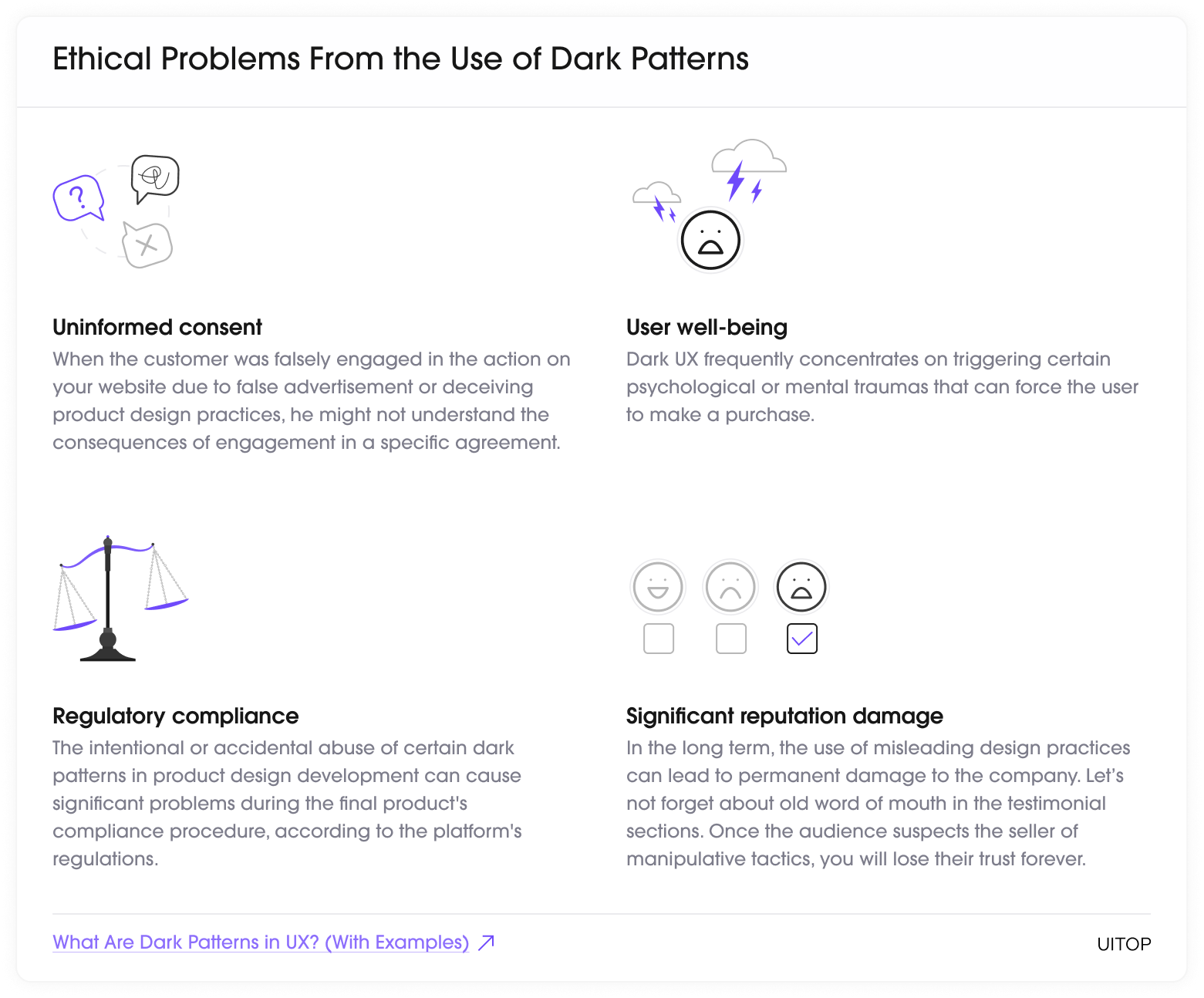
To avoid these pitfalls and build products that users trust, we need a set of positive principles.
Exploring the ethics of persuasive design
The article 'Exploring the ethics of persuasive design' by Miklos Philips offers an excellent, actionable list of guidelines for designers.
Please read the section 'Ethical Guidelines for Persuasive Design.' These seven points provide a robust checklist for ensuring your design choices remain on the right side of the ethical line.
To summarize, the key principles for ethical persuasive design are:
- Transparency: Be clear when you are using persuasive techniques. Don't create fake scarcity or urgency.
- User Control: Always provide users with the ability to opt out or make their own choices without friction or shame.
- Respect for Privacy: Be transparent about data collection and give users meaningful control over their information.
- Prioritizing Well-being: Avoid techniques that encourage addiction, anxiety, or unhealthy behaviors.
- Adherence to Regulations: Be aware of and follow laws and guidelines (e.g., GDPR, FTC).
Ultimately, ethical design is not about avoiding persuasion altogether; it's about using its principles to empower users and build long-term trust, which is far more valuable than any short-term gain from a manipulative trick.
4. Application and Reflection
Now, let's connect this to your practice. As a leader, you are in a position to influence not just the product, but the culture of design within your team.
Reflection Prompt:
Think of a persuasive feature you have either worked on, managed, or frequently encounter (e.g., a "limited time offer," a "recommended for you" section, a free trial sign-up flow, or a social media feed algorithm).
Using the framework of goal alignment, analyze this feature:
- What is the user's intrinsic goal?
- What is the business's goal?
- How well do these goals align?
- Based on your analysis, where does this feature sit on the spectrum from ethical persuasion to unethical manipulation? What specific design choices push it in one direction or the other?
There's no need to write a long response; this is a prompt for you to apply the concepts from today's lesson to your own professional context.
Conclusion
Today, we've navigated the complex ethical landscape that separates persuasion from manipulation. This is arguably one of the most important topics for any designer working with the principles of behavioral psychology.
Key Takeaways:
- Persuasion is ethical when it is mutually beneficial, respects user autonomy, and helps users achieve their goals.
- Manipulation (via dark patterns) is unethical because it exploits cognitive biases for unilateral gain, often through deception, and erodes user trust.
- The key ethical litmus test is goal alignment: Does the design serve the user's intrinsic goals or impose the company's goals on the user?
- An ethical design practice is built on a foundation of transparency, user control, and a genuine commitment to user well-being.
As you move forward, you are now better equipped to not only identify unethical practices but also to advocate for and build products that are both effective and respectful of the users they serve.
In our next module, we will begin exploring Framing, Priming, and Presentation. We'll start by examining how the way information is framed—as a gain versus a loss—can dramatically alter user perception and choice, building directly on the ethical foundation we've established today.
Can't find a good explanation? Sign up and we'll make it for you
Sign up