
Hello! Welcome to the first lesson of our third module, AI-Powered Content Creation Workflows.
In the last module, you created a strategic content calendar in Notion, mapping out topics for each stage of the marketing funnel. You have the "what" and the "when." Now, it's time to build the "how." How do you efficiently research those topics to create content that is insightful, accurate, and stands out from the competition?
Today, we'll address that by focusing on this lesson's outcome: Develop an advanced research workflow integrating Perplexity and ChatGPT for competitive analysis and content ideation.
You're already familiar with using ChatGPT for generating ideas. However, for deep research and competitive analysis, relying on a general-purpose chatbot alone can lead to outdated information or "hallucinations." We're going to build a more robust, professional-grade workflow that leverages specialized tools to give you a true analytical edge.
Step 1: Meet Your New Research Specialist, Perplexity AI
The first step in our advanced workflow is to separate the task of gathering information from analyzing and creating. For gathering fresh, verifiable information from the web, a tool designed specifically for that purpose is superior. Let's introduce Perplexity AI.
Think of Perplexity as a research engine, not just a chatbot. Its primary strength is its ability to search the internet in real-time, synthesize the findings, and—most importantly—provide direct citations to its sources. This is a game-changer for creating credible content.
To understand its key features and how it differs from ChatGPT and Google, let's watch a detailed overview.
Why I use Perplexity AI MORE than Google and ChatGPT for Content Research
The video 'Why I use Perplexity AI MORE than Google and ChatGPT for Content Research' by Grace Leung offers an excellent introduction to the platform's core functionalities.
Please watch from the beginning to 05:11. As you watch, focus on these key features that we will use in our workflow: How it differs from Google and ChatGPT: Notice the emphasis on direct answers with cited sources. Pro Search: Understand how this feature asks clarifying questions to deliver more comprehensive results. Search Focus: Pay close attention to this feature. The ability to limit searches to specific sources like Reddit, YouTube, or academic papers is incredibly powerful for market research.
To summarize the key differences, here is a helpful comparison chart:
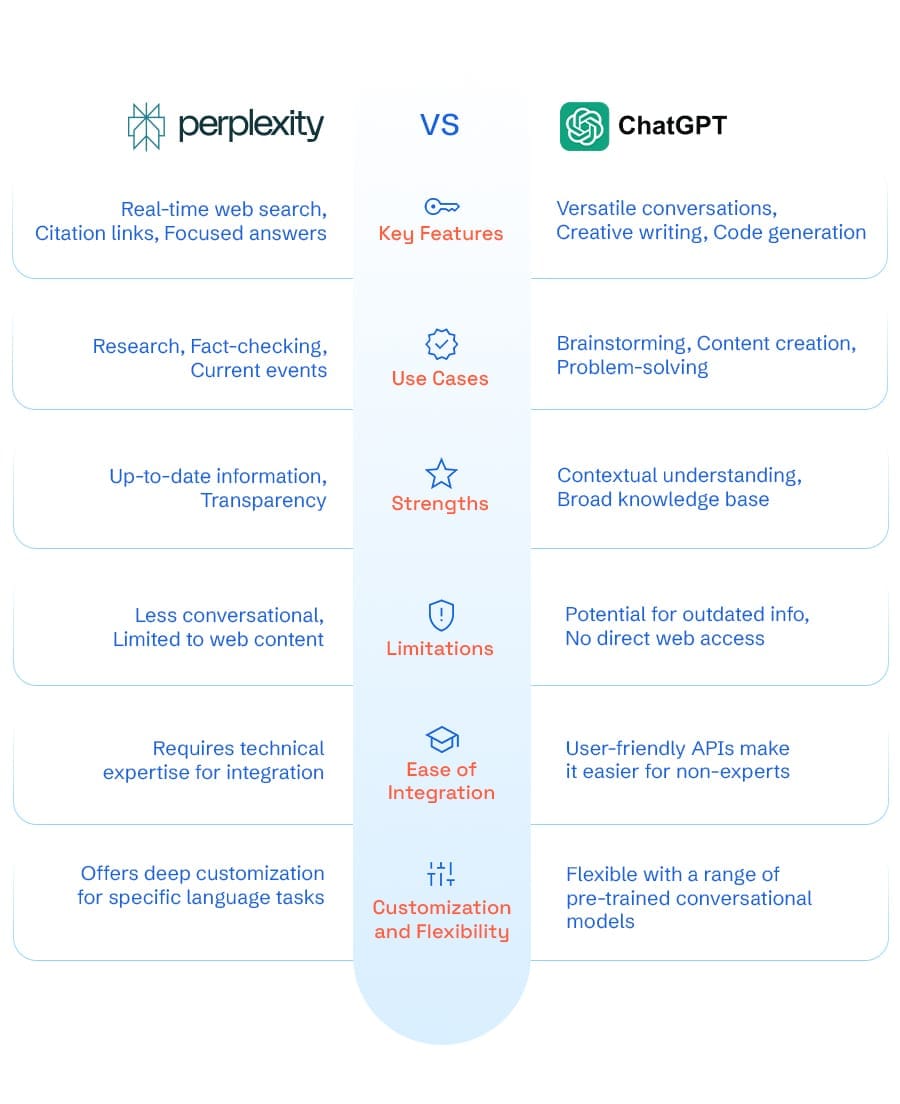
Step 2: A Foundational Workflow: Gathering Raw Intelligence
Now let's build our first workflow. The goal is to gather high-quality information from various sources and organize it for analysis in a controlled environment. For this, we'll combine Perplexity with another powerful tool from Google, NotebookLM. NotebookLM allows you to upload your sources (like PDFs or website links) and then use an AI to analyze only that information, preventing it from pulling in outside data. This "sandboxed" analysis is perfect for distilling insights from your curated research.
The following video demonstrates this exact workflow.
This NotebookLM + Perplexity Workflow Cuts Your Research Time by 80%
The video 'This NotebookLM + Perplexity Workflow Cuts Your Research Time by 80%' from Eliot Prince provides a practical, step-by-step guide to this powerful combination.
Watch from the beginning to 04:28. The video walks through a complete research cycle. Pay attention to these specific steps: Using Perplexity to find reports and sources on a topic. A clever prompt trick to get a clean, copy-paste-friendly list of URLs from Perplexity (01:10). Importing those website links into NotebookLM to create a private knowledge base (01:34). Using Perplexity's 'Focus' feature to search social platforms like Reddit for customer pain points (03:01).
This Perplexity → NotebookLM workflow is your new foundation for content research. It ensures your insights are grounded in real, verifiable data you've personally selected.
Test your understanding!
Let's say one of the ideas in your content calendar is a TOFU blog post about "Common mistakes new e-commerce stores make with inventory management."
How would you use the Perplexity → NotebookLM workflow to research this post? Describe the steps you would take.
Show answer
- Gather Sources with Perplexity:
- First, I'd use a broad prompt in Perplexity like, "Find recent articles, reports, and forum discussions about common inventory management mistakes for new e-commerce businesses."
- Next, I would use the 'Focus' feature to specifically search Reddit with a prompt like, "Search subreddits like r/ecommerce and r/shopify for threads where store owners discuss their biggest inventory management frustrations and mistakes."
- Extract URLs:
- For each search, I would add the instruction: "Provide findings in a numbered list with clean URLs on separate lines that I can easily copy and paste."
- Analyze in NotebookLM:
- I would copy the list of URLs from both searches and import them as sources into a new project in NotebookLM.
- Synthesize Insights:
- Once the sources are loaded, I would ask NotebookLM questions like: "Based on these sources, what are the top 5 most frequently mentioned inventory management mistakes?" or "Summarize the key frustrations people have with their inventory systems." This would give me a structured, evidence-based outline for my blog post.
Step 3: The Advanced Workflow: Assembling an "AI Analyst Panel"
For deep competitive analysis, we can take this a step further. Every AI model has its own way of processing information, its own biases, and sometimes access to different data. Instead of relying on one, you can get a far more comprehensive picture by assembling a "panel of experts."
This workflow involves running the same detailed research prompt across multiple AI platforms (like Perplexity, ChatGPT, Claude, and Gemini) and then using a model with a large context window to synthesize all their outputs into one master report.
This method is incredibly powerful for tasks like understanding a competitor's strategy, identifying market gaps, or defining your unique value proposition. Let's look at the resource that lays out this cutting-edge technique.
This Reddit post, 'Here is a deep research mega prompt for competitive intelligence...', is a masterclass in advanced AI strategy. It introduces the 'Analyst Panel' method.
Please read the entire post, but focus specifically on the sections 'Here's a quick rundown of their unique strengths' and 'Use The 'Analyst Panel' Method for Unbeatable Insights'. Pay close attention to the workflow described: Run the same master prompt on different platforms. Gather the individual reports. Use a 'super-model' (like Gemini or Claude) to synthesize a final, unified report.
The output of such an analysis can be a structured, data-rich table that gives you an at-a-glance view of the competitive landscape.

Step 4: The Core Principle: Masterful Prompting
Both of these workflows hinge on one critical skill: effective prompting. A vague prompt will yield vague results, no matter how powerful the tool. To get high-quality output, you must provide high-quality input.
The best prompts contain three key elements: Context, Role, and Expectation.
Practical guide: when to use ChatGPT, Claude, or Perplexity
The article 'Practical guide: when to use ChatGPT, Claude, or Perplexity' from Clickforest brilliantly breaks down this principle and shows how different tools fit into a single workflow.
Read the sections 'The secret to good AI prompts: context, role, and expectation', 'When to use Perplexity', and 'Practical workflows: the 3-tool strategy'. The section on prompting will teach you the universal framework for talking to any AI. The section on Perplexity reinforces its role as your research specialist. The workflow section provides another example of how to combine these tools strategically.
Here's how you might structure a mega-prompt for competitive analysis, applying this framework:
Role: "You are a world-class SaaS market analyst and business strategist."
Context: "I am the founder of a new SaaS product called '[Your SaaS Name]'. Our tool helps [Your ICP] solve the problem of [The Problem] by providing [Your Core Feature/Benefit]. We are about to launch and need to understand the competitive landscape. Our primary competitors are [Competitor 1], [Competitor 2], and [Competitor 3]."
Expectation: "Your task is to conduct a deep competitive analysis. For each competitor, research and report on the following:
- Product & Features: What are their core features? What is their key value proposition?
- Pricing & Tiers: How do they structure their pricing? What are the key limitations of each tier?
- Target Audience: Who do their marketing messages seem to target?
- Marketing Strategy: What are their primary marketing channels (e.g., SEO, social media, paid ads)?
- Strengths & Weaknesses: What are they known for being good at? Where are their apparent weaknesses or what are customers complaining about (search forums and social media)?
Format the final output as a detailed markdown table for easy comparison."
This type of detailed prompt, when used in the workflows we've discussed, will yield vastly superior results for both your competitive analysis and content ideation.
Conclusion
You now have a professional framework for AI-powered research that goes far beyond simple queries. By using the right tool for the right job and communicating your intent clearly, you can generate deep, actionable insights for your content and overall business strategy.
Key Takeaways:
- Specialize Your Tools: Use Perplexity AI for real-time, source-backed information gathering. Use ChatGPT, Claude, or NotebookLM for analysis, synthesis, and creative generation.
- The Foundational Workflow: Use the Perplexity → NotebookLM workflow to gather targeted information and analyze it in a controlled environment.
- The Advanced Workflow: For deep competitive intelligence, use the "AI Analyst Panel" method to synthesize reports from multiple AI models.
- Prompting is Paramount: The quality of your research is directly tied to the quality of your prompts. Always provide Context, Role, and Expectation.
Preview of the Next Lesson:
You've mastered how to gather and analyze research. The next step is to turn that research into polished, publishable content. In our next lesson, we will build a library of custom prompts for ChatGPT or Claude to generate differentiated, long-form content in a consistent brand voice. You'll learn how to take your research findings and systematically transform them into articles, social media posts, and more.