Hello! Welcome back to our series on investment due diligence.
In our last two lessons, we established a framework for analyzing a startup's potential, focusing on the "who" (the team) and the "where" (the market opportunity). We covered how to evaluate founder capabilities and how to pressure-test market size, competition, and go-to-market strategy.
Today, we turn to the third and final pillar of core business diligence: the "what." A great team in a huge market still needs a product that works and can win. This lesson is dedicated to today's learning outcome: to assess a startup's product and technology for feasibility and defensibility.
Given your computer science background, you have a distinct advantage in grasping the technical concepts. Our goal today is not to perform a code review, but to apply an investor's strategic lens. We will focus on asking the right questions to determine if the technology is sound and if it creates a lasting competitive advantage.
1. The Two-Part Test: Feasibility and Defensibility
When evaluating a startup's product and technology, your assessment boils down to two fundamental questions:
- Feasibility: Can this team actually build what they claim? Is the technology robust, scalable, and reliable enough to deliver on its promise?
- Defensibility: If they build it, can they protect it? What stops a competitor—whether a tech giant or another startup—from replicating their product and stealing their market share?
A product must pass both tests. A brilliant, defensible idea is worthless if the team can't execute it. Conversely, a perfectly executed product that anyone can copy is not a venture-backable business.
2. Assessing Technical Feasibility
Technical feasibility is about looking under the hood to ensure the engine is solid. While you won't be debugging code, you need to probe the core architectural decisions, data handling practices, and performance claims that determine if the product can scale.
The following resource from Qubit Capital outlines the key areas of a technical assessment.
Key Documents And Metrics For AI Startup Due Diligence
Let's begin by understanding the core components of a technical evaluation. This article, 'Key Documents And Metrics For AI Startup Due Diligence,' provides a concise overview.
Read the section titled 'Technical Assessments.' Pay attention to the four key areas it highlights: functionality, performance, architecture, and robustness.
Building on this, an investor's feasibility check, especially for the AI startups you'll be targeting, should focus on these critical areas. For a more detailed framework, the "AI-Driven Due-Diligence Checklist" from Rebel Fund provides a comprehensive set of criteria. We will use it to structure our thinking.
Key Feasibility Areas to Investigate:
-
1. Technical Infrastructure and Scalability:
- The Question: Is the system built for growth, or will it collapse under its own weight?
- What to look for: A modern, scalable architecture (e.g., microservices over a monolith), sound cloud deployment strategy, and robust security and disaster recovery plans. Your CS background will help you spot red flags like single points of failure or a lack of proper monitoring. (See point #3 in the "AI-Driven Due-Diligence Checklist" for more detail).
-
2. Data Quality and Integrity (Critical for AI):
- The Question: Is the data fueling the AI clean and reliable, or is it "garbage in, garbage out"?
- What to look for: Clear processes for how data is collected, validated, and maintained. What are the sources? How fresh is it? Crucially, what measures are in place to detect and mitigate bias? A model trained on biased data is a significant product and reputational risk. (See point #1 in the checklist).
-
3. Model Architecture and Performance:
- The Question: Does the AI model actually work as advertised?
- What to look for: You don't need to be a PhD in machine learning to ask smart questions. Ask how they measure performance. Look for standard metrics like accuracy, precision, and recall. How do they test for robustness and handle edge cases? A team that can't clearly articulate its model validation process is a major red flag. (See point #2 in the checklist).
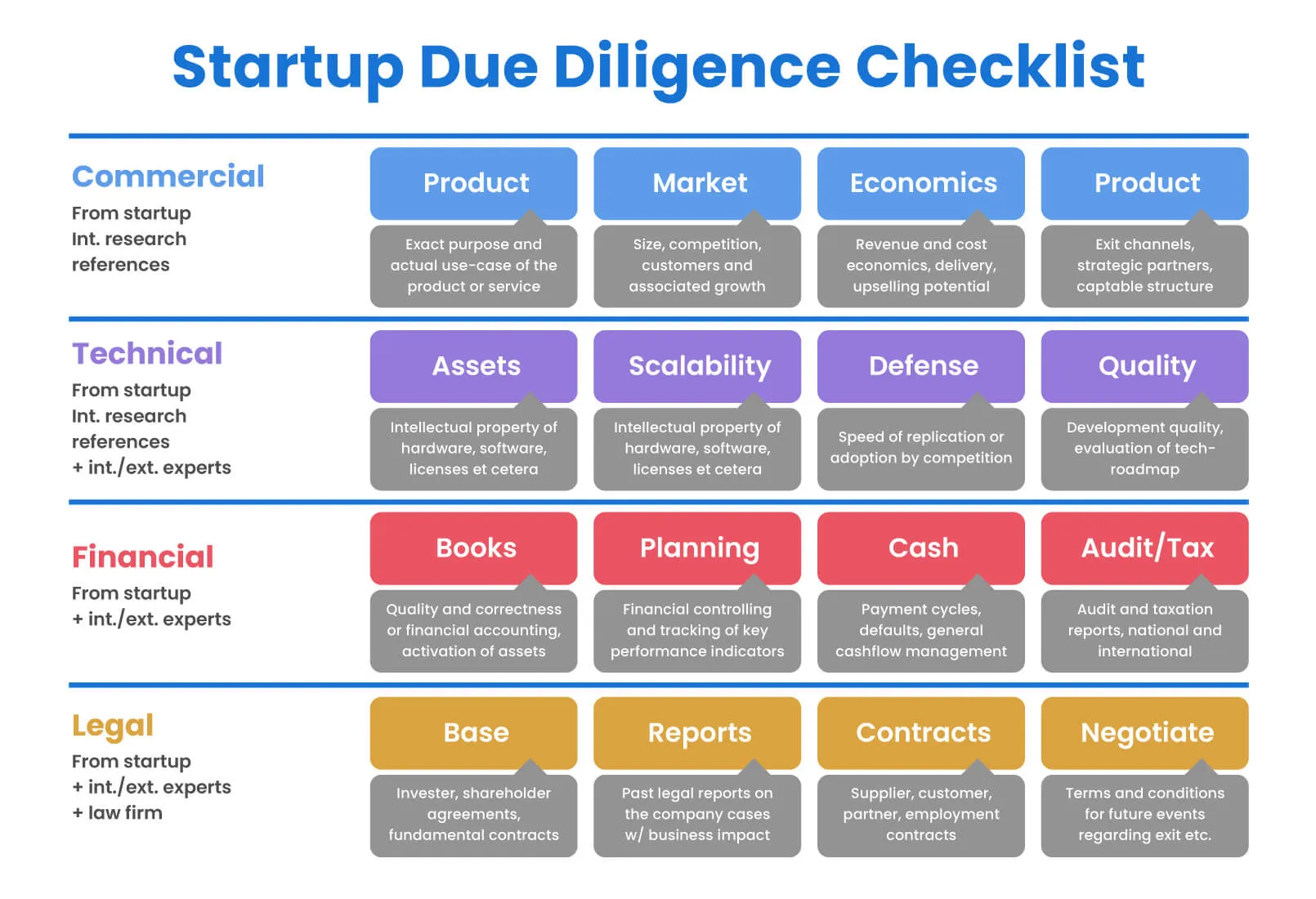
The following image provides a high-level due diligence checklist that situates these technical points within a broader framework. Notice how "Assets," "Scalability," "Defense," and "Quality" are all core components of the "Technical" quadrant.
Test your understanding!
A founder pitches you an AI startup that predicts customer churn. They claim their model is "99% accurate." Based on the feasibility framework above, what are two critical follow-up questions you would ask to scrutinize this claim?
Show answer
Here are a few excellent questions you could ask:
- Question about the metric: "How do you define 'accuracy'? In a churn prediction model, if only 1% of customers actually churn, a model that predicts no one will churn is 99% accurate but completely useless. How do you measure precision and recall?" This tests their understanding of meaningful performance metrics versus vanity metrics.
- Question about the data: "What data was the model trained and tested on? Was the test data truly separate and representative of your real-world customers? What steps did you take to ensure there was no bias in the data that might affect the model's fairness or reliability?" This probes the quality and integrity of their data infrastructure.
3. Assessing Product Defensibility
Once you're confident the team can build the product, you must determine if they can defend it. As we discussed in the last lesson, this is about building a "moat." In today's fast-moving AI landscape, an initial technical advantage can be fleeting.
This video from NFX provides a modern playbook for building defensibility, especially for AI companies.
The New Defensibility Playbook for AI Founders
This video, 'The New Defensibility Playbook for AI Founders,' uses the analogy of building a fortress, not just a castle, to explain how startups can create lasting value.
Watch the video from the beginning to 03:32. Pay close attention to the six defensibility concepts it outlines and the three questions you can use to test a company's moat.
The video emphasizes that defensibility isn't a single feature; it's a layered strategy. Let's break down the most important product and technology moats for an AI startup.
Key Defensibility Layers:
-
Data Moats: This is arguably the most powerful moat for an AI company. It's not about having more data, but about having proprietary data that gets better as more people use the product. This creates a powerful flywheel:
- More users -> More data generated -> Better, more accurate AI model -> Better product -> Attracts more users.
A company whose model improves with every new user is building a formidable, compounding advantage.
- More users -> More data generated -> Better, more accurate AI model -> Better product -> Attracts more users.
-
Embedding & High Switching Costs: How deeply does the product integrate into the customer's daily operations? A product that becomes a core part of a workflow is "sticky." The pain of ripping it out and replacing it becomes a powerful moat. Think about how accounting software or a CRM becomes embedded in a business. For your accelerator, look for products that don't just provide insights but become the system of record or action for a critical business function.
-
Network Effects: As the video from Bessemer Venture Partners also highlights, a product has network effects if it becomes more valuable to each user as more users join. While classic examples are social networks (Facebook) or marketplaces (Airbnb), this can apply to B2B AI tools as well. For example, an AI tool that benchmarks a company's performance against an anonymized, growing dataset of its peers has a network effect.
-
Intellectual Property (IP): This is the most traditional moat. It includes patents on novel inventions and trade secrets around proprietary algorithms or processes. While a single algorithm is rarely a sufficient moat in AI, a portfolio of patents or a well-protected, secret "sauce" can provide a meaningful barrier to entry.
To understand the IP component of defensibility, it's crucial to know what to look for. This checklist from Rebel Fund and an article from Qubit Capital provide guidance.
First, review section '7. Intellectual Property and Patent Portfolio' in the Rebel Fund checklist. Note the different types of IP: patents, trade secrets, and open-source licensing.
Key Documents And Metrics For AI Startup Due Diligence
Now, let's consider the ownership complexities. This section from Qubit Capital's article highlights the 'tangled web' of AI ownership.
Read the section titled 'Who Actually Owns the AI Part?'. This will help you think critically about whether the startup truly owns its 'secret sauce' or if it's dependent on third-party tech.
The image below, from a pitch deck, shows how a startup might articulate its defensibility. Notice the emphasis on proprietary data and the learning effects of tracking the user funnel—a classic data moat.

Conclusion
You have now completed the core framework for business due diligence: Team, Market, and Product. By assessing both the feasibility and defensibility of a startup's technology, you can form a holistic view of its potential.
Key Takeaways:
- Dual Assessment: Evaluating product and technology requires a two-part test: Feasibility (Can they build it?) and Defensibility (Can they protect it?).
- Feasibility Checklist: For an AI startup, feasibility analysis should scrutinize the technical infrastructure, data quality and integrity, and model performance metrics. Don't be swayed by vanity metrics.
- AI Defensibility is Layered: The strongest moats for AI companies are rarely just the algorithm. They are built on compounding advantages like data moats, deep workflow embedding (high switching costs), and network effects.
- IP is a Piece of the Puzzle: Formal Intellectual Property like patents and trade secrets contribute to defensibility, but you must verify true ownership and understand dependencies on third-party technology.
Preview of the Next Lesson
We have analyzed the business from the inside out. However, even the most promising startup can be derailed by external threats and hidden liabilities. In our next lesson, we will move to the fourth pillar of diligence: risk assessment. The topic will be: Identify key legal, regulatory, and intellectual property risks during diligence. This will build directly on our discussion of IP and expand into the broader legal landscape that can make or break a company.