
Welcome back. In the previous lesson, we traced the historical record of IMI and NMC-A, separating the original organism label, isolation date, source, allele, and genomic context. The central finding was that IMI-like carbapenemases do not have one simple epidemiological story: some are associated with chromosome-integrated EcloIMEX-like elements, whereas others occur on plasmids with greater potential for interstrain and interspecies transfer.
Now we turn that historical record into an epidemiological analysis. By the end of this lesson, you should be able to describe what is—and is not—supported about the distribution of IMI-producing Enterobacter across species, sequence types (STs), regions, clinical material, and environmental reservoirs. The focus is especially relevant when interpreting an IMI-positive isolate from a sink, shower, or drain: detection is important, but it is only the beginning of the inference.
Distribution is an observation, not automatically a prevalence estimate
When a paper states that IMI-producing Enterobacter occur in a particular country, species, or ST, first ask: distribution among which sampled population?
A useful report separates five linked dimensions:
| Dimension | Core question | Example of a defensible result |
|---|---|---|
| Species | Which genome-confirmed Enterobacter species carry the allele? | E. cloacae subsp. cloacae was the most common species in a French reference collection. |
| Lineage | Which STs or phylogenetic clusters occur? | ST820 dominated a regional IMI-1 outbreak. |
| Geography | Where were isolates collected or submitted from? | A cluster occurred in Mayotte and La Réunion, with a distinct ST820 isolate in Paris. |
| Source | Was the isolate from infection, colonization screening, or an environment? | River-water recovery establishes aquatic occurrence; it does not establish a hospital source. |
| Genetic context | Is the gene chromosomal, plasmid-borne, or unresolved? | IMI-1 may be in an EcloIMEX-type chromosomal element, whereas IMI-2 and IMI-6 may be plasmid-borne. |
The word prevalence requires a denominator. Formally:
A national reference-centre collection rarely provides prevalence among all hospital Enterobacter isolates, because isolates reach the reference laboratory through clinical, laboratory, and referral filters. It can provide a well-defined estimate within the submitted collection, such as the proportion of carbapenemase-producing Enterobacterales referred to that centre that were IMI/NMC-A producers.
This distinction matters because IMI-like enzymes may be under-detected. Their phenotypes can be atypical, and a producer may not look like the extensively drug-resistant archetype associated with KPC or NDM. Therefore, low detection can reflect true rarity, incomplete testing, selective referral, or some combination of these.
A large French collection: informative, but not a global denominator
The most useful current dataset for integrating species, ST, geography, and gene context is the French National Reference Center collection from 2012–2022. It contains 112 nonduplicate IMI/NMC-A-producing isolates submitted because they showed antimicrobial resistance. This is a strong genomic surveillance dataset, but it should be read as a reference-laboratory series, not as a random sample of all Enterobacter in France or globally.
Read this surveillance study carefully because it combines ANI-based species assignment, MLST, core-genome relatedness, geography, and chromosomal versus plasmid gene locations in one IMI/NMC-A dataset.
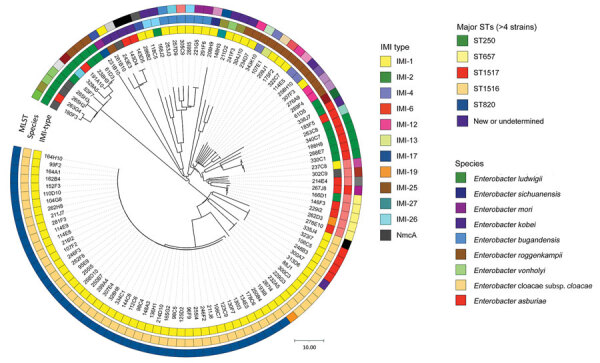
In the section “The Study,” begin with the surveillance population. Note exactly what was counted and the referral-based denominator used for the annual percentages. Continue in the same section from the ANI and MLST results. Find Figure 1 and compare its phylogenetic tree with the three annotation rings: sequence type, species, and IMI/NmcA enzyme type. Then read the genetic-context paragraph beginning the chromosome and plasmid comparison. Finally, read the short outbreak analysis beginning the SNP evidence. Focus on why ST identity alone was insufficient to establish clonality.
The collection included IMI/NMC-A producers every year from 2014 onward, but they represented only to of carbapenemase-producing Enterobacterales analysed by the French centre annually. That is evidence of persistent low-frequency detection in this surveillance stream. It is not evidence that the corresponding fraction applies to all French hospitals, to every Enterobacter species, or to any environmental niche.
The study’s most direct result is species composition. ANI assigned all isolates to the Enterobacter cloacae complex (ECC), and E. cloacae subsp. cloacae was the most common taxon: 56 of 112 isolates, or 50%. Other species occurred, but the correct conclusion is not that IMI is exclusive to E. cloacae subsp. cloacae. It is that this species was over-represented within this particular submitted collection.
Species distribution: historical names and genomic assignments tell different stories
The IMI/NMC-A family is strongly associated with the ECC, but this should never be simplified to “an E. cloacae carbapenemase.” Early reports often used E. cloacae as a broad phenotypic label. Modern genome-based work resolves members now called E. cloacae subsp. cloacae, E. asburiae, E. ludwigii, E. kobei, E. roggenkampii, and others.
This changes the biological interpretation. If older reports labelled every ECC isolate E. cloacae, then an apparent species association may partly be a naming convention. Conversely, re-analysis may reveal that one species repeatedly carries a chromosomal IMI-associated element, which could represent a real host association worth testing.
The French phylogeny demonstrates two points simultaneously:
-
A dominant species can exist in a surveillance collection.
E. cloacae subsp. cloacae accounted for half of the isolates. -
The enzyme family is not restricted to that dominant species.
The tree includes several ECC species carrying IMI-family enzymes or NMC-A.
Thus, the appropriate language is calibrated:
- Strong: “In this collection, E. cloacae subsp. cloacae was the most common ANI-assigned species.”
- Appropriate but broader: “IMI/NMC-A enzymes have been documented in genetically diverse ECC members.”
- Too strong: “IMI is characteristic of E. cloacae subsp. cloacae.”
- Unsupported without direct data: “A sink isolate identified as E. cloacae therefore originated from a particular clinical clone.”
Species assignment matters particularly for environmental investigations. If a hospital study reports “IMI-positive E. cloacae from sinks,” but identification was based only on an older biochemical system or low-resolution marker, the species-level ecological conclusion remains provisional. A genome-based assignment gives much stronger support, but even then it does not prove that the species prefers sinks. It establishes that it was detected there under a particular sampling design.
Sequence types: markers of lineages, not proof of transmission
MLST assigns an ST from alleles at a defined set of housekeeping loci. It is a useful label for comparing isolates, but it samples only a tiny fraction of the genome. Two important consequences follow:
- Different STs indicate that isolates are genetically differentiated at the MLST loci.
- The same ST does not by itself establish recent common transmission, a common environmental source, or identical plasmids.
In the French study, 105 of 112 isolates received one of 42 known STs. The remaining seven had novel or undetermined STs. That combination—many STs but a few recurring ones—is typical of a pathogen population containing both broad diversity and local expansions.
The major STs were:
| ST | Number of isolates in the collection | Interpretation |
|---|---|---|
| ST820 | 45 | Dominated because of a large IMI-1-associated outbreak in Mayotte and La Réunion |
| ST250 | 5 | Recurrent but far less numerous; requires isolate-level investigation before inferring a clonal association |
| ST657 | 5 | Recurrent lineage in the collection |
| ST1516 | 4 | Smaller recurring lineage |
| ST1517 | 4 | Smaller recurring lineage |
The ST820 finding is an especially clear warning against overinterpreting ST labels. Forty-four IMI-1-producing E. cloacae subsp. cloacae ST820 isolates from Mayotte and La Réunion differed by only 1–62 core-genome SNPs. Together with their temporal and geographical concentration, this supports a clonal outbreak population.
However, one further ST820 IMI-1 isolate was recovered in Paris and differed by more than 1,200 SNPs from the Mayotte/La Réunion ST820 isolates. So the same MLST label described two genomically distant groups.
The analytical hierarchy should therefore be:
- Species assignment tells you the taxonomic host.
- ST gives an initial lineage label and supports comparison with published collections.
- Core-genome phylogeny or SNP analysis, interpreted with dates and locations, evaluates fine-scale relatedness.
- Plasmid and gene-context comparison tests whether the resistance vehicle itself may be shared.
A practical conclusion for hospital-water work follows: several sink isolates with the same ST deserve further investigation, but they are not automatically a persistent drain clone. Isolates from the same sink with different STs can still carry related resistance elements, and conversely, isolates with the same ST can be distantly related.
Geography: clusters, repeated detections, and uneven observation
The historical record established that IMI/NMC-A was first recognized in North America and France, while IMI-2 provided an early aquatic environmental finding in US river samples. Subsequent reports span multiple regions and several countries. This is evidence of geographical breadth of reporting, not a map of global burden.
The French study shows why local resolution is more valuable than country-level labels. “France” includes geographically distant territories with different healthcare networks and ecological contexts. Within the 2012–2022 collection:
- 44 closely related IMI-1-producing ST820 isolates were associated with an outbreak in Mayotte and La Réunion.
- A Paris ST820 isolate was genetically distant from that outbreak population.
- Multiple other STs and IMI/NMC-A variants appeared outside that dominant cluster.
This is not a single national epidemic in the simple sense. It is a mixture of a large regional clonal expansion plus a wider background of genetically diverse isolates.
When interpreting a geographical claim, separate at least four possibilities:
| Observation | Possible explanation | Evidence needed to discriminate |
|---|---|---|
| Many isolates from one region | A real local outbreak or persistent reservoir | Dates, ward links, fine-scale genomics, repeated environmental sampling |
| One isolate from a new country | Importation, local acquisition, or detection after testing changed | Travel and healthcare history, local surveillance denominator |
| Same IMI allele in distant regions | Shared gene, independent acquisition, or shared plasmid | Gene neighbourhood and complete plasmid comparison |
| No reports from a region | True absence or lack of detection | Testing practice, reporting systems, sequencing availability |
The relevant question is therefore not “Where is IMI endemic?” unless surveillance is truly population-based. A more defensible question is: In which locations, hosts, and settings has IMI been detected, and what evidence supports local persistence or spread?
Clinical material, colonization, and environmental reservoirs
An IMI-producing Enterobacter isolate can be recovered from several biologically distinct source categories:
- Clinical infection specimens, such as blood, urine, respiratory material, or wounds. These establish that the organism was recovered during patient care, but not necessarily that it caused disease; clinical adjudication remains necessary.
- Colonization-screening specimens, commonly rectal swabs. These demonstrate carriage in the gastrointestinal reservoir and may precede infection or environmental shedding.
- Environmental samples, such as river water, wastewater, sink drains, shower outlets, traps, faucets, or biofilm material. These show environmental occurrence at the sampled site.
- Reference-laboratory submissions with incomplete metadata. These can demonstrate gene and lineage diversity but may not support source-specific epidemiological claims.
The IMI-2 discovery in E. asburiae from US river samples is important evidence that an IMI-family carbapenemase has occurred in an aquatic environmental setting. But it does not demonstrate that rivers are the direct source of clinical IMI producers, nor does it demonstrate that hospital plumbing is an established IMI reservoir.
For a sink or shower investigation, the claim “this drain is an IMI reservoir” should be graded by evidence:
| Strength of inference | What the data show |
|---|---|
| Detection | An IMI-positive organism was recovered once from one sample. |
| Repeated local recovery | The organism or gene is repeatedly detected from the same plumbing site over time. |
| Resident-population evidence | Multiple related isolates persist in a site and are distinguishable from sporadic introductions. |
| Clinical–environmental linkage | Patient and environmental isolates are closely related by appropriate genomic comparison and connected in time and place. |
| Transmission inference | The overall epidemiological record supports a plausible direction and route of movement; direction is usually the hardest part to establish. |
A water-associated isolate can reflect at least three different processes:
- True plumbing persistence, in which a strain or mobile element establishes in drain biofilm.
- Repeated seeding, in which patient waste, handwashing waste, or contaminated materials repeatedly introduce organisms.
- Transient detection, in which an organism passes through the system without establishing a stable population.
The gene context helps distinguish plausible mechanisms but cannot settle them alone. A chromosomal IMI-1 within an EcloIMEX-type element can persist as part of a successful bacterial lineage. A conjugative IncFII-type plasmid carrying IMI-2 or IMI-6 creates a plausible route for horizontal transfer in a mixed community. Neither finding alone proves that transfer occurred in a particular sink biofilm.
Synthesis: two epidemiological modes within one enzyme family
The emerging distribution of IMI-like carbapenemases is best understood as two partially overlapping modes.
First, lineage-associated chromosomal persistence. IMI-1, NMC-A, IMI-4, IMI-12, and many IMI-13 contexts are chromosomal in the French dataset. Most occur in EcloIMEX-type elements, often inserted between setB and yieP. A successful ECC lineage carrying such an element can expand locally, as illustrated by the IMI-1 ST820 outbreak in Mayotte and La Réunion.
Second, plasmid-associated dissemination. IMI-2, IMI-6, IMI-17, IMI-19, IMI-25, IMI-26, and IMI-27 were plasmid-borne in that collection. IMI-6 was consistently carried on large IncFII(Yb)-type plasmids, and most IMI-2 producers carried IncFII(Yp)-type plasmids. In the study’s conjugation experiments, the tested plasmids were conjugative except the plasmid carrying IMI-17. This mode can generate the same gene family across distinct strains, species, or ecological settings.
The two modes are not mutually exclusive. A plasmid can introduce a gene into a lineage; an element can then become stably maintained in a chromosome; that lineage can clonally expand in a hospital or another environment. Distribution therefore reflects the interaction of mobile-element biology, bacterial population structure, patient movement, local antimicrobial selection, and environmental persistence.
Key takeaways
IMI/NMC-A producers occur across multiple ECC species and STs, but the strength of an association depends on the quality of species assignment, the sampling denominator, and the genomic resolution used. In the French 2012–2022 reference collection, E. cloacae subsp. cloacae was the most common ANI-assigned species, while the collection as a whole was genetically diverse.
ST820 illustrates localized clonal expansion: 44 IMI-1-producing isolates from Mayotte and La Réunion were closely related by core-genome SNP analysis. Yet a Paris ST820 isolate was more than 1,200 SNPs distant, demonstrating that MLST identity is not evidence of a shared recent outbreak.
Geographical and environmental reports must be interpreted cautiously. IMI-2 in river-associated E. asburiae establishes aquatic environmental occurrence, but not direct transmission to hospitals or patients. For sinks and showers, robust reservoir claims require repeated sampling, high-resolution genomic comparison, and linkage to plumbing and patient metadata.
Next, we will examine the focused question of IMI and Enterobacter ST250: which species assignments, alleles, sources, locations, and genomic relationships actually support—or fail to support—a specific ST250 association.
Can't find a good explanation? Sign up and we'll make it for you
Sign up