
Welcome back. Last lesson established that IMI-family carbapenemases occur in more than one ecological and genomic mode: some blaIMI alleles are embedded in chromosomal EcloIMEX-like elements, while others are plasmid-borne. We also saw why an ST label alone cannot establish outbreak transmission.
This lesson applies that discipline to a narrower claim: is blaIMI genuinely associated with Enterobacter ST250? We will distinguish a defensible observation—ST250 appeared repeatedly in one genomic surveillance collection—from stronger claims about species, allele, geography, source, and clonality that require isolate-level evidence.
Turn “IMI-ST250 association” into testable subclaims
The phrase “IMI-producing Enterobacter ST250” can conceal several different hypotheses. They should be evaluated separately rather than treated as one finding.
| Question | What must be shown | What would not be enough |
|---|---|---|
| Repeated occurrence | More than one IMI-positive isolate is assigned ST250 within a defined collection | One ST250 isolate |
| Species association | Genome-based assignment of each ST250 isolate to a named species | Historic or low-resolution “E. cloacae” reporting |
| Allele association | The exact allele is reported for each isolate, such as IMI-1 or IMI-2 | Reporting only “IMI positive” |
| Geographic or source concentration | Isolate-level dates, locations, and specimen or environment categories | The location of the reference laboratory |
| Clonal association | Fine-scale genomic relatedness plus compatible epidemiology | Shared MLST designation |
| Shared mobile element | Comparable gene neighbourhoods and, where relevant, complete plasmid comparison | The same carbapenemase family alone |
This matters particularly for environmental work. Suppose five IMI-positive isolates from sinks are called ST250. That result may represent one resident drain clone, repeated introduction of related organisms from patients, several unrelated ST250 strains, or even a shared plasmid in distinct bacterial backgrounds. Those explanations make different predictions and require different data.
A compact rule is:
ST identifies a lineage label; core-genome analysis tests strain relatedness; gene-context analysis tests resistance-element relatedness.
What the French 2012–2022 collection actually establishes
The strongest published starting point is the French National Reference Center series of 112 nonduplicate IMI/NMC-A-producing Enterobacter cloacae complex isolates collected from 2012–2022. It is a valuable genomic surveillance collection, but it is not population-based surveillance of all French Enterobacter.
Read the core results of this Emerging Infectious Diseases study. It supplies the key denominator, ANI-based species framework, and MLST counts needed to assess ST250 without mistaking a reference-centre collection for a national prevalence survey.
In the section “The Study,” begin in the opening paragraph where the authors define which resistant isolates were received by the French National Reference Center. Read the collection definition and note the referral-based denominator. Then continue to the paragraph beginning “We confirmed ECC species identification using average nucleotide identity.” Read the species and ST results. Focus on three distinctions: ANI is used for species assignment, MLST assigns STs, and ST250 is one of several recurring STs rather than the dominant lineage.
The paper reports that ST250 occurred in 5 of 112 isolates. Within this specific submitted collection, that is:
or approximately 4.5% of the IMI/NMC-A-positive isolates. A rough 95% binomial confidence interval is about 1.9% to 10.0%, reflecting the small numerator.
That figure supports a modest claim:
ST250 was a recurrent ST among IMI/NMC-A-producing ECC isolates referred to the French reference centre between 2012 and 2022.
It does not support any of the following:
- ST250 is the dominant IMI lineage in France.
- ST250 is an international high-risk clone.
- ST250 is restricted to one Enterobacter species.
- ST250 carries one particular IMI allele.
- ST250 isolates share a recent common ancestor.
- ST250 is associated with hospital plumbing.
The number five is important, but it remains a small cluster of observations within a highly selected collection. Inclusion required recognition of antimicrobial resistance and referral to the reference centre. The collection therefore measures detection within that surveillance pathway, not the frequency of ST250 among all clinical, carriage, wastewater, sink, or shower isolates.
Read the phylogeny as a metadata map, not a transmission map
The study’s phylogenetic figure places the 112 isolates on a whole-genome SNP-based tree and adds three metadata rings: MLST, ANI-assigned species, and IMI or NMC-A type.
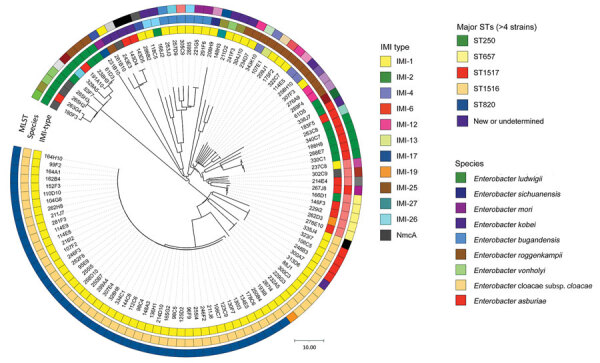
The figure is useful because it forces three variables into view at once:
- MLST ring: locate the five isolates assigned ST250.
- Species ring: inspect which ANI-assigned species corresponds to each ST250 position.
- IMI-type ring: inspect whether those ST250 isolates carry the same IMI allele or different alleles.
But it has an important limitation: a figure with coloured rings is a screening display, not a complete epidemiological dataset. It does not, by itself, provide the exact SNP distance between every pair of ST250 isolates, the sampling date of each isolate, the patient or environmental source, or the full sequence of the associated plasmid or chromosomal element.
For evidence-grade interpretation, each ST250 isolate should be represented in an isolate-level table rather than inferred solely from a coloured arc:
| Required field | Why it is necessary for ST250 evaluation |
|---|---|
| Isolate identifier | Allows the evidence to be traced back to a particular genome and sample |
| ANI species assignment and reference set | Resolves whether “ST250” occurs in one ECC species or more than one |
| MLST scheme and allele profile | Makes the ST designation reproducible and avoids ambiguity across schemes |
| Exact IMI allele | Separates IMI-1, IMI-2, IMI-6, and other variants with different epidemiological implications |
| Year and detailed location | Distinguishes a local cluster from temporally dispersed detection |
| Specimen category | Separates infection, carriage, wastewater, sink-drain, shower, or unknown sources |
| Core-genome comparison | Evaluates strain relatedness |
| blaIMI locus and flanking sequence | Evaluates chromosomal persistence versus possible mobile-element dissemination |
Species: do not let ST250 replace taxonomy
All isolates in the French collection were assigned to ECC species using average nucleotide identity, rather than relying only on historical phenotypic identification. This is a major strength. It means the study is not simply repeating the broad label “E. cloacae” for genetically heterogeneous organisms.
Yet the article’s main text gives an overall species result—56 of 112 isolates were E. cloacae subsp. cloacae—rather than a written, isolate-by-isolate account of the five ST250 entries. The figure contains the relevant visual pairing of ST, species, and IMI type, but a robust ST250 claim should be based on extracting those five individual records from the underlying study data.
This is more than a taxonomic technicality. Consider two hypothetical findings:
- All five ST250 isolates are ANI-assigned to the same species and occupy a tight core-genome cluster. This would support a species-associated clonal lineage hypothesis.
- ST250 isolates occur in more than one genome-assigned species or are widely separated on the tree. This would weaken a simple “ST250 clone” narrative and raise questions about the portability and resolution of the MLST label within the ECC.
Thus, the careful wording is not “ST250 is an E. cloacae clone” unless the relevant genomes were specifically shown to be the same currently accepted species. The defensible wording is:
“ST250 was assigned to five IMI/NMC-A-producing ECC isolates in this collection; the species identity of each isolate should be stated using the study’s ANI results.”
For future work, always record the species name and ST together. “E. cloacae complex ST250” is not interchangeable with “E. cloacae subsp. cloacae ST250,” nor with “Enterobacter ST250.”
Allele and genomic context: “blaIMI” is too broad
The phrase blaIMI describes a gene family, not a single genetic event. IMI-1 and IMI-2, for example, may have very different genomic locations and mobilization opportunities. Therefore, a statement such as “ST250 carries blaIMI” is incomplete unless the allele is named.
The French study provides an important allele-level framework:
- blaIMI-1, blaIMI-4, blaIMI-12, and blaIMI-13 were reported as chromosomal in that collection.
- blaIMI-2, blaIMI-6, blaIMI-17, blaIMI-19, blaIMI-25, blaIMI-26, and blaIMI-27 were reported as plasmid-borne.
- Most chromosomal IMI/NMC-A genes occurred in EcloIMEX-type elements, whereas many plasmid-borne examples had insertion sequences close to the resistance gene.
This does not permit an automatic inference about ST250. First establish the allele in each ST250 isolate. Then establish its location and surrounding sequence. Only then can the finding be interpreted.
For example:
| Observation in ST250 | Appropriate interpretation | Overstatement to avoid |
|---|---|---|
| Several isolates carry chromosomal IMI-1 in comparable EcloIMEX-like contexts | Consistent with lineage-associated maintenance; clonality still needs genome comparison | “The IMI gene cannot move” |
| Several isolates carry IMI-2 on similar IncFII-type plasmids but have distant chromosomes | Consistent with plasmid-associated dissemination | “ST250 is spreading clonally” |
| ST250 isolates carry different IMI alleles or distinct gene contexts | No single resistance-acquisition event is supported | “ST250 has a characteristic IMI plasmid” |
| A short-read contig contains blaIMI | Locus is unresolved without adequate linkage evidence | “The gene is plasmid-borne” |
The central point is that an ST association and a gene association are distinct epidemiological claims. A clone can spread with a chromosomal IMI element; a plasmid can move through several unrelated lineages; a related transposon can appear on different plasmids. ST250 alone cannot decide among these possibilities.
Geography and source: distinguish collection geography from acquisition setting
The study title identifies France and its overseas regions, and it gives compelling geographic detail for ST820: 44 closely related IMI-1-producing isolates formed an outbreak-associated population in Mayotte and La Réunion. That detailed ST820 evidence should not be transferred to ST250 merely because both STs recur in the same dataset.
For ST250, the main text establishes the count of five isolates but does not provide a comparably detailed narrative of:
- their individual French or overseas locations,
- whether they were recovered in the same year,
- whether they came from the same hospital,
- their clinical versus colonization versus environmental sources,
- or whether patient movement linked them.
A source label is essential. “Isolated in France” can mean several very different things:
| Reported setting | What it can support | What it cannot by itself support |
|---|---|---|
| Blood or urine culture | Recovery during clinical care; possible infection after clinical review | A hospital environmental reservoir |
| Rectal screening | Gastrointestinal colonization | Clinical infection or onward transmission |
| Sink drain, trap, shower outlet, or wastewater | Environmental occurrence at that site | A resident reservoir after one detection |
| Reference-centre submission without source metadata | Resistance-gene and lineage occurrence | A clinical or environmental association |
For a hospital-water study, a claim of an ST250 plumbing reservoir should minimally show repeated recovery from the same plumbing unit over time, with isolate-level genome data. A stronger claim would also show a temporally compatible related patient isolate. The direction of movement—patient to drain, drain to patient, or a shared unsampled source—usually remains the most difficult question.
Clonal relatedness: ST250 requires its own analysis
The French study gives a useful contrast. For ST820, the authors did not stop at MLST. They constructed an SNP matrix for 44 outbreak-associated isolates and found only 1–62 SNPs between pairs. They then estimated an evolutionary rate and the date of the population’s common ancestor. In contrast, a Paris ST820 isolate was more than 1,200 SNPs from the Mayotte/La Réunion ST820 outbreak isolates.
That comparison proves an essential point:
The same ST can contain both a recent outbreak cluster and a genomically distant lineage.
The publication does not report an equivalent pairwise SNP matrix, recombination-filtered analysis, or time-scaled reconstruction specifically for the five ST250 isolates in its main text. Therefore, the evidence currently supports ST250 recurrence, but not a conclusion that the five ST250 isolates are clonal.
A rigorous ST250 clonal analysis would proceed in this order:
- Confirm that the compared genomes are sufficiently comparable, especially at species level.
- Use a suitable reference or core-genome allele scheme.
- Mask recombination and low-quality regions where appropriate.
- Calculate pairwise core-genome SNP or allele differences among the five ST250 isolates.
- Interpret those distances alongside dates, hospitals, wards, patient links, and environmental locations.
- Independently compare the blaIMI neighbourhood and any implicated plasmids.
There is no universal SNP threshold that converts “same ST” into “transmission.” A small genomic distance can support recent relatedness only when it is biologically plausible in the time window and consistent with the epidemiological record. Conversely, a very large distance within one ST strongly argues against a recent direct-transmission chain.
A calibrated conclusion about IMI and ST250
At present, the French genomic surveillance study provides moderate evidence of recurrence: ST250 accounted for 5 of 112 IMI/NMC-A-producing ECC isolates submitted to the French reference centre over 2012–2022.
It does not, from the main reported results alone, establish a single ST250 IMI clone, a fixed ST250 species identity, an ST250-specific IMI allele, a particular hospital or geographic reservoir, or clonal transmission among the five isolates.
A publication-ready interpretation would read:
“In a French reference-centre collection of 112 IMI/NMC-A-producing Enterobacter cloacae complex isolates from 2012–2022, ST250 was identified in five isolates. This supports repeated detection of an IMI/NMC-A-associated ST250 lineage label within that submitted collection. Species-level, allele-level, source, geographic, and clonal conclusions require isolate-resolved ANI, resistance-gene, metadata, and core-genome analyses.”
That wording is appropriately cautious, but it is not weak. It clearly separates what has been observed from what remains to be demonstrated.
Key takeaways
- ST250 occurred in 5 of 112 IMI/NMC-A-producing ECC isolates in the French 2012–2022 reference-centre collection, about 4.5% of that defined collection.
- This supports recurrent detection, not ST250 dominance, prevalence in the general population, or a high-risk-clone designation.
- An ST250 claim must specify the ANI-assigned species, exact IMI allele, gene location and context, sample source, date, and location.
- The current main report provides detailed SNP-based clonal evidence for ST820, not for ST250. The ST820 example demonstrates why MLST identity is insufficient evidence of recent relatedness.
- For sink and shower investigations, establish plumbing persistence and clinical–environmental linkage through repeated sampling, detailed metadata, core-genome comparison, and separate analysis of the blaIMI genetic vehicle.
Next, the course moves from IMI epidemiology into hospital-water ecology: why Enterobacter can persist in nutrient-limited plumbing environments, even before antibiotic resistance and transmission are considered.
Can't find a good explanation? Sign up and we'll make it for you
Sign up