
Hello. This is the final lesson in the interview sprint. So far, you have built the technical ingredients of an MLOps design: clarify the product and prediction target, estimate scale, choose an inference pattern, govern features and data, reproduce training, release safely, and monitor the live system.
The final interview skill is orchestration. A strong ML engineering manager answer does not recite every component. It makes a coherent case: given these goals and constraints, here is the simplest credible system, why I chose it, how it fails safely, who runs it, and what I would build next.
By the end of this lesson, you will have a repeatable structure for a 40–45 minute MLOps system-design interview answer.
Treat the interview as a sequence of decisions
A system diagram is not the answer; it is evidence for an argument. The interviewer needs to be able to follow this chain:
- What are we optimizing, and for whom?
- What constraints make the problem hard?
- What baseline architecture meets those constraints?
- Which trade-offs did we accept, and why?
- How do we detect and contain failure?
- Who owns each operational boundary?
- What evidence would justify a more complex next version?
The central management principle is progressive disclosure. Start broad enough to establish an end-to-end system, then go deep where the risks, constraints, or interviewer’s questions demand it. Do not spend ten minutes selecting a neural architecture before establishing whether the product even needs synchronous inference.
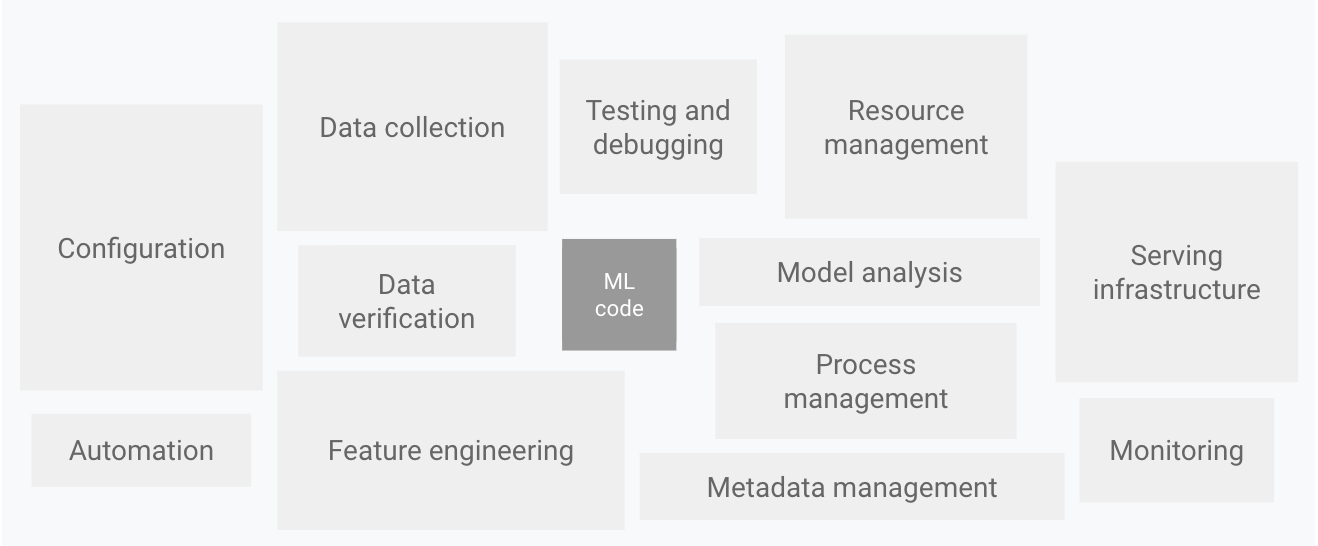
The MLOps system map below is a useful antidote to “model-first” answers. The model code is important, but it is only one small part of a production system.
A helpful opening is:
“I’ll first align on the objective, prediction target, and operating constraints. Then I’ll propose a simple end-to-end architecture, drill into the highest-risk decisions, and close with release, monitoring, ownership, failure handling, and a phased evolution.”
That statement buys structure without sounding scripted. It also gives the interviewer clear opportunities to redirect you.
This ML Design Interview strategy got me into Meta
Watch “This ML Design Interview strategy got me into Meta” from MLEpath for a compact demonstration of why prompt comprehension, pacing, and a high-level design come before technical detail.
Start with the framing, which identifies weak prompt interpretation and pacing as common failure points. Then watch scoping assumptions and the macro design. Notice the recommended order: make bounded assumptions, establish a broad architecture, and defer model specifics until they are justified.
A practical 40-minute answer structure
A framework should control time, not make you rigid. The following template fits a 40-minute round; in a 45-minute round, use the extra time for interviewer questions and one deeper drill-down.
| Time | Purpose | Visible output |
|---|---|---|
| 0–5 min | Clarify and scope | Objective, prediction target, primary metric, constraints, assumptions |
| 5–8 min | Estimate and choose the operating mode | Throughput, latency, freshness, availability, batch or online decision |
| 8–13 min | Present the baseline architecture | A legible end-to-end system divided into major layers |
| 13–25 min | Drill into the ML lifecycle | Data and features, training/evaluation, serving decision |
| 25–32 min | Explain safe operation | Release strategy, monitoring, fallbacks, incident response |
| 32–37 min | State trade-offs and ownership | Decisions, alternatives, accountable teams |
| 37–40 min | Close with evolution | Summary, bottlenecks, phased roadmap, questions to explore next |
The exact minute marks matter less than two habits:
- Finish the baseline early. By roughly one-third of the interview, the interviewer should understand how data reaches the model and how the prediction reaches the user.
- Keep a closing reserve. Do not let an interesting discussion of embeddings consume the monitoring, ownership, and evolution sections. Those latter topics distinguish an MLOps-oriented answer from an offline ML answer.
Machine Learning System Design Interview (2025 Guide)
Read this interview framework from Exponent to compare its six-stage pacing model with the template in this lesson. Its emphasis on a deliberate wrap-up is especially useful for avoiding a rushed ending.
In the “ML System Design Framework” section, read the six-step overview and note how every stage receives a time budget. Then find the “Step 6: Wrap Up the Design” subsection and read the wrap-up guidance. Focus on the idea that the final minutes should connect design choices to bottlenecks, scale, and future adjustments rather than merely repeat the diagram.
Scope with questions that change the design
Ask questions only when their answers could change a material decision. Five high-yield categories are usually enough:
- Product objective and decision: What action will the product take from the prediction? Is a false positive or false negative more costly?
- Success criteria: Which business outcome matters, and what model metric acts as its operational proxy?
- Labels and feedback: What is the label source, how delayed is it, and can it be trusted?
- Workload and experience: What are request volume, latency, freshness, availability, and geographic requirements?
- Risk and governance: Are there privacy, fairness, explainability, audit, or human-review requirements?
When details are absent, state a bounded assumption and proceed:
“Unless there is a strict real-time requirement, I’ll assume recommendations can be refreshed hourly. That makes a batch-first baseline cheaper and operationally simpler. If personalization must reflect the current session within seconds, I would introduce a narrow real-time feature path.”
This shows judgment: you recognize uncertainty, make it explicit, and preserve an alternative.
Draw an architecture that tells an operational story
For an MLOps answer, organize the whiteboard into four logical areas. You do not need to name a cloud vendor or a long list of tools unless asked.
| Area | Components to show | Question it answers |
|---|---|---|
| Product and decision path | Client or upstream service, API, request validation, prediction response, fallback | How does a user receive a safe, timely result? |
| Data and feature path | Events, source systems, validation, offline storage, feature transformations, online features if needed | Where do trustworthy inputs and labels come from? |
| Training and governance path | Experiment tracking, evaluation, model registry, approval gates | How does a candidate become an approved artifact? |
| Operations and control path | Deployment controller, monitoring, alerting, audit metadata, rollback | How does the system remain reliable after launch? |
Keep one “happy path” visible. For example, in a personalized feed design, user context is validated, relevant features are retrieved, a registered model scores candidates, and the service returns a ranked feed. Interaction events are later captured for training and evaluation. The control path qualifies and releases new model versions while production telemetry evaluates their behavior.
Then name the one or two interfaces most likely to fail. Examples include:
- the contract between a producer and the feature pipeline;
- the separation between offline and online feature computation;
- the dependency between the prediction service and feature retrieval;
- the handoff from candidate evaluation to model registry and deployment.
This is more convincing than drawing a feature store simply because feature stores are familiar. Every component should answer a stated requirement.
Give the architecture a baseline
Interview candidates often make one of two opposite mistakes:
- They propose a research prototype that cannot be operated safely.
- They propose a globally distributed, real-time platform before learning whether the problem needs it.
Instead, say what a credible v1 does. A v1 might train daily, generate scores in batch, store results in a cache, use a simple ranking model, validate data before training, require approval before promotion, and fall back to globally popular items when personalization is unavailable.
That baseline is not an admission of limited ambition. It is an explicit choice to reduce latency, cost, and operational risk until data proves that added complexity improves the product.
Communicate trade-offs as decisions, not vocabulary
An interviewer learns little from “we could use batch, streaming, or online inference.” Make a recommendation, name the rejected alternative, and state the consequence.
A compact pattern is:
“I choose X because requirements A and B dominate. I reject Y for v1 because it adds cost or operational complexity without sufficient benefit. The downside of X is C, which I mitigate with D. I would revisit this choice when signal E appears.”
Here are common MLOps decisions that work well in this format:
| Decision | Default recommendation when constraints are modest | Main trade-off | Trigger to revisit |
|---|---|---|---|
| Prediction mode | Batch scores or asynchronous inference | Lower cost and reliability versus lower freshness | Material value from minute-level context |
| Model choice | Interpretable baseline or lightweight ranker | Less model capacity versus faster iteration and easier debugging | Offline and online evidence show a persistent quality ceiling |
| Feature freshness | Periodic updates for most features | Some staleness versus simpler, more consistent pipelines | Freshness-related quality loss is measurable |
| Deployment | Canary or shadow before promotion | Slower release versus reduced blast radius | Mature automated evidence and low-risk use case |
| Retraining | Scheduled plus evidence-based retraining | Potentially slower adaptation versus protection from bad data | Confirmed, sustained outcome decline |
| Fallback | Cached, rules-based, or popular-result fallback | Lower personalization versus continuity of service | Fallback usage or quality becomes materially costly |
For a management-level answer, connect technical trade-offs to product cost. A heavy real-time model may improve ranking quality, but it can also raise p99 latency, reduce availability through more dependencies, increase GPU spend, and complicate incident response. The question is whether the incremental product value exceeds those costs.
Make failure modes, ownership, and recovery explicit
A design is incomplete until it states what happens when normal assumptions fail. The previous lesson introduced the monitoring loop: service, data, and model signals should lead to an owner and a decision. Use that operational logic directly in your interview answer.
| Failure mode | Detection | Immediate containment | Accountable boundary |
|---|---|---|---|
| Feature retrieval is slow or unavailable | Dependency latency, timeout rate, valid-prediction rate | Serve cached or approved default features; use a safe fallback; scale or fail over | Serving/platform team |
| Upstream source emits malformed data | Schema violations, missingness, freshness, volume anomaly | Quarantine bad inputs; preserve last known good data; stop affected pipeline | Producing data team, with data platform support |
| New model regresses in production | Canary metrics, business guardrails, error and latency comparison | Halt promotion and roll back to the registry-approved incumbent | Model owner and release owner |
| Model quality declines over time | Mature labels, calibration, task metrics, slice outcomes | Investigate data integrity; train and evaluate a candidate; do not auto-replace blindly | ML team, with product/risk approval for material trade-offs |
| Traffic exceeds forecast | Queue depth, saturation, p99 latency | Autoscale, shed noncritical work, degrade to cheaper fallback | Serving/SRE team |
Do not claim that “the ML team owns the model” and leave it there. Distinguish accountability for a decision from responsibility for operating a shared platform.
A useful ownership model is:
- Product, policy, or risk owners set the decision objective, acceptable harm, and business guardrails.
- Data-producing teams own the semantic correctness and timeliness of the systems that emit source data.
- ML engineers own labeling logic, feature and model design, evaluation, and diagnosis of model-quality issues.
- ML platform engineers own reusable training, registry, deployment, metadata, and governance capabilities.
- Serving and SRE teams own service SLOs, capacity, reliability engineering, and immediate production mitigation.
In a small organization, a few people may cover several roles. The boundaries still matter, because they prevent unresolved incidents where every team assumes another team owns the fix.
A concise failure statement during an interview might sound like this:
“If the feature store is unavailable, the serving owner first protects the user experience with a cached or non-personalized fallback. The data and platform teams diagnose the dependency. We record fallback usage by segment, because a successful HTTP response is not necessarily a valid personalized decision. If labels later show quality deterioration, the ML owner investigates; the system does not automatically retrain on potentially corrupted inputs.”
Describe evolution as evidence-driven investment
“Later, I would add streaming, deep learning, and a vector database” is a feature list, not a roadmap. A phased evolution should explain which observed limitation justifies each investment.
| Phase | Minimum capability | Why it is enough now | Evidence needed for the next phase |
|---|---|---|---|
| Phase 1: dependable baseline | Batch data processing, validated training set, simple model, model registry, manual approval, batch or cached serving, dashboards and alerts | Establishes a measurable product and a safe rollback path | Evidence that quality, freshness, or scale is constrained |
| Phase 2: automated and controlled operation | Automated validation and training, feature versioning, canary release, better lineage, autoscaling, slice monitoring | Reduces operational toil and release risk as usage grows | Evidence that manual processes or stale features limit business outcomes |
| Phase 3: selective real-time sophistication | Streaming features where valuable, online ranking or personalization, multi-stage retrieval, richer experimentation | Invests only in latency-sensitive paths with demonstrated return | Sustained value and scale that justify higher serving cost and complexity |
Notice that the system evolves selectively. A recommendation system might retain batch-generated item embeddings while adding real-time session features only to the final ranker. This can capture much of the freshness benefit without making every training and retrieval component real time.
Phasing also makes a strong closing answer because it demonstrates prioritization. First prove the product can learn from reliable feedback. Next automate the operational controls. Only then spend heavily on low-latency personalization or highly complex models.
A concise closing answer you can adapt
Imagine the prompt is: Design a personalized merchant-offer ranking system for a consumer app.
“I’ll optimize incremental offer engagement while protecting long-term customer value, with p95 response latency under 150 milliseconds and a fallback feed available during dependency failure. I’ll assume labels are clicks and subsequent purchases, with purchases arriving later.
“For the baseline, I would train daily on validated interaction, merchant, and customer data. A shared transformation definition produces versioned features. The training pipeline evaluates a lightweight ranking model against a rules-based and current-model baseline, including segment-level guardrails. Approved artifacts enter a model registry.
“At request time, the serving layer validates user context, retrieves a precomputed candidate set and recent approved features, ranks candidates, applies policy rules, and returns results. I choose a batch-first candidate pipeline because most offer relevance does not need second-level freshness. A real-time path would be justified only if session signals show measurable incremental value.
“For release, I would shadow and then canary the candidate. Promotion requires service health, latency, and business guardrails to remain acceptable. We monitor service SLOs, feature freshness and missingness, score distributions, and delayed outcome metrics by customer segment. A feature-store outage uses cached features or a popular-offers fallback; a model regression halts promotion and rolls back.
“Product owns engagement and risk trade-offs; data producers own source contracts; ML owns evaluation and candidate diagnosis; platform and SRE own the operational tooling and service reliability. Phase one uses batch scoring and manual approval. Phase two automates validation and canary promotion. Phase three adds real-time session features only if data confirms that freshness is the limiting factor.”
This is not meant to be memorized word for word. Its value is its compression: every sentence either establishes a decision, explains a reason, or connects a signal to an owner and action.
Key takeaways
A high-quality, time-boxed MLOps system-design answer should:
- establish scope and assumptions before proposing technology;
- present a complete baseline architecture early;
- go deep on the decisions created by the prompt’s actual constraints;
- state trade-offs as recommendations, alternatives, consequences, and revisit triggers;
- connect failure modes to detection, containment, and accountable owners;
- distinguish model, data, platform, serving, and product responsibilities;
- present evolution as a sequence of evidence-driven investments;
- reserve time to synthesize the design rather than ending inside a technical detail.
For interview practice, use the time boxes as a speaking outline, record one complete answer, and review whether an interviewer could identify your objective, baseline, trade-offs, failure response, ownership model, and next investment without having to infer them.
Can't find a good explanation? Sign up and we'll make it for you
Sign up