
Hello. In the previous lesson, you selected inference patterns by separating caller latency, feature freshness, workload shape, and cost. That decision now constrains the data layer: a synchronous ranker may need millisecond feature reads, while a batch model needs historically correct training data at much larger scale.
This lesson designs the governed data and feature layer behind those systems. The goal is not merely to create a feature store. It is to establish trustworthy feature contracts: validated inputs, temporally honest training datasets, reproducible versions, visible lineage, and least-privilege access. These are the details that distinguish an MLOps architecture from a diagram containing a warehouse and Redis.
A feature layer is both a data plane and a control plane
A feature is a model input derived from raw data, such as orders_last_30m, customer_lifetime_value, or merchant_chargeback_rate. A feature layer makes these inputs reusable across models while preserving their meaning and operational guarantees.
A practical design separates two responsibilities:
- The data plane computes, stores, and retrieves feature values.
- The control plane records feature definitions, schemas, owners, versions, quality expectations, permissions, and lineage.
The data plane normally includes:
- Source systems: operational databases, event streams, warehouse tables, and external data feeds.
- Transformations: batch jobs for large historical computation and stream processing for rapidly changing aggregates.
- An offline store: historical, timestamped feature values used for training, backfills, analysis, and validation.
- An online store: the latest eligible values keyed by an entity, optimized for low-latency inference.
- A serving API or library: a controlled way for applications to retrieve online features.
The control plane is typically a feature registry or catalog. It should answer questions such as:
- What exactly does
merchant_risk_7dmean? - Which entity key and timestamp does it use?
- Who owns it, and what is its freshness SLA?
- Which source tables and transformation revision produced it?
- Which models and training datasets consume it?
- Is it approved for production use?
- Is it sensitive, restricted, deprecated, or scheduled for removal?

This architecture is a useful conceptual map, not a mandatory technology choice. The image happens to show Spark, Redis, S3, Airflow, and PostgreSQL; the interview-quality decision is to explain why you need an offline history, a low-latency serving path, and a governed registry, whatever tools implement them.
A clean interview statement is:
“I would use one governed feature definition to drive both historical retrieval for training and materialization for online serving. The offline store retains timestamped history; the online store holds current values. A registry captures ownership, schema, validation rules, version, lineage, and access policy.”
Validation: stop bad data before it becomes a bad feature
Feature pipelines have more ways to fail than ordinary application code. A source column can disappear, a producer can change units, an event stream can lag, a join can suddenly produce mostly null values, or an upstream release can send malformed entity identifiers. The pipeline may still complete successfully while silently corrupting model inputs.
Validation therefore belongs at more than one boundary:
| Boundary | What to validate | Example response to failure |
|---|---|---|
| Raw ingestion | Schema, parseability, required fields, event timestamps, duplicate rate | Quarantine malformed records; alert source owner |
| Feature transformation | Entity-key validity, null rate, expected ranges, uniqueness at entity and timestamp, join coverage | Block publication; preserve the last known-good online values |
| Materialization | Freshness, row count, store-write success, online/offline parity for sampled entities | Retry safely; prevent partial promotion |
| Training dataset creation | Feature schema, missingness, point-in-time join coverage, label validity | Fail the training run or require explicit approval |
| Serving request | Request schema, required feature presence, value bounds | Apply a defined default or fallback; log the event |
The appropriate rules depend on the feature. For a monetary amount, negative values may be invalid. For a fraud score input, a value outside is invalid. For a new-user feature, missingness may be expected; for a stable customer identifier, it usually is not. Governance means each feature owner makes those semantics explicit rather than relying on a generic “data quality passed” signal.
The key policy is to distinguish warning conditions from publication blockers. A small distribution change might open an investigation while allowing an update. An incompatible schema, a missing entity key, or a failed transformation should block the new feature materialization from replacing a healthy production value.
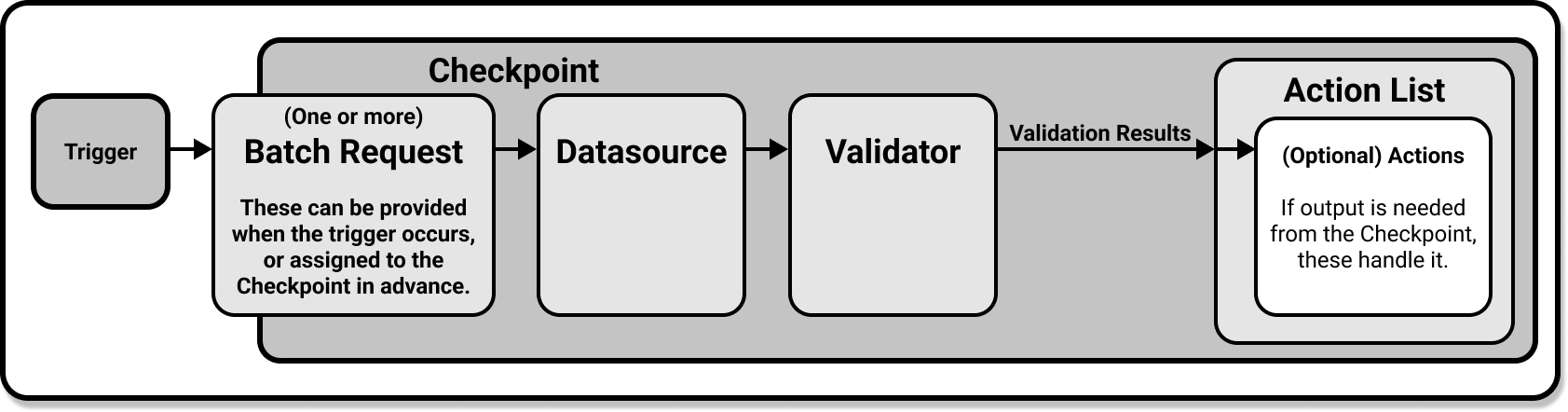
A checkpoint is a useful operational pattern because it treats validation as a repeatable workflow rather than an analyst inspecting a dashboard after the fact. Define the batch to validate, apply versioned expectations, persist the result, and take an explicit action.
MLOps with Feature Store - Move models from development to production
Watch the selected parts of MLOps with Feature Store – Move models from development to production from AIEngineering for a compact view of feature-store architecture, immutable training datasets, validation, and feature statistics.
First watch feature architecture, which distinguishes mutable feature groups from immutable training datasets and introduces statistics for drift detection. Then watch validation checks for an example of validation rules in a feature pipeline, including streaming feature engineering. Treat the named products as examples; focus on the control points that any implementation needs.
A manager should also insist on evidence. Store validation results with the pipeline run, feature definition version, input data interval, and output version. “The job succeeded” is not evidence that the data was trustworthy.
Point-in-time correctness: training must not see the future
Point-in-time correctness is the safeguard against one of ML’s most damaging silent failures: data leakage.
Suppose a marketplace wants to predict whether a merchant transaction at 10:00 will become fraudulent. A training row has:
- entity: merchant
- prediction or label event time: 10:00
- target: whether the transaction was later confirmed fraudulent
For each feature, training may use only the value that would have been available when the decision was made. A rolling count calculated at 10:05 contains five minutes of future activity relative to the decision. Joining it to the 10:00 training example makes offline evaluation look better than production performance can justify.
A historical feature retrieval should use:
- an entity key, such as
merchant_id; - an entity event timestamp, the time at which the model conceptually made its decision;
- a feature’s own event timestamp, describing the time the feature value represents;
- often an availability timestamp (sometimes called created timestamp), describing when that value actually became available to the system.
For every training example, retrieve the latest eligible feature record for the same entity whose event time is not later than the example’s event time. A time-to-live window can limit how far backward the system may search; if no fresh-enough value exists, the feature is missing and the dataset must apply its declared missing-value policy.
The harder case is a late-arriving event or a correction. Imagine a feature record represents 09:50 activity but was backfilled at 11:00. Its event time is before 10:00, but at 10:00 the production system could not have known it. If the training join ignores availability time, the backfilled record leaks future knowledge into training.
This is why mature designs maintain both timestamps when possible:
| Timestamp | Question answered |
|---|---|
| Event time | When did the behavior or state represented by this value occur? |
| Availability time | When did the feature system have this value available for use? |
| Training example time | When would the model have made this particular prediction? |
The Feast documentation gives a concrete implementation view of this logic.
Point-in-time joins | Feast: the Open Source Feature Store
Read Point-in-time joins from Feast’s documentation to see how timestamped feature history is joined to labeled examples without exposing future feature values.
In the opening section, read from “Feast is able to join features” through the explanation that historical retrieval uses each training row’s timestamp and a TTL window. Focus on why TTL is relative to the training event, not to the moment you run the query. Then read the section “Retrieving features as of the event time,” especially the availability time safeguard. Notice how filtering by created timestamp prevents late corrections and backfills from contaminating the training set.
Point-in-time joins are not merely a feature-store feature. They are a dataset contract. You must still make good choices about event-time definitions, clock consistency, late-data policy, TTL, labels, and missing values.
For example, a business might reasonably choose one of these policies for late events:
- exclude events arriving after a defined lateness cutoff;
- delay training-data publication until the watermark passes;
- include late data only in a later backfill, while preserving the original availability timestamp;
- use the corrected data for analytical reporting but not for replaying the original online decision.
The wrong policy is to use current “latest” tables for every historical training row because it is convenient.
Version features as products, not columns
A model’s input is a contract. Changing a feature’s type, definition, window, source, or unit can change model behavior even when the feature name stays the same.
For example, customer_spend_30d might initially mean completed purchase value in USD over 30 calendar days. A later implementation might include refunds, use a rolling 30 times 24-hour window, or change currency normalization. Each change may be legitimate, but it is not necessarily compatible with a model trained on the former definition.
A governed feature should have a versioned specification containing at least:
| Metadata | Why it matters |
|---|---|
| Name, description, entity key, data type | Defines the interface consumed by models |
| Transformation logic and code revision | Explains how values were computed |
| Source datasets and source versions | Makes upstream dependencies visible |
| Event and availability timestamp semantics | Enables temporally correct retrieval |
| Refresh frequency, freshness SLA, and TTL | Sets operational expectations |
| Validation rules and validation-result history | Establishes data-quality evidence |
| Owner, domain, sensitivity classification | Enables accountability and access policy |
| Status: experimental, approved, deprecated | Prevents accidental production use |
For breaking changes, prefer a new versioned feature or feature view, such as merchant_risk_features_v2, rather than mutating an existing production contract. Models consuming version 1 remain reproducible while a candidate model is trained and evaluated against version 2.
Versioning must cover more than code. To reproduce a training dataset, retain a dataset manifest with:
- label definition and extraction query revision;
- entity population and time range;
- selected feature-view versions;
- point-in-time retrieval settings, including TTL and availability-time filtering;
- source snapshot identifiers or time-travel references;
- feature schema and feature statistics;
- dataset output location and immutable identifier.
This makes it possible to explain a model’s behavior months later: not just “which model file was deployed,” but “which input definitions and historical data state produced it.”
Lineage: make impact and diagnosis possible
Lineage records the relationships among raw sources, transformations, feature versions, training datasets, models, and serving deployments. It serves two managerial purposes.
First, it enables impact analysis. If an upstream team plans to rename a column or discovers a defect in a source table, you should be able to identify affected feature views, datasets, models, and endpoints before production breaks.
Second, lineage enables diagnosis and audit. If a model’s conversion rate declines, you can inspect the exact feature version, the validation history, materialization runs, and source-data changes associated with that model.
At minimum, capture these lineage links:
- Source table, event topic, or external feed to transformation job and code revision.
- Transformation run to feature definition version and materialized offline or online data version.
- Feature definition version to each immutable training dataset.
- Training dataset to model run, model artifact, and evaluation result.
- Approved model artifact to serving deployment and the feature contract it expects.
Some platforms can create part of this graph automatically. Snowflake’s feature-store documentation illustrates the desirable goal: tracking data flow from source through feature and dataset to trained model. The governance principles apply whether lineage comes from a managed platform, orchestrator metadata, a catalog, or an internal service.
Read the selected sections of the Snowflake Feature Store overview from Snowflake as a concrete example of how feature discovery, access control, point-in-time retrieval, feature views, and lineage can be integrated with a governed data platform.
Start with the opening overview and focus on the claims that data remains governed and that feature access is role based. Then, in “How does it work?”, read the explanation beginning feature views; relate it to a versioned feature contract. Finally, read “Back-end data model,” especially database enforced governance. Also note the ML Lineage statement immediately before “How does it work?” as an example of the lineage trail your architecture should expose.
Lineage should not be confused with documentation alone. A wiki page saying “this feature uses payments data” is helpful, but it cannot reliably answer whether a particular model run consumed a flawed partition produced by a particular pipeline run. Connect lineage to actual immutable identifiers.
Access control: govern both metadata and values
Feature data is often sensitive even when raw data is not directly exposed. A feature may encode location behavior, financial history, health-related signals, or inferred personal characteristics. A low-latency feature API can also become a path for unintended data disclosure if any service can query any entity.
Use least privilege and separate the permissions for discovery, definition changes, offline retrieval, online retrieval, and administration.
A reasonable role model looks like this:
| Role | Typical permissions |
|---|---|
| Feature owner or domain team | Define and update features in its domain; view quality results; approve compatible releases |
| Feature pipeline identity | Read authorized inputs; write only its assigned feature views; publish materializations |
| Data scientist | Discover metadata; retrieve only approved offline features for authorized projects |
| Training pipeline identity | Read exactly the dataset sources and feature versions approved for one training job |
| Production serving identity | Read only the feature keys and feature sets required by its endpoint; no broad offline access |
| Platform administrator | Manage infrastructure and policies, with tightly audited access to sensitive values |
| Auditor or privacy team | Inspect metadata, lineage, access logs, and approval records without needing broad value access |
Apply controls at several levels:
- Environment isolation: development, staging, and production need separate identities and data policies.
- Domain and project namespaces: teams can discover governed shared features without writing to another domain’s feature definitions.
- Column-level and row-level policies: restrict especially sensitive feature values or entity populations where the platform supports it.
- Sensitivity tags: classify features such as public, internal, confidential, or restricted; propagate policy from source data where appropriate.
- Service identities and short-lived credentials: pipelines and serving applications should authenticate as non-human identities, not shared user accounts.
- Audit logs: record who retrieved or changed a feature definition, training dataset, and sensitive online value.
Avoid a tempting but unsafe shortcut: granting the online serving service broad warehouse read access because it “may need more features later.” An online endpoint should read a narrow approved feature set through a controlled interface. Adding a feature should be a reviewable contract change, not an incidental query change.
A concise system-design answer
In an interview, do not list every data-platform tool. State the governance problem, draw the main boundaries, and then explain the controls.
For a fraud model requiring sub-50 ms online scoring and regular retraining, an effective answer would sound like this:
“I would ingest transactions and merchant events into a governed feature layer. Batch and streaming transformations compute versioned merchant and transaction feature views. Timestamped history goes to an offline store for point-in-time training retrieval, while current approved values are materialized into an online store for low-latency serving.
Each feature view has an owner, entity key, schema, event-time and availability-time semantics, freshness SLA, validation rules, and sensitivity tag in the registry. Validation runs before materialization; schema or critical-quality failures quarantine the new data and retain the last known-good online values.
Training data is built using point-in-time joins at each transaction’s decision time, with availability-time filtering so later backfills cannot leak into the past. Every dataset is immutable and records feature versions, source snapshots, and retrieval settings.
Finally, lineage links sources, transformations, feature versions, datasets, and models. RBAC gives the serving service access only to the production feature set it needs, while data scientists access approved offline features through project-scoped roles.”
That answer makes the business consequences explicit: trustworthy evaluation, predictable serving, controlled sensitive-data use, faster impact analysis, and reproducibility when something changes.
Key takeaways
A governed data and feature layer has five essential properties:
- Validation: enforce schema, completeness, freshness, range, and business-rule checks; block unsafe publication rather than silently replacing good values.
- Point-in-time correctness: construct every training example from feature values available at that example’s decision time, not from today’s latest tables.
- Versioning: version feature definitions, transformation logic, data snapshots, and immutable training datasets; use new versions for breaking semantic changes.
- Lineage: connect sources, transformations, features, datasets, models, and deployments so teams can audit, diagnose, and assess impact.
- Access control: use least-privilege roles, environment isolation, sensitivity classifications, controlled online retrieval, and auditable identities.
Next, you will build on these contracts by designing a reproducible training pipeline: tracking experiments, versioning artifacts, evaluating candidates, and registering approved models.
Can't find a good explanation? Sign up and we'll make it for you
Sign up