
Hello. The prior lesson ended with an approved, immutable model version in a registry, backed by reproducible training inputs and an evaluation report. That approval answers, “Is this artifact a legitimate release candidate?” It does not yet answer, “Can we safely let it make production decisions?”
This lesson covers that second question. You will design a release workflow that applies automated checks, exposes a candidate safely through shadowing or a canary, promotes it only when evidence supports doing so, and restores the known-good version quickly when it does not. In an ML engineering manager interview, the important point is not naming a deployment tool: it is showing that releases are evidence-driven, reversible, and have clear owners.
A release is a controlled decision, not a deployment command
A reliable model release begins with an important separation:
- Model registration: an artifact has passed offline evaluation and has complete lineage.
- Deployment: the artifact and its serving dependencies are placed in an environment where they can receive requests.
- Release: the organization deliberately changes which model’s predictions can influence users or business processes.
A model can be registered but never deployed. It can be deployed in a shadow environment but not affect any user. And it can be deployed to a small canary cohort without being promoted to all traffic.
This distinction prevents a dangerous shortcut: treating the registry alias approved as though it should immediately receive all production traffic. The release service should instead create a durable release record that resolves every mutable reference to immutable versions.
A release record normally contains:
| Release field | Why it matters |
|---|---|
| Candidate model version and artifact checksum | Identifies exactly what is being released |
| Incumbent model version | Defines the rollback target and comparison baseline |
| Serving image and configuration version | A model cannot be separated from its runtime behavior |
| Feature or input schema contract | Detects incompatible requests before they affect decisions |
| Rollout plan | States cohorts, traffic percentages, and bake periods |
| Promotion and rollback policy version | Makes decision criteria auditable |
| Owner and on-call escalation path | Ensures someone can act when a gate fails |
| Release status and evidence | Preserves whether the release was promoted, held, or rolled back |
The incumbent must remain runnable during the rollout. “Rollback” is not a vague instruction to rebuild last week’s environment; it is a tested routing action to a specific known-good model and serving configuration.
Checks belong at several points in the workflow
The previous lesson established offline model validation: predictive performance, segment guardrails, feature compatibility, and model package checks. Release automation adds a different class of checks: can the model behave correctly in the actual serving path and under production-like load?
Google Cloud’s MLOps: Continuous delivery and automation pipelines in machine learning usefully separates continuous integration checks from delivery checks.
Read the Google Cloud Architecture Center guidance to distinguish tests of ML pipeline code from tests of a deployed prediction service. This distinction is central to explaining why a model can pass offline evaluation yet still be unsafe to release.
In the “Continuous integration” section, read the listed CI checks. Notice that these establish that feature logic, training code, and pipeline components work as intended. Then move to “Continuous delivery.” Read the delivery considerations. Focus on infrastructure compatibility, prediction API tests, load tests, and the distinction between test, pre-production, and production environments.
A practical workflow has three gates.
1. Continuous-integration gate: can we build and trust the change?
This gate runs when model-serving code, pipeline components, or infrastructure configuration changes. It should be fast and deterministic enough to run automatically on every meaningful change.
Examples include:
- Unit tests for transformations and preprocessing.
- Tests that the model loader can deserialize the registered artifact.
- Contract tests using valid, missing, and malformed requests.
- Dependency and container-image checks.
- Integration tests that ensure the serving application requests the correct feature versions.
- A small deterministic inference test set, including expected output shape and allowable score ranges.
The goal is not to prove the model is better. Its purpose is to eliminate preventable software and packaging failures before infrastructure is provisioned.
2. Pre-deployment qualification: can this artifact run in the target environment?
Before sending it any production traffic, deploy the candidate to an isolated test or pre-production endpoint. Then verify:
- The exact container image, model artifact, and configuration load successfully.
- The service accepts the documented input schema and returns a valid response.
- Authentication, authorization, secrets, and feature retrieval operate with production-like permissions.
- The service meets capacity and latency expectations under load.
- Logging, tracing, and metric emission work before they are needed in an incident.
- The deployment mechanism can route traffic back to the incumbent model.
This last point is often neglected. A team has not demonstrated rollback merely because it has a prior model in the registry. It must verify that routing configuration, permissions, and the incumbent endpoint are available when a release fails.
3. Online-validation gate: does the candidate behave safely on real traffic?
Offline evaluation uses historical data; online validation checks the live request distribution, feature-service behavior, runtime performance, and user-facing consequences. It is where shadow and canary release strategies belong.
Not all signals become available at the same speed:
| Signal type | Example | Suitable for automatic release decisions? |
|---|---|---|
| Immediate service signal | Error rate, timeout rate, p95 latency, resource saturation | Yes, usually |
| Immediate data or contract signal | Missing features, invalid category rate, input-schema rejection | Yes, usually |
| Immediate model-output signal | Score distribution, abstention rate, decision-volume shift | Often, with carefully chosen bounds |
| Delayed outcome signal | Fraud confirmed later, churn, repayment, clinical outcome | Not for an immediate rollout decision alone |
For example, fraud labels may arrive weeks after a transaction. Do not claim that a two-hour canary can validate fraud recall. It can validate that the candidate serves correctly, receives valid features, produces plausible decision volumes, and does not violate latency or error budgets. The workflow should retain the candidate at a controlled exposure level until sufficient delayed-outcome evidence supports full promotion.
Shadow deployment: observe real traffic without changing decisions
In a shadow deployment, the incumbent model still serves the user-facing prediction. The system copies eligible production requests to the candidate model, records the candidate’s behavior, and discards its response for purposes of the live user interaction.
This is particularly useful when even a small number of incorrect decisions would be costly: credit, fraud, safety systems, pricing, or a major serving-stack rewrite.
A shadow comparison should ask focused questions:
- Can the candidate receive the same request shape as the incumbent?
- Does it retrieve valid features and produce responses reliably?
- Does its latency remain within budget at representative volume?
- Do its predictions or downstream decision rates differ in an expected, explainable way?
- When delayed labels arrive, how do candidate and incumbent compare on the same population?
The last point matters. A prediction difference is not automatically a defect. If the candidate was trained to reduce false positives, it may intentionally make fewer positive decisions. The shadow analysis must compare that behavior with the release hypothesis and business guardrails.
Shadowing has operational caveats:
- Mirror requests only to side-effect-free inference paths. A duplicated request must not send an email, trigger a payment, write a decision twice, or consume a limited downstream action.
- Apply the same privacy, access-control, and data-retention rules to mirrored data as to production data.
- Size the shadow environment realistically. A lightly provisioned shadow endpoint may look healthy only because it never receives enough traffic.
- Sample if full mirroring is too expensive, but ensure that sampling represents critical segments and peak workload.
- Keep the candidate’s outputs linked to request identifiers in a privacy-safe way so they can later be joined to outcomes.
Shadowing gives excellent evidence about integration and operational behavior, but it cannot measure the full user impact of a new prediction policy because the candidate does not control the outcome.
Canary deployment: expose a bounded cohort and learn
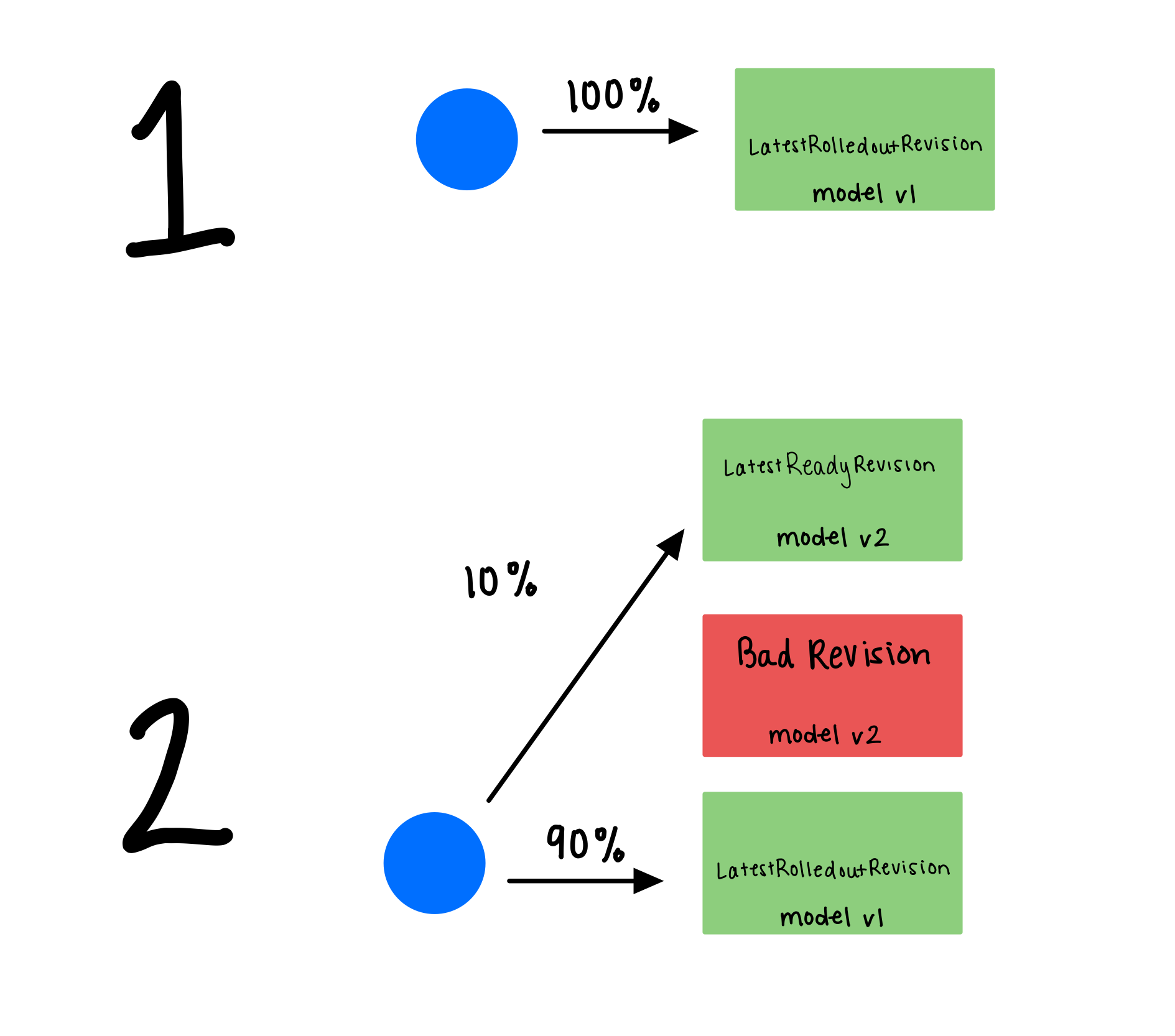
A canary deployment lets the candidate’s predictions affect a deliberately limited part of live traffic. The stable and candidate versions run concurrently; the release controller changes traffic allocation only after a defined observation period and a successful promotion gate.
AWS’s Machine Learning Lens offers a concise overview of when shadow, canary, and related strategies are appropriate.
MLREL04-BP02 Use an appropriate deployment and ...
Read this AWS Well-Architected Machine Learning Lens guidance for a compact comparison of release strategies and the operational ingredients of a controlled rollout.
In “Implementation guidance,” begin with the strategy-selection guidance. Relate the choice of shadow versus canary to the consequences of a wrong prediction. Then read steps 1 through 9 under “Implementation steps,” concentrating on versioning, traffic shifting, monitoring, and rollback. Treat the named cloud products as examples; the control design applies regardless of platform.
A typical canary policy could define stages such as a very small initial cohort, then progressively larger cohorts, followed by full traffic. The exact percentages are not universal. They depend on request volume, risk, how fast meaningful evidence accumulates, and how much user harm is acceptable.
At every stage, the release controller requires:
- A minimum sample size so that a handful of requests does not create false confidence.
- A minimum bake period covering normal traffic patterns, including peak periods if relevant.
- Explicit promotion criteria, rather than an operator’s impression of a dashboard.
- Explicit rollback criteria and a tested rollback action.
- A decision owner for ambiguous cases, especially when business outcomes are delayed.
Cohort design is part of the safety design
Random routing is often reasonable for stateless, high-volume use cases. However, user or entity stickiness is usually important: the same customer, merchant, account, or session should consistently receive one model version during the experiment. Otherwise, the models’ differing decisions can create an inconsistent experience and confound later analysis.
In some cases, routing by region, product surface, or a lower-risk customer segment is safer than random selection. That choice creates comparability risks: a new region may behave differently from the overall user population. The release plan should therefore document cohort selection and compare the canary with an appropriate baseline, not merely with an organization-wide average.
A canary is a safety rollout, not automatically an A/B experiment. An A/B test is designed to estimate the causal effect of alternatives on a product metric and needs an experimental design, statistical plan, and sufficient duration. A canary’s first job is to detect operational or safety regressions while limiting exposure. One rollout can serve both purposes only if it is designed to meet both standards.
Controlled promotion means a release policy makes the decision
The release controller should not promote simply because no alert fired. “No alert” may mean there was too little traffic, a dashboard was misconfigured, or important outcomes have not matured yet.
Instead, define the release policy before rollout. A useful policy has four kinds of criteria:
| Criterion | Example question | Typical action on failure |
|---|---|---|
| Service health | Did latency, errors, or availability breach the SLO? | Immediate automated rollback |
| Input and feature health | Are requests rejected, features missing, or unknown categories elevated? | Hold or rollback, then diagnose upstream contract changes |
| Prediction behavior | Did score distributions, decision rates, or abstentions move outside justified bounds? | Pause promotion; investigate candidate, data, or routing |
| Business and risk outcomes | Where outcomes are available, does the candidate meet the agreed business guardrails? | Promote only after sufficient evidence; otherwise retain incumbent |
A controlled promotion workflow has a small number of clear decisions:
- Deploy the approved candidate beside the incumbent after release qualification passes.
- Shadow it, when product risk or architectural novelty requires real-traffic evidence without user impact.
- Begin a canary only when the release owner accepts the exposure policy.
- Bake and evaluate the declared metrics against thresholds and the incumbent baseline.
- Promote, hold, or roll back based on recorded policy evidence.
- Mark the release outcome in the registry or release system, retaining dashboards, logs, and decision rationale.
A useful management rule is:
Automation should handle known, fast safety failures. Humans should decide cases where evidence is delayed, uncertain, or involves a material business trade-off.
For instance, a large increase in server errors should cause automatic rollback. A small apparent improvement in conversion with wide statistical uncertainty should place the rollout on hold for review or longer observation, not trigger automatic global promotion.
Rollback must be fast, specific, and operationally complete
A rollback policy defines more than “use the old model.” It answers four questions:
-
What triggers it?
Examples include a hard error-rate threshold, severe latency regression, incompatible input-schema failures, an unsafe decision-volume shift, or a security incident. -
Who or what executes it?
Fast technical guardrails should invoke automated routing rollback. A designated release owner should retain authority to trigger a manual rollback through a documented kill switch. -
Where does traffic go?
Back to the immutable incumbent model version and its compatible serving configuration, not a mutableproductionlabel whose meaning may have changed. -
What happens after rollback?
Stop further promotion, preserve evidence, notify the model and platform owners, and open an incident or investigation record. Do not silently delete the candidate or overwrite its release history.
There is an ML-specific limitation: rollback stops future candidate decisions, but it cannot undo decisions already made. A high-stakes system may also need a business remediation procedure, such as reviewing a bounded set of transactions, pausing automated actions, or routing cases to manual review. That remediation sits alongside the technical rollback plan.
Blue-green infrastructure can make rollback especially fast by keeping a full incumbent environment ready for traffic, at the cost of duplicate capacity. Canary rollout reduces the number of users exposed before failure is detected. A mature architecture may combine them: blue-green environments provide rapid routing reversal, while a canary policy controls how much traffic reaches the green environment.
How to present this in an interview
For a time-boxed ML system-design interview, describe the workflow in terms of controls and decisions:
“After a candidate passes offline evaluation and is registered with immutable lineage, the release pipeline runs serving qualification checks: artifact integrity, schema and API contract tests, dependency compatibility, load tests, and observability checks. It deploys the candidate beside the incumbent, retaining the incumbent as a tested rollback target.
“For high-risk or major changes, I first mirror production requests to a shadow deployment, where the candidate response is logged but never used for customer decisions. Once operational behavior is healthy, I run a canary with sticky, deliberately chosen cohorts and defined bake periods. The controller evaluates immediate service, data-quality, and model-output guardrails against explicit thresholds; delayed business outcomes govern later promotion decisions.
“Promotion happens only through a versioned release policy with minimum evidence requirements. Severe service or safety thresholds trigger automatic traffic rollback to the immutable incumbent. We preserve the release record and investigate root cause rather than treating rollback as a silent retry.”
That answer demonstrates an engineering-manager perspective: technical design, risk management, ownership, and evidence are connected.
Key takeaways
A safe ML release workflow:
- Keeps registration, deployment, and user-impacting release separate.
- Uses automated checks for both ML artifacts and the real serving path.
- Uses shadow deployment to observe candidate behavior on production traffic without affecting decisions.
- Uses canary deployment to limit live exposure while gathering controlled evidence.
- Defines promotion gates before the rollout, including sample requirements, bake periods, thresholds, and owners.
- Treats rollback as a tested routing capability to a specific, immutable incumbent version.
- Preserves release evidence and recognizes that technical rollback may need business remediation for decisions already made.
Next, you will define the service, data, and model monitoring signals that make these release gates and longer-term retraining decisions reliable.
Can't find a good explanation? Sign up and we'll make it for you
Sign up