
Hello. In the previous lesson, you practised supported weight shifts and defined success as controlled and recoverable: you could shift, pause, and return to centre without grabbing suddenly for support, moving a foot, twisting through the knee, or provoking pain or instability.
This lesson adds a simple training-design skill: adjusting balance practice without turning it into guesswork. You will learn to keep a reliable baseline, alter one approved variable at a time, and use what you observe to decide whether to stay at that level, progress slightly, or regress. This is particularly important during rehabilitation, when a task that is theoretically “good for balance” may not be appropriate in its usual form.
One task, one deliberate change
Balance tasks have many adjustable features. You can change foot placement, hand support, the range of a weight shift, how long you pause, the surface underfoot, visual input, head movement, speed, or the addition of a second task such as talking or carrying something.
The difficulty is that changing several features at once makes the result impossible to interpret. If you narrow your stance, use less hand support, and hold longer in the same practice session, then a wobble tells you very little. Was the stance too narrow? Was less support too much? Did fatigue build because the hold was longer?
Instead, use a small change-control process:
- Keep a known, safe version of the task.
- Choose one variable that is permitted by your physiotherapist.
- Make one modest change.
- Observe movement quality and symptoms.
- Keep, reverse, or postpone that change based on the evidence.
This is not being overly cautious or bureaucratic. It gives your nervous system a clear, repeatable problem to solve, while giving you clearer information about what your knee and balance system currently tolerate.
A progression makes the balance demand modestly greater while maintaining quality. A regression makes the task easier or safer when quality or symptoms indicate that the present version is too demanding. Neither is permanent: your appropriate level can vary from day to day with sleep, pain, rehabilitation load, confidence, or fatigue.
The variables you can adjust — and the ones to hold steady
The following image shows several common “knobs” used in vestibular and balance rehabilitation: stance, surface, visual input, whether the task is static or moving, head movement, cognitive load, and environment.

For your present situation, not all of those variables belong in your practice. Your restrictions are part of the task design, not obstacles to work around.
| Variable | Example of a modest change | Current approach |
|---|---|---|
| Stance width | Hip width to slightly narrower, with feet still parallel and a clear gap | May be appropriate if clinician-approved |
| Weight-shift range | A small shift to a slightly fuller but still controlled shift | May be appropriate if within your rehabilitation range |
| Hand support | Firm two-hand contact to lighter contact | Keep at your current approved level unless your physiotherapist has cleared a change |
| Pause time | A brief pause to a slightly longer pause | Can be adjusted cautiously, but keep it separate from other changes |
| Repetitions or rounds | One short round to a second short round | This changes training dose, so only increase if quality remains steady |
| Foot position front-to-back | Parallel stance to a gentle staggered stance | Only if explicitly approved; set the feet by stepping, never twisting into position |
| Surface, vision, head movement, speed, dual task | Foam, eyes closed, head turns, faster shifts, conversation | Hold steady for now unless specifically cleared |
Several commonly advertised balance progressions are not suitable defaults for you at this stage. In particular, do not add a soft or uneven surface, close your eyes, perform head turns, speed up, pivot, or combine balance with a distracting task merely because those options appear in a general balance programme.
Foot placement changes the base of support, which changes the geometry of the balance problem.
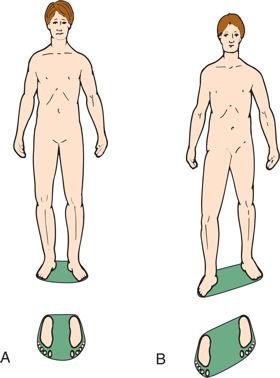
A slightly narrower parallel stance can be a useful, controlled adjustment. A full tandem stance is much more demanding and should not be treated as the inevitable “next level.”
A progression is earned through quality, not bravery
The OTAGO balance guidance describes a gradual reduction in hand support, beginning with releasing individual fingers only after a person has mastered the preceding level. That principle is useful: master the present version before changing it. However, its specific hand-release progression is not an instruction to reduce your support now. Your current two-hand counter support remains the default unless your physiotherapist has approved lighter contact.
[PDF] OTAGO Strength and Balance - Oxford University Hospitals
Read the short “Balance progression” guidance to see a clinical example of gradual, stepwise progression and the use of an exercise diary.
In the PDF, go to page 42 and find the paragraph headed “Balance progression.” Read the progression paragraph. Notice the sequence: establish confidence, make a small change, and master that level before changing again. For your own practice, apply that logic only to variables your physiotherapist has approved; do not assume that reduced hand support is currently appropriate.
A useful criterion for “mastery” is not perfection or zero sway. It is consistency. You are ready to consider one small change when, across more than one practice session:
- you can complete the current task with your agreed movement-quality criterion;
- you are not rushing, gripping harder, or repeatedly correcting with your feet;
- symptoms stay within the limits agreed in rehabilitation;
- you recover calmly at the end of each short set; and
- your knee does not show an unacceptable delayed response according to your physiotherapist’s guidance.
This makes progression different from a test. You are not trying to prove that you can survive a difficult version once. You are checking whether the current version has become a stable learning platform.
The following short video gives a useful overview of common ways people alter balance difficulty. Treat it as a menu of general ideas, not as a prescription: the presenter includes reducing countertop support and increasing speed, both of which should remain unchanged for you unless cleared.
UPDATED 7 Best Beginner Balance Exercises | Start Your Balance Program Today
Watch the closing progression overview from “UPDATED 7 Best Beginner Balance Exercises” by Movement & Function. It helps distinguish possible challenge variables from the principle of changing them gradually.
Watch the progression overview. Identify the three variables the presenter names: hand support, repetitions, and speed. Then apply this lesson’s rule: select only one approved variable for a given trial, rather than changing all three. For now, do not adopt the suggestions to reduce support or increase speed unless they are consistent with your physiotherapy plan.
Build a stable baseline before you alter anything
For the next few sessions, use the supported side-to-side weight shift from the previous lesson as your reference task. Keep the setup predictable:
- firm, level, clear floor;
- stable counter in front of you;
- both hands on the counter, unless your clinician has approved another arrangement;
- stable gaze on a point ahead;
- feet parallel at your usual comfortable width;
- slow, small-to-comfortable weight shifts;
- no pivoting, twisting through the knee, impact, or rushed movement.
Your reference task might be described in a note as:
“Facing kitchen counter; both hands supported; feet hip width and parallel; firm floor; small controlled side-to-side shifts with a brief pause; no symptoms beyond rehabilitation limits.”
That description matters more than exact repetition counts. It lets you reproduce the task next time.
Keep dose separate from difficulty
There is a small but important distinction:
- Difficulty is how demanding each repetition is. Narrowing stance width or increasing shift range can alter difficulty.
- Dose is how much you do. More repetitions, more rounds, or longer practice alters dose.
Dose can make an otherwise safe task become poor-quality through fatigue. Therefore, when you are testing a new stance width or shift range, keep the number of repetitions and pauses the same as in your reference task. Only adjust dose on a different day, after the task itself is stable.
A 10–15 minute one-variable practice protocol
Use this as a modular segment alongside your rehabilitation programme, not in addition to any limits your physiotherapist has set.
1. Check readiness
Before beginning, ask:
- Is my knee status consistent with what my rehabilitation plan permits today?
- Is the floor clear and dry?
- Do I have my usual approved footwear or other setup?
- Can I use the counter with both hands available?
- Am I alert enough to move slowly and pay attention?
If the answer to any safety question is no, use the easiest approved version or postpone the balance practice.
2. Rehearse the reference task
Complete one short, familiar set of supported weight shifts. Do not alter anything yet.
Use the established criterion:
Controlled and recoverable: I can shift, pause, and return to centre without a sudden grab for support, a foot adjustment, knee twist, or increased pain or instability.
If this reference version is not controlled today, that is your information. Do not progress. Regress if needed by making the shift smaller, using firmer hand contact, or taking a rest, provided these fit your rehabilitation plan.
3. Choose one approved variable
For this lesson, choose only one of these options if it has been approved:
- Stance width: move each foot a small amount closer to the midline while retaining a visible gap and parallel foot direction.
- Shift range: travel slightly further over each foot while keeping both feet planted and your knee aligned with the foot.
- Pause time: keep the same stance and shift range, but pause a little longer in the shifted position.
Do not combine options. For example, if you narrow your stance, do not also lengthen the pause or lighten your hand contact.
4. Test the changed version briefly
Perform the same short amount of practice as your reference task. Move slowly enough to pause at any point. After each side, notice:
- Did my feet stay planted?
- Did the knee remain aligned, without rotation?
- Could I return to centre smoothly?
- Did my hand support remain calm rather than becoming a sudden rescue?
- Did symptoms stay within my agreed limits?
If the changed version is controlled and recoverable, return to the reference stance and rest. One short, high-quality exposure is sufficient for a first trial. The objective is to gather useful information, not to exhaust yourself.
5. End on a familiar version
Finish with one or two calm repetitions in your ordinary stance. This gives you a predictable end point and helps reinforce the feeling of centred, supported control.
How to decide: stay, progress, regress, or stop
Use the following decision rules during and after practice.
Stay at the current level
Stay when the task is controlled but still requires clear concentration. This is often the most productive place to practise. There is no need to add difficulty merely because you completed it.
Progress one small step next time
Consider a further small change only when the present variation is consistently controlled over separate sessions and has no concerning symptom response. Keep all other task features the same.
For instance, if a slightly narrower parallel stance becomes reliable with both hands on the counter, you might later make the stance slightly narrower again. You would not at the same time reduce hand support or add a longer hold.
Regress immediately
Return to the previous version when you notice loss of control: repeated foot adjustments, sudden gripping, rushing, twisting, pain increase, or a sense that the knee may give way. A regression might mean widening the stance, reducing the shift range, returning to the centred position, or resting.
The correct interpretation is: the task setting was too demanding for useful practice today. It is not a verdict on your capacity to learn.
Stop for the day and follow your rehabilitation plan
Stop if you experience sharp or increasing pain, giving way, locking or catching, marked swelling, dizziness, visual disturbance, or any warning signal your physiotherapist has identified. Do not try to “train through” warning signs in order to make a balance exercise work.
Keep a compact change log
A brief note turns practice into evidence you can use. It need not be detailed.
| Date and status | Reference task | One variable changed | Result | Decision |
|---|---|---|---|---|
| Tuesday; knee comfortable | Both hands, hip-width stance, small shifts | Stance narrowed slightly | Controlled right and left; no symptom change | Repeat next session |
| Friday; tired after rehab | Same reference task | None | Reference task felt less steady | Stay at baseline; shorter session |
| Monday; mild stiffness | Same reference task | Shift range slightly smaller | Smooth and comfortable | Use this regression today |
The log helps you distinguish a genuine pattern from the inevitable variation of rehabilitation. It also gives your physiotherapist concrete information: what setup you used, what changed, and what happened.
Key takeaways
A balance progression is not simply “making it harder.” It is a controlled experiment: keep a safe baseline, change one clinician-approved variable, observe movement quality and symptoms, and make the next decision from that evidence.
For now, the most relevant variables are likely stance width, weight-shift range, and perhaps pause time. Keep the environment firm and predictable, retain your approved hand support, move slowly, and avoid pivots, impact, knee twisting, soft surfaces, closed eyes, head movements, speed work, and dual tasks unless your clinician clears them.
Next, the course shifts from external balance conditions to internal regulation: you will use a brief body scan to identify and label sensations before, during, and after movement practice.
Can't find a good explanation? Sign up and we'll make it for you
Sign up