
Hello! In our last lesson, we explored how to validate or refute a greedy strategy using counterexamples and exchange arguments. We saw that for the Fractional Knapsack problem, the greedy choice of taking the item with the highest value density first is optimal, largely because sorting by that metric creates a sequence of safe, locally-optimal decisions.
Today, we'll apply this powerful combination of sorting and greedy thinking to a new category of problems: those involving intervals. We'll tackle the "Merge Intervals" problem, a common interview question that serves as a foundation for many others. You'll see how arranging the input in a specific order transforms a complex problem into a straightforward linear scan, reinforcing the patterns we've begun to build.
By the end of this lesson, you will be able to devise and implement an efficient algorithm to merge a collection of overlapping intervals by first sorting them by their start times.
The "Merge Intervals" Problem
Imagine you have a list of time slots for meetings, represented as pairs of start and end times. Some of these meetings might overlap. Your task is to condense this list into the minimum number of non-overlapping intervals that cover all the original time slots.
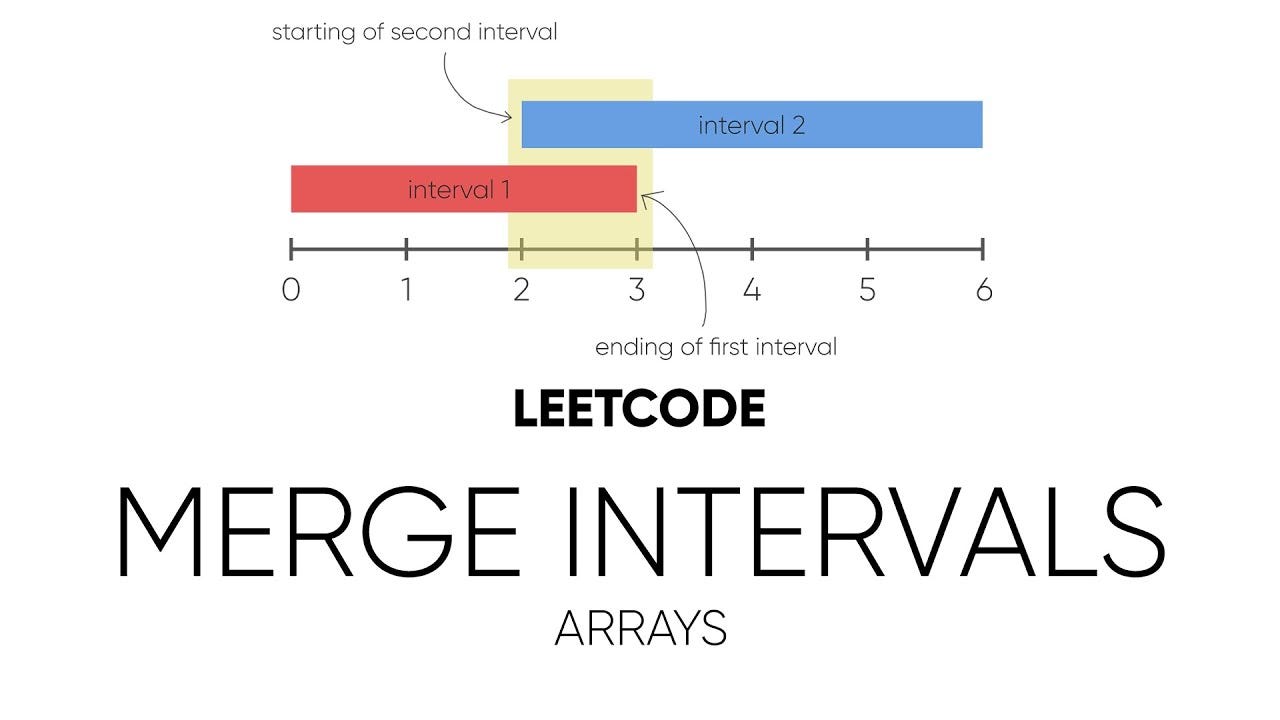
For example, given the intervals [[1, 3], [2, 6], [8, 10], [15, 18]], the intervals [1, 3] and [2, 6] overlap. They can be merged to form a single interval, [1, 6]. The other intervals, [8, 10] and [15, 18], do not overlap with any others, so they remain as they are. The final merged list would be [[1, 6], [8, 10], [15, 18]].
An important detail is that intervals that "touch" at their endpoints are considered overlapping. For instance, [1, 4] and [4, 5] would merge into [1, 5].
The Greedy Strategy: Sort and Scan
If the intervals are in a random order, figuring out all the overlaps seems complicated. You might have to compare every interval with every other interval, which would be inefficient, likely taking time. As you know from your development experience, nested loops over the same large collection are often a performance red flag.
This is where a greedy approach, enabled by sorting, comes in. What if we first sort the intervals based on their start times?
Once sorted, a crucial property emerges: if two intervals are going to overlap, they will be adjacent in the sorted list. This insight simplifies the problem dramatically. We no longer need to look at all possible pairs. We can simply iterate through the sorted intervals and make a local decision at each step: does the current interval overlap with the previous one?
This is a "greedy" approach because at each step, we greedily extend our current merged interval as far as possible. This choice is "safe" because, thanks to sorting, once we encounter an interval that doesn't overlap with our current merged block, no subsequent interval can either (since all subsequent intervals will start even later).
The following resource provides an excellent explanation of this core idea.
56. Merge Intervals - In-Depth Explanation
This article from Algo.monster clearly explains the intuition behind the sort-and-scan strategy.
Please read the section titled "Intuition". Focus on this paragraph, which explains why sorting by the start point allows us to simplify the problem from a global comparison to a local one.
The videos below offer great visual walkthroughs of this concept, plotting the intervals on a number line to make the effect of sorting intuitive.
Merge Intervals - Sorting - Leetcode 56
The NeetCode channel provides a concise visualization of why sorting works.
Watch from this segment, where the presenter draws the unsorted and then sorted intervals on a number line, demonstrating how sorting brings potential merges together.
Merge Intervals (LeetCode 56) | Full Solution with diagrams and visuals | Interview Essential
This video from Nikhil Lohia also gives a fantastic visual breakdown.
Focus on the part from this section. It shows how plotting intervals on a number line naturally leads to the idea of sorting them by their start points to group potential overlaps.
The Algorithm Step-by-Step
With the core idea in place, let's define the algorithm. The process is a single pass through the sorted intervals while maintaining the "current" merged interval.
- Sort: Sort the array of intervals in ascending order based on their start times.
- Initialize: Create a result list for the merged intervals. Take the first sorted interval and consider it the
current_merge. - Iterate and Merge: Loop through the remaining sorted intervals, one by one. For each
next_interval:- Check for Overlap: Compare the start of
next_intervalwith the end ofcurrent_merge. An overlap exists ifnext_interval.start <= current_merge.end. - If Overlap: Greedily extend the
current_mergeby updating its end point:current_merge.end = max(current_merge.end, next_interval.end). We usemaxto handle cases where one interval is completely contained within another (e.g., merging[1, 10]and[2, 5]should result in[1, 10]). - If No Overlap: The
current_mergeis complete. Add it to the result list. Then, thenext_intervalbecomes the newcurrent_merge.
- Check for Overlap: Compare the start of
- Finalize: After the loop finishes, the last
current_mergehas not yet been added to the result list. Make sure to add it.
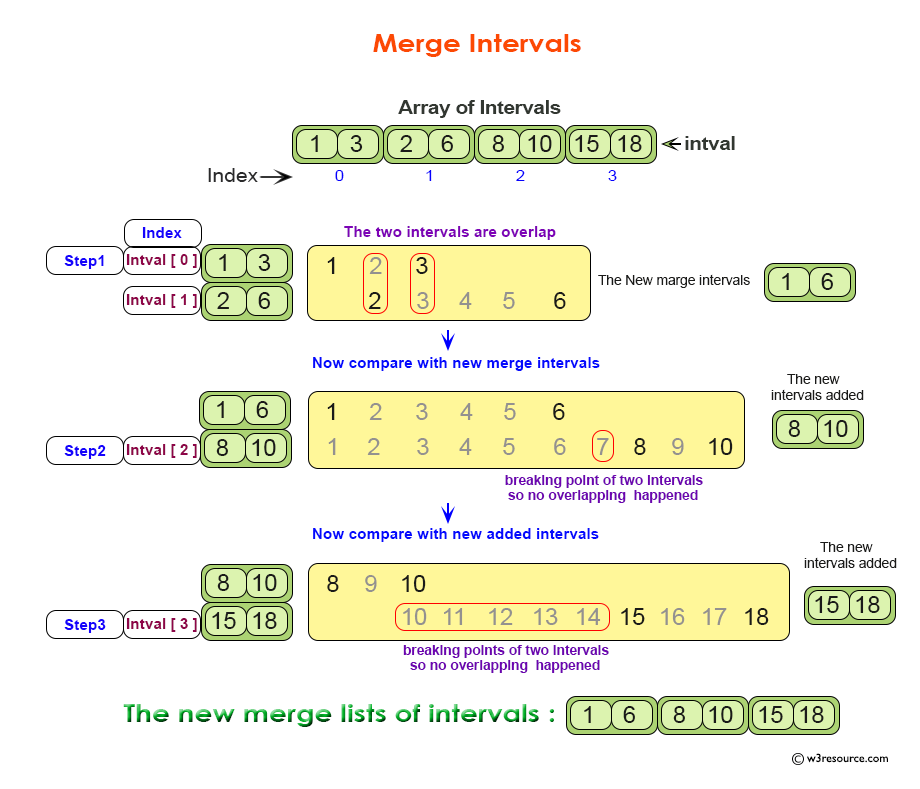
Let's trace this with an example: [[1,3], [2,6], [8,10], [15,18]]. The input is already sorted.
- Step 1: Initialize
merged_intervals = [].current_mergestarts as[1, 3]. - Step 2: Look at the next interval,
[2, 6].- Does it overlap with
[1, 3]? Yes, because2 <= 3. - Merge them: The new
current_mergebecomes[1, max(3, 6)], which is[1, 6].
- Does it overlap with
- Step 3: Look at the next interval,
[8, 10].- Does it overlap with
[1, 6]? No, because8 > 6. - The
[1, 6]merge is complete. Add[1, 6]tomerged_intervals. [8, 10]becomes the newcurrent_merge.
- Does it overlap with
- Step 4: Look at the next interval,
[15, 18].- Does it overlap with
[8, 10]? No, because15 > 10. - The
[8, 10]merge is complete. Add[8, 10]tomerged_intervals. [15, 18]becomes the newcurrent_merge.
- Does it overlap with
- Step 5: The loop is done. Add the last
current_merge,[15, 18], tomerged_intervals.
Final Result: [[1, 6], [8, 10], [15, 18]].
The following resource provides a detailed text walkthrough of this algorithm.
56. Merge Intervals - In-Depth Explanation
This guide will solidify your understanding of the implementation details.
Read the "Solution Approach" section, which outlines the four main steps. Then, carefully follow the "Example Walkthrough" which traces the algorithm with the same input we just used. Pay attention to the logic for handling both overlapping and non-overlapping cases.
Implementation in TypeScript
Now, let's translate this logic into code. Given your background in front-end development, the syntax should feel familiar. The key parts are the custom sort comparator and the loop that performs the merge.
function merge(intervals: number[][]): number[][] {
    // Handle edge case of empty or single interval
    if (intervals.length <= 1) {
        return intervals;
    }

    // 1. Sort intervals by their start time
    intervals.sort((a, b) => a[0] - b[0]);

    const mergedIntervals: number[][] = [];
    let currentStart = intervals[0][0];
    let currentEnd = intervals[0][1];

    // 2. Iterate through the rest of the intervals
    for (let i = 1; i < intervals.length; i++) {
        const intervalStart = intervals[i][0];
        const intervalEnd = intervals[i][1];

        // 3. Check for overlap
        if (intervalStart <= currentEnd) {
            // Overlap exists, extend the current merge
            currentEnd = Math.max(currentEnd, intervalEnd);
        } else {
            // No overlap, push the completed interval and start a new one
            mergedIntervals.push([currentStart, currentEnd]);
            currentStart = intervalStart;
            currentEnd = intervalEnd;
        }
    }

    // 4. Add the last merged interval
    mergedIntervals.push([currentStart, currentEnd]);

    return mergedIntervals;
}
Complexity Analysis
- Time Complexity: . The
intervals.sort()operation dominates the runtime. The single loop for merging takes time, which is overshadowed by the sort. - Space Complexity: This can be described in two ways. The auxiliary space required by the algorithm (e.g., for sorting) is typically or depending on the sort implementation. In JavaScript,
Array.prototype.sort()can use up to space. However, we also need space for the output array, which can be up to in the worst case (if no intervals merge). In an interview, it's good practice to state both: for the output and note the additional space for sorting.
For a final review of the implementation and common errors, the following resources are very helpful.
56. Merge Intervals - In-Depth Explanation
This reading contains the full TypeScript implementation and a list of common mistakes to avoid.
Review the TypeScript code provided. Then, read the "Common Pitfalls" section. Pay close attention to pitfalls #2 ("Incorrect overlap condition") and #5 ("Forgetting to add the last interval"), as these are frequent sources of bugs.
Conclusion
In this lesson, we dissected the "Merge Intervals" problem and saw how a greedy strategy, unlocked by sorting, provides an elegant and efficient solution. This pattern of sort -> iterate -> decide is a fundamental tool in your algorithmic toolbox, especially for problems involving intervals or ordered data.
Here are the key takeaways:
- Problem Transformation: Sorting by start time simplifies the problem from comparing all pairs to making a simple local check between adjacent intervals.
- Greedy Choice: The safe, greedy choice at each step is to extend the current merged interval if an overlap exists. If not, we finalize the current merge and start a new one.
- Implementation Details: Key implementation points include handling the sort, the overlap condition (
<=), updating the end boundary usingmax(), and remembering to add the final interval after the loop.
In our next lesson, we'll continue with interval problems by looking at how to select the maximum number of non-overlapping activities from a set. This will introduce a variation on today's theme, where we'll find that sorting by the end time is the key to another correct greedy strategy.
Can't find a good explanation? Sign up and we'll make it for you
Sign up