Introduction
Welcome to our next lesson. In our previous session, we explored Alexis de Tocqueville's analysis of how voluntary associations in democratic America formed a crucial "buffer" between the individual and the state. He saw these associations as a modern, man-made substitute for the "intermediate powers"—the nobility, the church, the independent towns—that had naturally constrained monarchs in the aristocratic age. Tocqueville's argument was, in essence, that the pre-modern world possessed a kind of built-in institutional pluralism that was swept away by the leveling tide of equality.
Today, we will travel back in time to examine that very system whose disappearance so concerned Tocqueville. This brings us to our learning outcome: to analyze medieval constitutionalism and the pluralism of competing jurisdictions (e.g., church, crown, guilds) as a historical model for liberty.
Our goal is not to romanticize the Middle Ages, which was in many ways a harsh and hierarchical period. Instead, we will analyze its political structure as an abstract model. We will dissect how a society with multiple, overlapping, and competing sources of authority—a concept starkly different from our modern idea of a single, sovereign state—unintentionally created conditions for liberty.
1. Medieval Constitutionalism as Polycentric Sovereignty
When we speak of "medieval constitutionalism," we are not referring to a single, written document like the U.S. Constitution. Rather, it was an un-codified system of governance defined by a web of overlapping authorities, legal systems, and customary rights that collectively limited the power of any single ruler.
Modern political theory has a term for this historical reality: polycentric sovereignty. "Polycentric" means having many centers. In contrast to the modern ideal of a single, indivisible sovereign (the state) holding a monopoly on law and legitimate force within its territory, medieval political life was a dynamic struggle between multiple, quasi-sovereign entities.
The Medieval Constitution of Liberty: Political Foundations of a Free and Prosperous Europe
To frame our discussion, let's start with the introduction to a book titled The Medieval Constitution of Liberty. The authors, Alexander Salter and Andrew Young, are economists who analyze this historical period through the lens of political economy. Their thesis is that the unique 'polycentric' order of the Middle Ages was a crucial precondition for the emergence of liberty in the West.
Please read the introduction to the book, which is the first few paragraphs on the linked page before the table of contents. Focus on the central question the authors pose and their core argument about 'polycentric sovereignty' as the key to understanding the origins of Western liberty.
As the authors argue, the liberty we associate with the modern West did not spring fully formed from the Enlightenment. Its roots lie in this medieval arrangement where power was fragmented and contested. Let's now examine the key players in this polycentric order.
2. The Competing Jurisdictions
At least three major types of institutions wielded significant, often overlapping, authority: the Crown, the Church, and the self-governing towns and guilds.
A. The Church: A Transnational Spiritual and Legal Power
The Catholic Church was arguably the most powerful and coherent institution in medieval Europe. It was a transnational entity with its own head (the Pope), its own administrative structure, its own sources of revenue (tithes and vast landholdings), and, most importantly, its own comprehensive legal system—canon law.
The Church claimed jurisdiction not just over the clergy but over all Christians in matters of faith and morals. This authority extended to crucial areas of civil life, including marriage, family, oaths, and wills. This created a parallel legal universe that operated alongside, and often in direct competition with, the secular law of kings and nobles.
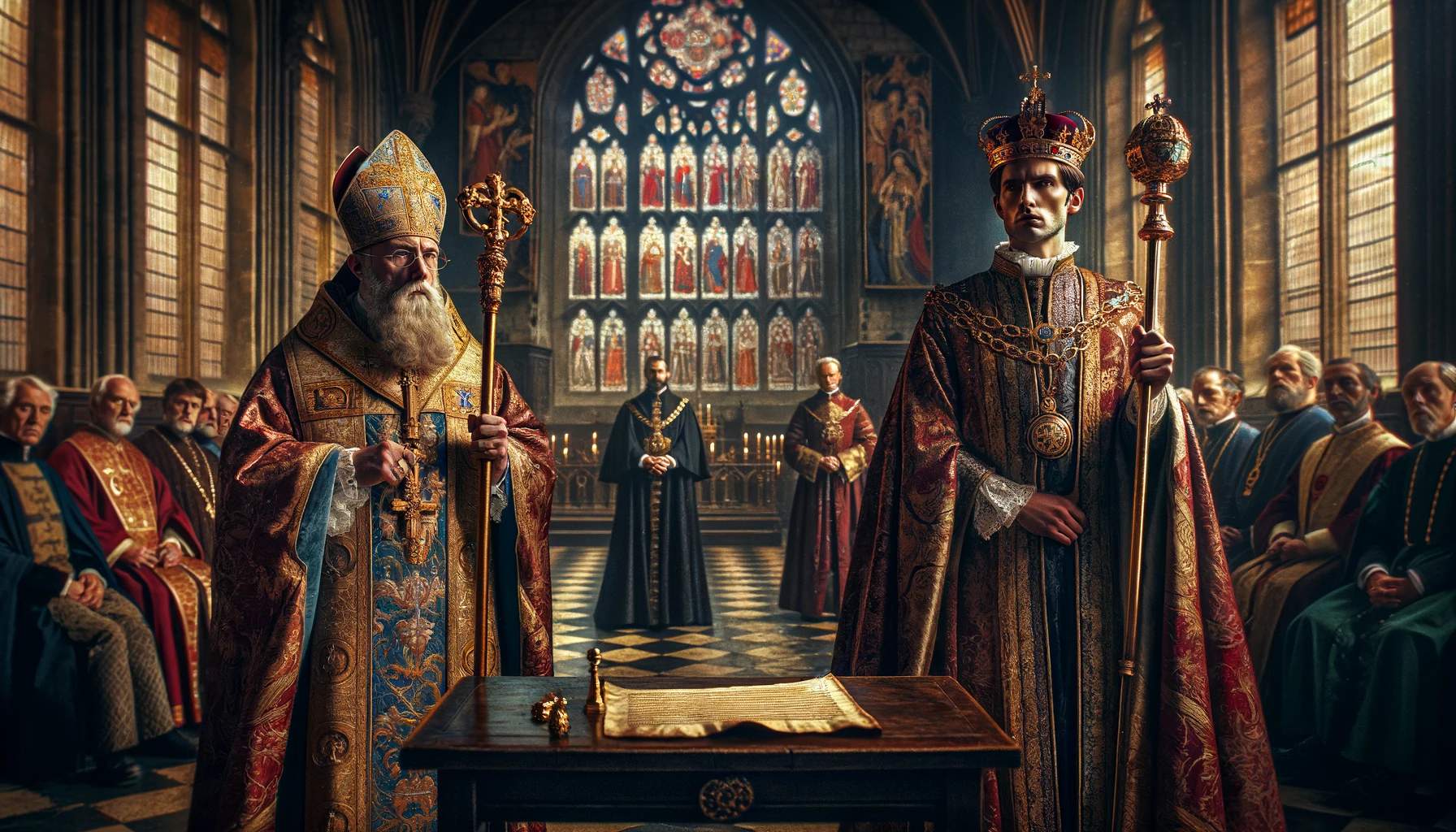
A key manifestation of this separate jurisdiction was the existence of clerical courts.
How Much Power Did the Catholic Church Have in the Middle Ages?
This video, 'How Much Power Did the Catholic Church Have in the Middle Ages?', provides excellent context. We'll watch a short segment explaining how clergy and even university students were subject to the Church's legal system, not the king's.
Please watch the segment from 15:52 to 17:18. Pay attention to the concept of 'Town Gown relations' and the very practical advantage for a student of being tried in a clerical court versus a secular one. This is a concrete example of competing jurisdictions in action.
This "benefit of clergy" illustrates the reality of legal pluralism. The same person, in the same physical location, could be subject to two different legal systems, with the "correct" one being a matter of status and contention. The Church's power was not just theoretical; it was institutionalized in a separate and often more lenient legal track.
B. Guilds and Cities: Self-Governing Economic Powerhouses
Alongside the universal Church and the kingdoms of secular rulers, a third source of power emerged in the growing towns and cities. Merchants and artisans organized themselves into guilds, which were part trade union, part cartel, and part self-governing body.
Powerful guilds and the cities they dominated often obtained charters of liberty from kings or local lords, granting them a high degree of autonomy. They could elect their own officials, create their own laws and courts, and levy their own taxes. They were, in effect, small, self-governing republics embedded within the larger kingdom.
Eleanor Janega Explains How Secret Guilds Controlled Medieval London
To understand the power wielded by these urban communes, let's watch some clips from 'How Secret Guilds Controlled Medieval London'. This video details the economic, political, and legal power of these associations.
Please watch the following three segments: Economic and Political Power (1:56 - 4:00): Focus on how guild membership translated directly into political power, including electing the city's mayor who could speak to the king on par with the nobility. 'Freeman' Status (5:19 - 6:41): Note the specific legal and economic advantages that came with being a 'freeman of the city', a status tied to guild membership. This was a distinct legal identity. Guilds as Law Enforcers (16:32 - 18:03): This segment discusses how guild members acted as sheriffs and, more strikingly, how their wealth and connections could place them above the normal consequences of the law. These clips collectively demonstrate that guilds were not mere economic clubs, but constituted a distinct jurisdiction with its own legal privileges and political authority.
The guilds and free cities formed another layer of jurisdiction. A London fishmonger was subject to the rules of his guild, the laws of the City of London, the law of the English Crown, and the canon law of the Church. His loyalties were divided, and the authority over him was fragmented.
3. Jurisdiction as a Contested and Creative Act
Our modern minds tend to think of jurisdiction in clear, territorial terms—the law is what the state says it is within these borders. The medieval picture was far more complex and fluid. Jurisdiction was not a pre-defined map of boundaries; it was a performance, an ongoing "assertion of the right to declare what is law."
This created a dynamic legal environment where norms from different sources—Roman law, customary law, canon law, royal decrees—were "entangled." Understanding this fluidity is key to seeing beyond the anachronistic model of the modern nation-state.
Law beyond the legal renaissance: rethinking jurisdiction ...
The following academic paper, 'Law beyond the legal renaissance', offers a sophisticated analysis of this very point. It argues against state-centric legal history and proposes we view jurisdiction as an 'interpretive, even imaginative act' performed by various actors.
This is a challenging text, so let's focus on the core conceptual arguments in three key sections. Read the Introduction (the first three paragraphs). Focus on the core argument that 'sharper jurisdictional divides emerged' and the goal to understand jurisdiction as the 'assertion of the right to declare what is law'. Next, read the section titled 'III. Plurality without a history'. This section explains why modern, state-centric thinking makes it difficult to grasp the medieval reality. Pay attention to the critique of applying modern ideas of territorial jurisdiction anachronistically. Finally, read the section 'V. A new approach to jurisdiction?'. This outlines the paper's 'actor-centric' perspective, where jurisdiction is 'repeatedly created, claimed, asserted and supported through people, networks and institutions'. Your background in statistics and modeling might find the critique of historical-legal 'models' here particularly interesting. The authors are essentially arguing for a different, more dynamic model of legal evolution.
As the paper argues, legal authority was not a static fact but a claim to be made and defended. The result was a constant, low-level conflict and negotiation between different legal actors, all seeking to assert their "right to declare what is law." It is within this contested space that a unique form of liberty could grow.
4. How Institutional Pluralism Fostered Liberty
How did this messy, overlapping, and conflict-ridden system provide a foundation for liberty? The answer is that freedom was largely an unintended byproduct of the balance of power.
- Constraint through Competition: No single institution could achieve absolute power. A king who overstepped his authority would face resistance not just from his subjects, but from an organized, wealthy, and transnational Church that could challenge his legitimacy. Likewise, the Church's power was checked by secular rulers, and both were checked by the concentrated economic and military power of free cities. This rivalry created a system of mutual constraint. The signing of Magna Carta, where rebellious barons (supported by the Church) forced King John to acknowledge that he was subject to the law, is the archetypal example of this dynamic.

-
Liberty in the Gaps: Freedom found room to grow in the "interstices" between these large, competing powers. Individuals, and more often groups like guilds, monasteries, or universities, could carve out zones of autonomy by playing one jurisdiction against another. This is a classic balance-of-power dynamic: your enemy's enemy is your potential ally or protector.
-
The "Exit Option": The existence of multiple legal systems created, in a limited sense, an "exit option." A merchant unhappy with a lord's taxes might relocate to a chartered free city with more favorable laws. A scholar in a dispute could appeal to a university or clerical court. This competition between jurisdictions, while not a free market, incentivized legal authorities to offer relatively predictable and just governance to attract and retain productive subjects.
This medieval model was not a deliberate design for liberty. It was a chaotic equilibrium born from rivalry. Yet, it established the crucial precedent that power could be limited, that rulers were subject to law, and that different spheres of life could be governed by different authorities. This fragmentation of power, this polycentric sovereignty, is the deep historical root of Western constitutional liberty.
Test your understanding!
A core feature of the modern state is its claim to a monopoly on legislation for a given territory. Contrast this with the medieval model we've discussed. If a modern centralized state decided to "revive" medieval-style guilds by granting them official charters and regulatory power over their industries, would this successfully recreate the medieval model of liberty? Why or why not, using the concepts of polycentric sovereignty and contested jurisdiction?
Show answer
No, this would not recreate the medieval model of liberty. It would be a superficial imitation because it misses the fundamental principle of polycentric sovereignty.
In the medieval model, the guilds (and the Church) were quasi-sovereign entities whose authority arose independently and often stood in competition with the crown. Their jurisdiction was not a gift from a supreme state but a power they carved out and defended. The "right to declare what is law" was genuinely contested.
In the modern scenario, the state would be delegating power, not acknowledging a co-equal. The guilds' authority would derive entirely from the state and could be revoked by the state. They would be arms of the central administration, not true competitors to it. This is a model of decentralized administration within a monocentric sovereign state, not polycentric sovereignty. Liberty in the medieval model arose from the fact that no single entity had the ultimate authority to grant and revoke all other powers.
Conclusion
Today we have examined the structural architecture of medieval society, not as a historical narrative, but as a model of governance. We have seen how the fragmentation of power among competing institutions—the Crown, the Church, and the guilds—created a system of "polycentric sovereignty."
Key Takeaways:
- Medieval constitutionalism was not a written constitution but a system of fragmented power and overlapping jurisdictions that constrained rulers.
- Power was polycentric, with the Crown, the transnational Church, and autonomous cities/guilds all acting as competing centers of authority and law.
- Jurisdiction was not neatly territorial but fluid, entangled, and contested—a "right to declare what is law" that had to be actively asserted and defended.
- This institutional pluralism fostered a form of liberty, not by design, but as a byproduct of the constant competition and balance of power, which prevented any single entity from achieving absolutism.
Preview of the next lesson:
The medieval model of fragmented authority may seem like a distant historical curiosity. However, the core ideas have modern echoes. In our next lesson, we will explore two related concepts that are very much alive in contemporary political theory and practice. First, we will examine the principle of subsidiarity, which argues that matters ought to be handled by the smallest, lowest, or least centralized competent authority. Then, we will look at polycentric governance, the modern theoretical framework that studies the benefits of overlapping, competing systems of authority—a direct intellectual descendant of the medieval reality we analyzed today.