Introduction
Welcome. In our last lesson, we explored medieval constitutionalism as a historical example of "polycentric sovereignty," where the constant competition between the Crown, the Church, and guilds inadvertently constrained power and created space for liberty. This system was not designed with a coherent principle in mind, but emerged from a dynamic balance of power.
Today, we delve into a modern principle that seeks to formalize one of the key intuitions from that period. This brings us to our learning outcome: to explain the principle of subsidiarity and its allocation of authority to the most local competent level.
We will unpack this principle by examining its philosophical origins, its dual nature, and its practical application. Critically, we will also frame subsidiarity through an economic lens, analyzing it as a principle of efficiency for organizing a multi-level governance structure. This will connect the concept directly to your background in economics and systems analysis, revealing it to be less a vague preference for the local and more a rigorous framework for institutional design.
1. Defining Subsidiarity: Beyond Simple Devolution
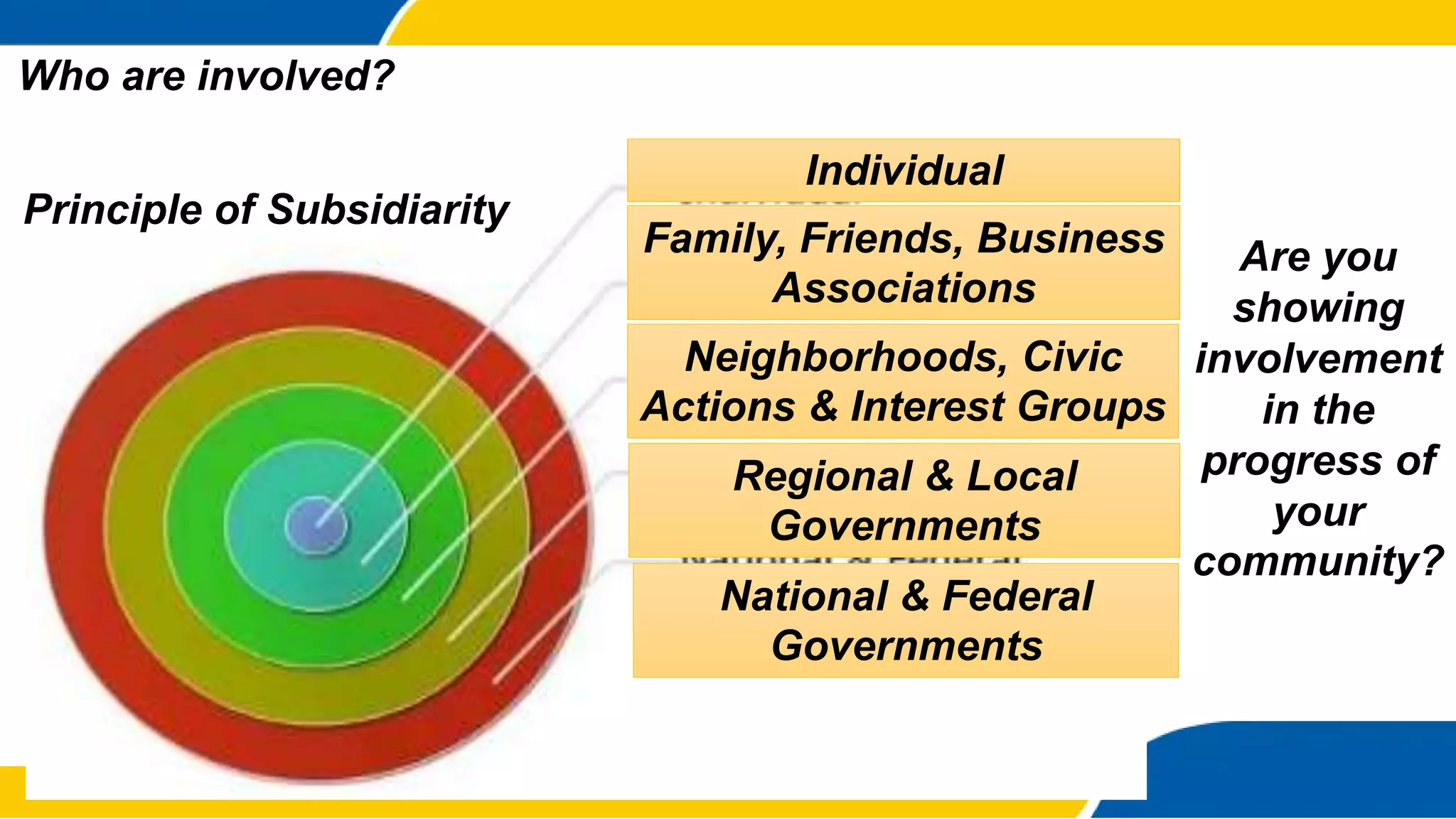
At its core, the principle of subsidiarity proposes a default rule for the allocation of authority in a society with multiple levels of organization (e.g., individual, family, local community, regional government, national government).
The principle states that social and political issues should be dealt with at the most immediate or local level that is capable of resolving them. A higher, more centralized authority should only intervene when a lower-level body is unable to address the issue effectively.
The following diagram provides a simple visual model of this "bottom-up" approach:
In contemporary political discourse, subsidiarity is often conflated with devolution—the simple transfer of power from a central government to regional or local ones. However, this is an incomplete and often misleading interpretation. To grasp the full meaning of subsidiarity, we need to look at its origins and its dual functions.
2. The Philosophical Core: Mediating Structures and Dual Obligations
The principle of subsidiarity was first formally articulated in Catholic social theory, most notably in Pope Pius XI's 1931 encyclical Quadragesimo anno. This context is crucial because it reveals a more complex logic than mere anti-centralism.
SUBSIDIARITY AS A PRINCIPLE OF GOVERNANCE
To understand the foundational definition of subsidiarity, let's turn to the law review article 'SUBSIDIARITY AS A PRINCIPLE OF GOVERNANCE' by Robert K. Vischer. This reading will introduce the original formulation and its underlying purpose.
Please read the following three parts of the article: Introduction: Read the first paragraph to get the literal definition and the initial framing of the concept. Part II, Section A ('The Catholic Roots of Subsidiarity'): Focus on the passage quoting Pius XI's Quadragesimo anno. This is the classic definition of the principle. Part II, Section D ('Subsidiarity and Mediating Structures'): This is the most important section. Focus on the explanation of subsidiarity's 'dual negative/positive meaning' and how it relates to 'mediating structures.' Pay close attention to how the principle aims to foster the health of 'mediating structures'—the institutions like families, neighborhoods, and voluntary associations that stand between the individual and large 'megastructures' like the state.
As the reading highlights, subsidiarity is not just about limiting the state. It has two distinct components, creating a set of dual obligations for higher levels of authority:
-
A Negative Obligation (Non-Interference): A higher-level community should not take over functions that can be effectively performed by a lower-level one. This is the "hands-off" aspect that is most commonly understood. It protects the autonomy and initiative of individuals and smaller social units.
-
A Positive Obligation (Enablement): A higher-level community has an affirmative duty to help lower-level communities develop the capacity to manage their own affairs. This is the often-overlooked "helping hand" aspect. The goal isn't for the central power to abandon lower levels, but to provide them with the resources, legal frameworks, and support they need to become competent and self-sufficient.
This dual structure means that true subsidiarity is about empowerment, not just decentralization. It aims to foster the vitality of what Tocqueville might have called "intermediate associations," or what modern theorists call mediating structures. The ultimate goal is a society where problems are solved by those closest to them, not because the central state has withered away, but because it has actively cultivated the competence of its constituent parts.
3. An Economic Interpretation: Subsidiarity as an Efficiency Principle
While its origins are philosophical, the logic of subsidiarity has a powerful analogue in economics, particularly in the fields of fiscal federalism and institutional analysis. From this perspective, "the most local competent level" is not a moral judgment but an answer to an efficiency problem: which level of governance can provide a given service or regulation at the lowest social cost?
Answering this question involves weighing the economic arguments for decentralization against those for centralization.
THE PRINCIPLE OF SUBSIDIARITY AS A ...
The paper 'THE PRINCIPLE OF SUBSIDIARITY AS A PRINCIPLE OF ECONOMIC EFFICIENCY' by Anthony B. Marciano provides a clear framework for this analysis. It recasts subsidiarity as a rule for optimizing a multi-level governance system, which should resonate with your background in economics and optimization.
Please read the following sections: Part I ('THE PRINCIPLE OF SUBSIDIARITY AS A PRINCIPLE OF ECONOMIC EFFICIENCY'): This section introduces the core thesis. Part I.A.1 ('Economics of Subsidiarity'): Focus on the efficiency gains from decentralization. Note the references to Tiebout models (competition between jurisdictions) and Hayek's knowledge problem. Part I.A.2 ('Economics of Centralization'): Focus on the countervailing arguments: economies of scale, mitigating negative externalities (like a 'race to the bottom'), and the benefits of harmonization. As you read, think of the problem as an optimization exercise: you want to assign a task to the level of government that maximizes the net benefits from these competing effects.
This economic lens allows us to translate the abstract principle into a concrete analytical framework:
-
Arguments for Decentralization (Local is Better When...):
- Heterogeneous Preferences: Local communities know their own needs and preferences best. A uniform national rule is inefficient if different regions require different solutions (e.g., local zoning laws vs. a national building code). This improves allocative efficiency.
- Information Costs: Local actors possess local knowledge that is costly or impossible for a central authority to acquire (Hayek's "knowledge problem").
- Innovation and Competition: Decentralization allows for policy experimentation. Different jurisdictions can act as "laboratories," and successful innovations can be copied. This is the essence of the Tiebout model, where jurisdictions compete to offer the best mix of public goods and taxes.
-
Arguments for Centralization (National is Better When...):
- Economies of Scale: Some goods are cheaper to provide at a large scale (e.g., national defense, major infrastructure projects).
- Inter-jurisdictional Externalities: When the actions of one jurisdiction "spill over" and affect others (e.g., a state polluting a river that flows into another state). A central authority is needed to internalize these externalities.
- Preventing a "Race to the Bottom": To prevent jurisdictions from competing by lowering standards in areas like environmental protection or worker safety, a central authority can set a minimum standard.
- Harmonization: A single set of rules can reduce transaction costs for commerce that crosses jurisdictional lines.
Subsidiarity, viewed through this lens, is the principle that decision-making should be decentralized unless there is a compelling efficiency-based reason—such as economies of scale or significant externalities—to move it to a higher level.
4. Application: The European Union's Two-Part Test
This principle is not merely theoretical. It is a cornerstone of the constitutional architecture of the European Union, a complex, multi-level system of governance. The EU treaties formalize the principle of subsidiarity into a specific legal test to determine whether the EU (the higher authority) can legislate in areas where it shares competence with member states (the lower authorities).
THE PRINCIPLE OF SUBSIDIARITY AS A ...
Let's return to the Marciano paper to see how the EU operationalizes this principle.
Please read section Part I.B ('Efficiency of the Subsidiarity Principle in E.U. Primary Law'). This section explains the EU's 'double test' for applying subsidiarity, as derived from its treaties.
As the reading explains, for the EU to act, it must satisfy two cumulative conditions:
-
The Necessity Test: The objectives of the proposed action "cannot be sufficiently achieved by the Member States." This establishes a presumption in favor of member state action and places the burden of proof on the central authority to demonstrate the inadequacy of local solutions.
-
The Comparative Efficiency (or "Value-Added") Test: The objectives can, "by reason of the scale or effects of the proposed action, be better achieved at the Union level." This forces a comparison: even if local action is insufficient, the central action must be demonstrably superior.
This two-part test is a practical, institutionalized algorithm for applying the principle of subsidiarity. It moves the concept from a philosophical ideal to a concrete decision-making rule within a major political and economic entity.
Test your understanding!
Imagine a nation where a new, highly effective but expensive technology for recycling plastic has been developed. The central government is considering two policies:
- Mandate that every municipality build and operate one of these new recycling plants, providing a standard blueprint and funding.
- Set a national target for plastic recycling rates and create a fund that municipalities can apply to for financing innovative projects (including, but not limited to, the new technology) to meet that target. Municipalities would be free to design their own solutions, including collaborating with neighboring towns.
Analyze these two options through the lens of subsidiarity, considering both its philosophical (positive/negative duties) and economic (efficiency) dimensions. Which policy is more consistent with the principle?
Show answer
Policy 2 is far more consistent with the principle of subsidiarity. Here's why:
-
Philosophical Dimension:
- Policy 1 violates the negative obligation by taking over the "how" of the problem. It assumes a one-size-fits-all solution and removes local initiative.
- Policy 2 fulfills the positive obligation. The central government doesn't just abandon the problem to the local level; it provides crucial support (funding, clear goals) that enables local authorities to become competent actors. It empowers them to solve the problem, respecting their autonomy.
-
Economic Dimension:
- Policy 1 ignores heterogeneous preferences and local knowledge. A dense city might benefit from a large plant, while a rural area might be better served by a collection hub that transports plastic to a shared regional facility. Mandating a single solution is likely to be allocatively inefficient.
- Policy 2 fosters innovation and competition. By setting a target but allowing flexibility, it encourages municipalities to act as "laboratories." They might discover cheaper or more effective solutions than the single mandated technology. This process allows for discovery and optimization, aligning with the efficiency gains of decentralization. The central government's role is correctly focused on solving the externality (pollution from plastic waste) by setting a national standard, without over-prescribing the solution.
Conclusion
In this lesson, we have moved from the historical reality of fragmented power to the modern normative principle of subsidiarity. We have seen that it is a sophisticated concept for structuring authority in a complex society.
Key Takeaways:
- Subsidiarity is the principle that authority should reside at the most local, decentralized level competent to handle a matter.
- It has a dual nature: a negative duty on higher authorities not to interfere, and a positive duty to empower and enable lower authorities.
- It aims to cultivate the health of mediating structures (families, neighborhoods, associations) which stand between the individual and large-scale institutions.
- From an economic perspective, subsidiarity is a principle of efficiency, seeking to optimize governance by balancing the benefits of decentralization (local knowledge, competition) against the benefits of centralization (economies of scale, managing externalities).
Preview of the Next Lesson:
Subsidiarity provides a hierarchical framework for allocating authority—the default is local, and you move "up" the chain only when necessary. This is one way to organize a pluralistic system. However, the medieval model we first studied also contained non-hierarchical, overlapping systems.
In our next lesson, we will explore the modern version of this idea: polycentric governance. This theory examines the potential benefits of having multiple, independent, and often competing governing bodies operating at the same level to provide public goods and services. This will shift our focus from a vertical allocation of power to a horizontal one.