Hello! Welcome to your next lesson in the "Sourcing, Compliance, and Supplier Vetting" module.
In our last session, we compared the three main sourcing models: private label, wholesale, and print-on-demand. We established that for building a unique brand with high-profit potential, the China private label model is a powerful strategy, and Alibaba is the primary platform to execute it.
Today, we transition from strategy to practice. Your learning outcome is to use Alibaba to identify and vet potential manufacturers in China. This is one of the most critical, hands-on skills you'll develop. Your ability to find and, more importantly, thoroughly vet a reliable manufacturing partner is the foundation of your entire private label business. A great supplier can lead to success, while a poor one can cause significant financial loss and delays.
Let's dive into the practical steps for finding a trustworthy partner on the world's largest B2B sourcing platform.
1. The Starting Point: Filtering for Legitimacy
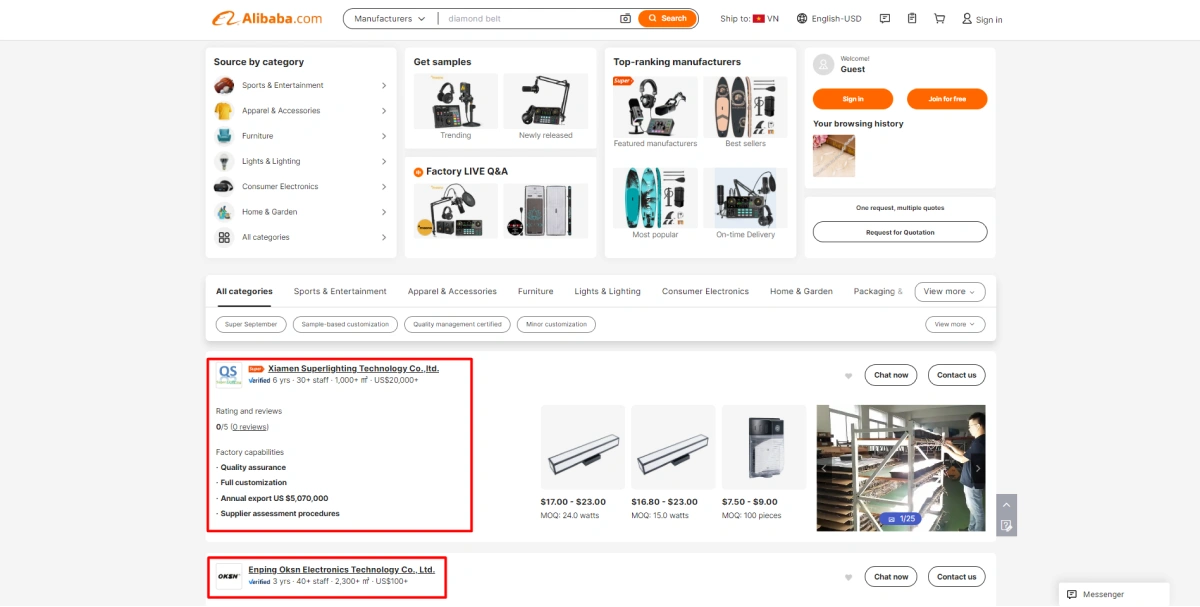
Before you even look at a single product, you must understand that Alibaba is a directory, not a retail store. It connects you with millions of suppliers, and it's your job to perform due diligence. Fortunately, Alibaba provides two essential filters to remove the vast majority of low-quality or untrustworthy actors right from the start.
- Verified Supplier: This badge indicates the supplier has paid a premium to undergo an in-depth, on-site inspection by a third-party company (like SGS, TÜV Rheinland, or Intertek). This check verifies their business license, factory location, and production capabilities.
- Trade Assurance: This is Alibaba's free payment protection service. When you pay through a Trade Assurance order, your money is held in escrow. Alibaba will mediate and potentially refund you if the supplier fails to ship on time or if the product quality doesn't meet the specifications in your contract. Never work with a supplier who doesn't support Trade Assurance for your initial orders.
To see how to apply these filters and understand their importance, let's watch a short segment from an expert guide.
Avoid Alibaba Scams: The Ultimate Guide to Finding Legit Suppliers
This video from the MyWifeQuitHerJob Ecommerce Channel clearly explains how to use Alibaba's key filters to create a shortlist of legitimate suppliers.
Watch the clip from 02:39 to 05:18. Focus on understanding what the 'Verified Supplier' and 'Trade Assurance' checkboxes mean and why they are your first and most important step in any search.
By applying these two filters, you are immediately focusing your search on suppliers who have invested in their credibility and are willing to offer payment protection.
2. Beyond the Badge: A Deep Dive into Vetting
Finding a Verified supplier is just the first step. The real work is in the vetting process. A "verified" badge confirms a company is real, but it doesn't guarantee they are good, reliable, or the right fit for your business.
Now, we will break down the process of systematically evaluating a supplier's profile.
Step 1: Analyze the "Verified Supplier" Report
The Verified Supplier badge isn't just an icon; it links to a detailed inspection report. This is where you find the objective data you need.
The following video provides an excellent walkthrough of a Verified Supplier profile, showing you exactly what to look for across six key checkpoints.
✅ How To Find The Best "VERIFIED" Alibaba Suppliers | "VERIFIED" Supplier Step-by-Step Tutorial
The GOODLIFE WARRIOR channel offers a detailed, side-by-side comparison of two 'Verified' suppliers, revealing how two seemingly similar profiles can be vastly different. This is a masterclass in reading between the lines.
Watch from the beginning to 11:03. As you watch, pay close attention to the six checkpoints the presenter analyzes: Company Overview: Look at the factory tour video and employee count. Main Market/Trading Capability: Check what percentage of their business is with North America or Europe. More experience with Western markets is a good sign. Production Capability: Do the photos and videos show actual machinery for your product, or just assembly lines? Quality Control: Do they have dedicated testing equipment? R&D Capability: Do they have patents or a research department? This is crucial for product customization. Customer Service: Note their response rate and recent quotation performance.
This analysis is vital. It helps you determine if a supplier is a large, established factory with deep expertise or a smaller operation that might be outsourcing key processes.
Step 2: Manufacturer or Trading Company?
On Alibaba, you'll encounter two main types of suppliers:
- Manufacturers (OEM/ODM): The actual factories that produce the goods. They generally offer lower prices and deep product expertise but have higher Minimum Order Quantities (MOQs).
- Trading Companies: Middlemen who source from multiple factories. They offer more product variety and lower MOQs but at a slightly higher price.
For a private label business, working directly with a manufacturer is often ideal. But how can you tell them apart? Sometimes a trading company's profile will show factory pictures.
✅ How To Find The Best "VERIFIED" Alibaba Suppliers | "VERIFIED" Supplier Step-by-Step Tutorial
Let's continue with the same video, which has a quick, brilliant tip for spotting a trading company.
Watch the short segment from 11:03 to 12:27. The key takeaway is to look at the supplier's main product catalog. A true manufacturer specializes. A trading company often sells a wide range of unrelated items (e.g., yoga mats, phone cases, and kitchen knives).
Step 3: Use a Vetting Checklist
As you analyze suppliers, it's helpful to use a consistent scorecard. This ensures you're comparing them on the same criteria.
The following table, adapted from the "Dropshipping Alibaba to Amazon" guide, provides a fantastic, actionable checklist. When you find a potential supplier, run them through these points.
| Verification Point | What to Look For | Why It Matters |
|---|---|---|
| Years on Alibaba | At least 3+ years | Longevity shows stability and experience. New suppliers can be risky. |
| Verified Supplier Badge | Must be present | Confirms a third party has inspected their factory and operations. |
| Trade Assurance | Must be active | Protects your payment in case of shipping or quality issues. Non-negotiable. |
| Response Rate | 85% or higher | Indicates they are attentive and professional in their communication. |
| On-time Delivery Rate | 90% or higher | Shows they have a track record of meeting deadlines. |
| Main Products | A clear focus on your product category | Specialists are better than generalists who sell everything from phone cases to socks. |
| Store Reviews | At least 4.5 stars or higher | Social proof from other buyers is a strong indicator of their performance. |
If a supplier checks all these boxes, they are a strong candidate for your shortlist.
3. Recognizing Red Flags and Common Scams
Just as important as finding good signals is learning to spot the bad ones. Polished profiles can hide problematic operations.
This table from the "How To Choose Alibaba Verified" guide highlights common warning signs.
| Signal | Legitimate Pattern | Warning Sign |
|---|---|---|
| Product Catalog | Focused on a few core categories; provides detailed technical specs. | Sells 100+ unrelated products; uses vague specs like “high quality.” |
| Communication | Professional email domains (@companyname.com); clear, clarifying questions. |
Uses Gmail/Yahoo; gives generic "Yes, we can do it!" answers without asking for details. |
| Payment Terms | Accepts Trade Assurance; standard 30% upfront, 70% after inspection/before shipping. | Insists on 100% upfront payment via Western Union or direct bank transfer outside of Alibaba. |
| Export Experience | Can provide redacted shipping documents (like a Bill of Lading) from past orders to your country. | Claims it's their "first time exporting" a common item; cannot show any proof of export. |
Test your understanding!
You are searching for a supplier for a high-tech electronic gadget. You find a "Verified Supplier" with 5 years on Alibaba and 4.8 stars. Their profile looks good.
However, you notice two things:
- Their product catalog includes the gadget, but also pet supplies, clothing, and garden furniture.
- When you ask about FCC certification (a requirement for electronics in the US), they reply "yes friend we have all certs, no problem."
Based on the vetting criteria and red flags, should you proceed with this supplier? Why or why not?
Show answer
You should not proceed with this supplier. There are two major red flags:
- Unfocused Product Catalog: The wide range of unrelated products strongly suggests they are a trading company, not a specialized manufacturer. For a high-tech product, you need a factory with deep technical expertise.
- Vague and Unprofessional Communication: Their generic answer about certifications is a classic warning sign. A professional manufacturer would ask which specific certifications you need and offer to provide the documentation for you to verify. The casual "yes friend" response is also a red flag.
Finally, even with Verified suppliers, be aware of common deceptive tactics. Watching this last clip will arm you with the knowledge to protect yourself.
Avoid Alibaba Scams: The Ultimate Guide to Finding Legit Suppliers
Let's return to the 'Avoid Alibaba Scams' video to learn about some common tactics that even legitimate-looking suppliers might use.
Watch from 11:20 to 14:55. This section covers several 'evil tactics' to watch out for, such as: Sudden price increases after you've approved samples. Significant differences in quality between the sample and the bulk order. Providing fake or invalid product certifications.
The key defense against these tactics is clear documentation, using Trade Assurance, and, as we'll discuss later, hiring a third-party inspection service before your final payment.
Conclusion
Finding and vetting a supplier on Alibaba is a systematic process, not a game of chance. By following a structured approach, you can dramatically reduce your risk and find a reliable partner to build your brand.
Key Takeaways:
- Always start by filtering for
Verified SupplierandTrade Assurance. This is your non-negotiable first step. - Vetting goes far beyond the badge. You must analyze the supplier's detailed profile, including their production capabilities, main markets, and QC processes.
- Distinguish between a specialist manufacturer and a generalist trading company by carefully examining their product catalog.
- Use a checklist to systematically score potential suppliers on key metrics like their years in business, response rate, and reviews.
- Learn to recognize red flags, such as an unfocused product catalog, unprofessional communication, and demands for unsafe payment methods.
Next Up:
In this lesson, we focused entirely on sourcing from China via Alibaba, which is the heart of the private label model. In our next lesson, we will explore the other side of the sourcing coin by learning how to use directories like SaleHoo to find and evaluate US-based wholesalers and dropshippers. This will give you a complete picture of your sourcing options.