
Hello! Welcome to the first lesson of our new module, "Lucid Dreaming: Consciousness Within Sleep."
In our last module, we focused on making sense of our dreams after waking up. You learned how to record your dreams, identify their symbolic language, and use a structured method to uncover the personal insights they offer. We treated dreams as messages from the unconscious to be decoded.
Now, we shift from being passive interpreters to active participants. This module explores lucid dreaming—the remarkable ability to become aware that you are dreaming while the dream is still happening. Our learning outcome for today is to define lucid dreaming and distinguish it from a typical dream experience.
This is a pivotal step in our journey. Understanding and cultivating this form of consciousness within sleep is the bridge between modern sleep science and the contemplative practices you're interested in, particularly the goal of maintaining awareness during rest for spiritual progress.
1. What Does It Feel Like to Be Lucid?
Before we get into formal definitions, the best way to understand lucid dreaming is to hear about the experience itself. Many people have their first lucid dream spontaneously, often during a nightmare, when the situation becomes so bizarre or terrifying that a part of the mind realizes, "This can't be real."
Let's begin with a short, personal story from researcher Tim Post about his first childhood experience with a lucid dream.
Lucid dreaming: Tim Post at TEDxTwenteU
This clip from the TEDx talk 'Lucid dreaming' provides an intuitive and relatable account of what it feels like to suddenly realize you are dreaming.
Please watch the first 1 minute and 45 seconds of the video (00:00 - 01:45). Notice the shift in feeling that occurs the moment he realizes, 'This is just a dream.'
As Tim Post's story illustrates, the core of a lucid dream isn't about magical powers; it's about a profound shift in awareness. The fear vanished not because the witch disappeared, but because he understood the nature of his reality at that moment.
2. Defining Lucid Dreaming: Awareness vs. Control
So, what is the formal definition?
A lucid dream is a dream during which the dreamer is aware that they are dreaming.
That's it. The fundamental requirement is simply the knowledge of being in a dream state.
This leads to a common misconception. Many people equate lucid dreaming with controlling the dream. While gaining some control over the dream's narrative, characters, or environment is possible and often happens during a lucid dream, it is a secondary effect, not the defining feature. The awareness itself is what makes a dream lucid.
The video below offers a great analogy to distinguish a typical dream from a lucid one.
This video from Insider Tech, 'How Lucid Dreaming Works,' clearly explains the basic definition of lucid dreaming and uses a helpful analogy.
Watch the first 52 seconds (00:00 - 00:52). Pay close attention to the comparison between a dream being like 'watching a movie' versus 'playing a video game.'
- Typical Dream: You are a character in a movie. The plot is happening to you. Your thoughts and actions feel largely involuntary.
- Lucid Dream: You are a player in a video game. You know you're in a simulated world, and because of that awareness, you can start making conscious choices and influencing the outcome.
To provide a more structured definition, we can refer to the work of German psychologist Paul Tholey. He proposed seven conditions that must be met for a dream to be considered fully lucid.
The Wikipedia article on lucid dreaming provides a concise definition and lists psychologist Paul Tholey's criteria for lucidity. This gives us a more rigorous way to understand what 'awareness' entails in this context.
Please read the section titled 'Definition.' Focus on the seven points proposed by Paul Tholey. You don't need to memorize them, but get a sense of the different facets of awareness they describe.
Tholey's criteria highlight that lucidity isn't just a simple "I'm dreaming" thought. It's a state of high-level consciousness that includes:
- Awareness of the dream state itself.
- Awareness of your own freedom to make decisions.
- Access to waking life memories.
- Awareness of your own identity ("I" am here).
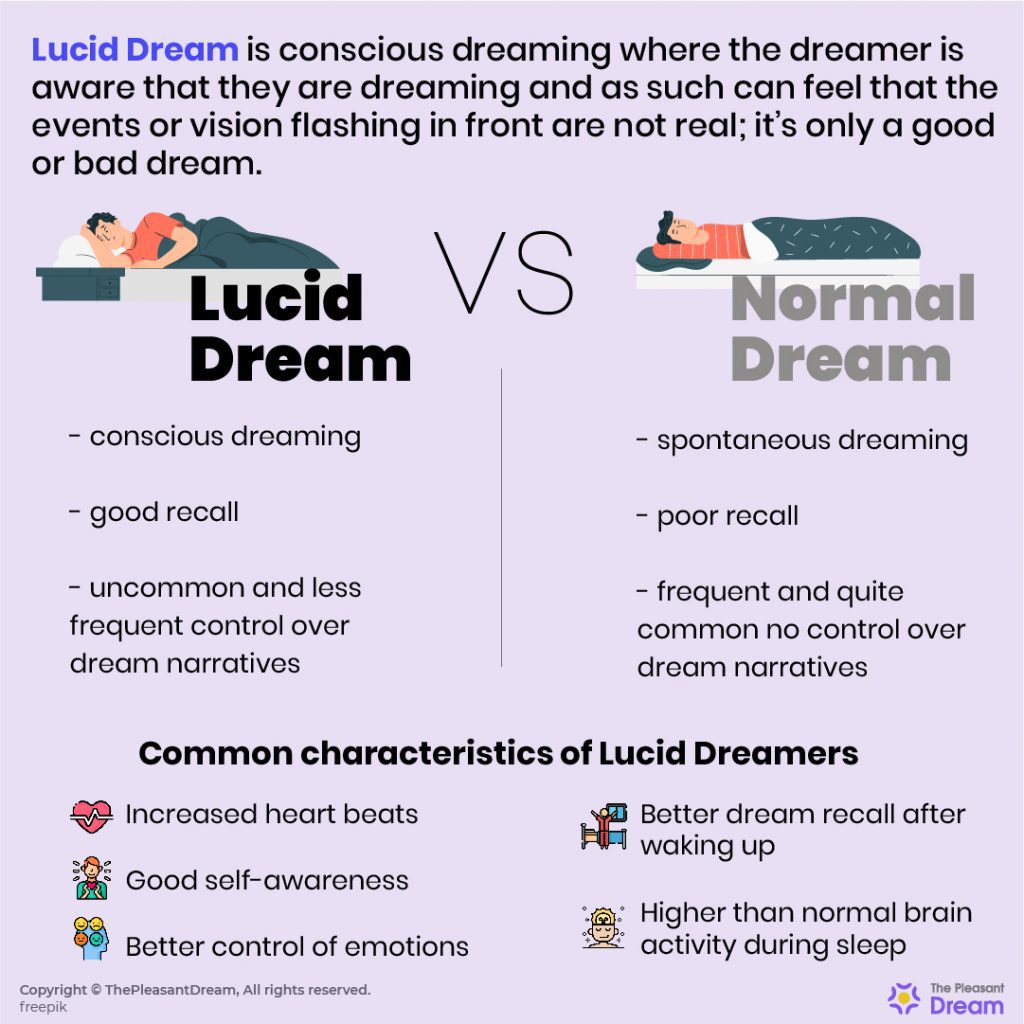
This infographic provides a simple, clear summary of the key differences between a typical and a lucid dream.
Test your understanding!
Consider these three dream scenarios. Which one qualifies as a lucid dream?
- You dream that you are flying. You think to yourself, "Wow, I'm flying!" and feel a sense of joy as you soar over a city.
- You dream you are in an exam for a class you never took. You feel panicked, and then a thought surfaces: "Wait a minute, I graduated years ago. This must be a dream!" The panic subsides, and you decide to calmly walk out of the classroom.
- You dream that you are having a conversation with a friend who tells you, "You know, you're dreaming right now." You nod in agreement in the dream and continue the conversation.
Show answer
Scenario 2 is the clear example of a lucid dream. The key is the moment of insight ("This must be a dream!") based on accessing waking life memories ("I graduated years ago"). This awareness then allows you to make a conscious decision ("walk out of the classroom").
Scenario 1 is a typical flying dream; the thought "I'm flying" is part of the dream's narrative, not an awareness of the dream state itself. Scenario 3 is what we might call "dreaming of being lucid." A dream character tells you that you're dreaming, but you don't achieve true, first-person meta-awareness. This leads us to our next crucial point.
3. The Skeptic's Challenge: Are You Really Aware?
How do we know that a lucid dream is a genuinely distinct state of consciousness and not just a regular dream about being lucid? This is a serious philosophical and scientific question, famously posed by the philosopher Daniel Dennett. He challenged researchers to prove that the experience wasn't just a false memory created upon waking.
Scientists and philosophers have met this challenge with two powerful lines of evidence: subjective experience (phenomenology) and objective verification (neuroscience).
The Subjective Difference: Meta-Awareness
From a subjective or phenomenological standpoint, there is a distinct feeling or quality to true lucidity that is different from just dreaming about being lucid.
Lucid Dreaming or Dreaming That You're Dreaming?
The article 'Lucid Dreaming or Dreaming That You're Dreaming?' by Evan Thompson directly tackles this question. We'll read the section that describes the crucial phenomenological difference.
Please read the two paragraphs under the heading 'Here’s the crucial phenomenological point.' Focus on the concepts of 'mental clarity' and 'meta-awareness'—the ability to direct your attention to the dreamlike quality of the state itself.
As the article explains, the key difference is meta-awareness. In a truly lucid dream, you don't just think "I'm dreaming." You can attend to the dream as a dream. You can observe its qualities, notice its instability, and appreciate its hallucinatory nature, all from a stable point of self-awareness that feels continuous with your waking self. This is very different from a dream character simply stating, "This is a dream," which is just more content within the dream's narrative.
The Objective Proof: Signaling from the Dream World
Subjective reports are powerful, but the definitive proof of lucid dreaming came from a series of ingenious experiments conducted in sleep labs, most famously by Stephen LaBerge at Stanford University.
LaBerge capitalized on a key discovery: eye movements made in a dream are often matched by the physical eye movements of the sleeper. He reasoned that if a dreamer could become lucid, they could consciously signal to the outside world from within the dream using a pre-arranged pattern of eye movements (e.g., left-right-left-right).
The following video describes this groundbreaking experiment.
Lucid dreaming: Tim Post at TEDxTwenteU
Returning to the TEDx talk, Tim Post explains the elegant experiment that Stephen LaBerge used to scientifically prove that lucid dreaming is a real phenomenon that occurs during uninterrupted REM sleep.
Please watch from 07:15 to 11:17. This section details the experimental setup and provides a fascinating example of a dreamer signaling lucidity, falsely dreaming of waking up, and then becoming lucid again.
These "signal-verified" lucid dreams proved, unequivocally, that:
- Lucid dreaming is real. A person can be verifiably conscious and communicative while their brain and body are, by all standard physiological measures, in a state of REM sleep.
- It is a distinct state. It is not a brief awakening or a misremembered dream. It is a unique hybrid state of consciousness, combining the dream world of REM sleep with aspects of waking awareness.
This scientific verification is crucial. It moves lucid dreaming from the realm of anecdote into an objectively verifiable phenomenon, allowing us to study what is happening in the brain during this unique state—which is exactly what we will do in our next lesson.
Conclusion
Today we have established a clear and evidence-based understanding of lucid dreaming. You have moved from simply interpreting dreams to understanding a state in which you can be consciously present within them.
Key Takeaways:
- Definition: A lucid dream is a dream in which you are aware that you are dreaming.
- Awareness, Not Control: The primary characteristic is meta-awareness, not necessarily the ability to control the dream, although control is often a consequence of awareness.
- Distinction from Typical Dreams: A typical dream is like a movie you watch passively, while a lucid dream is like a video game you actively play.
- Verifiable Reality: Lucid dreaming is a scientifically verified state of consciousness, distinct from both normal REM sleep and waking. This was proven through experiments where dreamers used deliberate eye movements to signal their lucidity to researchers from within the dream.
Preview of the Next Lesson:
We've answered the "what" and "if" of lucid dreaming. The next logical question is "how?"—or more specifically, "what is happening in the brain that allows for this state of consciousness?" In our next lesson, we will describe the neurological markers of lucid dreaming, contrasting brain activity with non-lucid REM sleep. This will lay the scientific groundwork for learning techniques to induce lucid dreams yourself.